Definition
Logistics eVTOL (Electric Vertical Take-Off and Landing) aircraft are innovative aerial vehicles designed specifically for cargo and logistics operations. Unlike traditional helicopters or fixed-wing aircraft, eVTOLs utilize electric propulsion systems that enable vertical take-off and landing, eliminating the need for conventional runways. These aircraft are highly adaptable for urban and regional delivery networks, especially in congested city environments and remote areas where ground transportation may be inefficient or impractical.
Get Free Sample https://www.intelmarketresearch.com/download-free-sample/1215/logistics-evtol-2025-2032-606
The market has seen increasing interest from logistics companies, aviation startups, and government bodies aiming to modernize transport infrastructure. The adoption of eVTOLs is further accelerated by the rising demand for rapid, sustainable, and flexible logistics solutions, especially in densely populated metropolitan regions.
Market Size
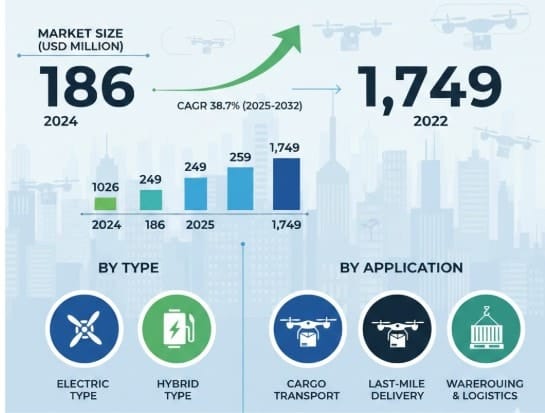
Global logistics eVTOL market was valued at USD 186 million in 2024. Industry projections suggest a significant surge, with the market expected to reach USD 249 million in 2025 and expand exponentially to USD 1,749 million by 2032. This growth represents a compound annual growth rate (CAGR) of 38.7% during the forecast period, highlighting the rapid adoption of eVTOL technology in the logistics sector.
Key statistics illustrating market scope include:
- Urban delivery demand: Increasing e-commerce penetration is driving demand for rapid delivery solutions, creating a lucrative market for eVTOLs.
- Emission reduction mandates: Regulatory pressures for carbon neutrality are encouraging companies to adopt electric aircraft over traditional diesel-powered logistics vehicles.
- Operational efficiency: eVTOLs offer faster delivery times and lower per-kilometer costs in congested areas, enhancing profitability for logistics operators.
Regional Analysis
North America currently dominates the logistics eVTOL market, primarily driven by the U.S. This region benefits from advanced aerospace technology infrastructure, high logistics demand due to e-commerce growth, and favorable government policies supporting autonomous and electric aviation. Companies such as Joby Aviation and Archer Aviation have established testing and operational hubs in California, demonstrating the region’s leadership.
Get Full Report https://www.intelmarketresearch.com/logistics-evtol-2025-2032-606-1215
Asia-Pacific is emerging as a rapidly growing market. China dominates this region with multiple players, including EHang, COMAC, Shanghai Autoflight, and Aerospace Era Feipeng. Strong government support for autonomous flight testing, urban air mobility initiatives, and high-density urban centers make this region a key growth driver. Japan and South Korea are also exploring logistics eVTOL trials to enhance supply chain efficiency.
Middle East and Africa have nascent markets, primarily focusing on high-value cargo delivery and testing autonomous air transport systems. Countries like the UAE and Saudi Arabia are actively investing in smart logistics infrastructure.
Latin America is at an early stage, with limited deployments focused on urban air delivery and pilot programs in Brazil and Mexico. However, increasing e-commerce penetration could stimulate market growth in the coming years.
Competitor Analysis
The logistics eVTOL market is highly competitive, with several key players driving innovation and deployment:
- Joby Aviation (U.S.): Focuses on urban air mobility and logistics, emphasizing low-noise, high-efficiency aircraft.
- Archer Aviation (U.S.): Invests in electric propulsion and autonomous navigation, targeting first-mile and last-mile delivery.
- Lilium (Germany): Offers a unique 6-seat electric aircraft adaptable for cargo, with a strong focus on vertical take-off efficiency.
- Aerospace Era Feipeng (China): Develops eVTOL prototypes for urban and intercity logistics.
- COMAC (China): Primarily a state-owned aircraft manufacturer, investing in eVTOL and urban air mobility solutions.
- EHang (China): Specializes in autonomous aerial vehicles, including cargo eVTOLs for commercial logistics.
- Shanghai Autoflight (China): Focuses on autonomous cargo delivery and air logistics infrastructure.
- Aerofugia Technology (China): Develops heavy-lift and medium-lift eVTOLs for commercial logistics.
- Zero Gravity Aircraft (China): Works on lightweight, scalable eVTOL platforms with advanced energy efficiency.
Strategies adopted by these companies include strategic partnerships with logistics providers, scaling prototype production, and developing regional infrastructure for operational deployment. The market is characterized by rapid technological innovation, early-stage regulatory adaptation, and high investment influx, positioning these competitors to capture early market share.
Global Logistics eVTOL: Market Segmentation Analysis
This report provides a deep insight into the global logistics eVTOL, covering all its essential aspects. This ranges from a macro overview of the market to micro details of the market size, competitive landscape, development trend, niche market, key market drivers and challenges, SWOT analysis, value chain analysis, etc.
In a word, this report is a must-read for industry players, investors, researchers, consultants, business strategists, and all those who have any kind of stake or are planning to foray into the Logistics eVTOL in any manner.
Market Segmentation (by Application)
- Urban Delivery
- Intercity Cargo Transport
- Emergency Medical Supplies
- High-Value Goods Transport
- On-Demand Freight Services
Market Segmentation (by Type)
- Fully Autonomous eVTOL
- Pilot-Assisted eVTOL
- Hybrid Electric eVTOL
- Cargo-Specific eVTOL
Key Company
- Joby Aviation (U.S.)
- Archer Aviation (U.S.)
- Lilium (Germany)
- Aerospace Era Feipeng (China)
- COMAC (China)
- EHang (China)
- Shanghai Autoflight (China)
- Aerofugia Technology (China)
- Zero Gravity Aircraft (China)
Geographic Segmentation
- North America
- Europe
- Asia-Pacific
- Middle East & Africa
- Latin America
FAQ Section
Q1: What is the current market size of Logistics eVTOL? A1: The global logistics eVTOL market was valued at USD 186 million in 2024 and is projected to reach USD 1,749 million by 2032, with a CAGR of 38.7%.
Q2: Which are the key companies operating in the Logistics eVTOL market? A2: Key companies include Joby Aviation (U.S.), Archer Aviation (U.S.), Lilium (Germany), Aerospace Era Feipeng (China), COMAC (China), EHang (China), Shanghai Autoflight (China), Aerofugia Technology (China), and Zero Gravity Aircraft (China).
Q3: What are the key growth drivers in the Logistics eVTOL market? A3: Key drivers include the rise of e-commerce, urban delivery demand, emission reduction mandates, operational efficiency of eVTOLs, and government incentives supporting electric aviation.
Q4: Which regions dominate the Logistics eVTOL market? A4: North America currently leads the market, followed by Europe and Asia-Pacific. China and Germany are major contributors to technological development and deployment.
Q5: What are the emerging trends in the Logistics eVTOL market? A5: Emerging trends include autonomous flight operations, hybrid-electric propulsion, cargo-specific eVTOL designs, partnerships between logistics and aviation companies, and the development of urban air mobility infrastructure for efficient deliveries.
Get Full Report https://www.intelmarketresearch.com/logistics-evtol-2025-2032-606-1215
About Us
Intel Market Research is a leading provider of strategic intelligence, offering actionable insights in information technology, digital media solutions, and communication infrastructure. Our research capabilities include:
- Real-time competitive benchmarking
- Global technology adoption monitoring
- Country-specific regulatory and market analysis
- Over 500+ technology reports annually
Trusted by Fortune 500 companies, our insights empower decision-makers to drive innovation with confidence.
🌐 Website: https://www.intelmarketresearch.com
📞 International: +1 (332) 2424 294
📞 Asia-Pacific: +91 9169164321
🔗 LinkedIn: Follow Us