Definition
Affordable luxury fashion refers to a rapidly growing category within the global fashion industry that blends elements of premium craftsmanship, elevated design, and aspirational brand value—while remaining accessible to a broader consumer base through moderate to upper-mid price points. Unlike traditional luxury, which focuses on exclusivity and high price tags, affordable luxury democratizes indulgence by offering products that provide consumers with prestige, quality, and emotional satisfaction without significant financial strain.
Get Free Sample https://www.intelmarketresearch.com/download-free-sample/905/Affordable-Luxury-Fashion-Market
Affordable luxury brands position themselves between mass-market fashion (e.g., Zara or H&M) and heritage luxury houses (e.g., Chanel or Louis Vuitton). They offer:
- Distinctive design identities
- Reliable product quality
- Selective distribution strategies
- Accessible price ranges
- Brand prestige associated with modern minimalism or classic sophistication
This makes the segment attractive to Gen Z, millennials, and emerging-market consumers who desire high-end aesthetics without the financial commitment of full luxury goods.
Market Size
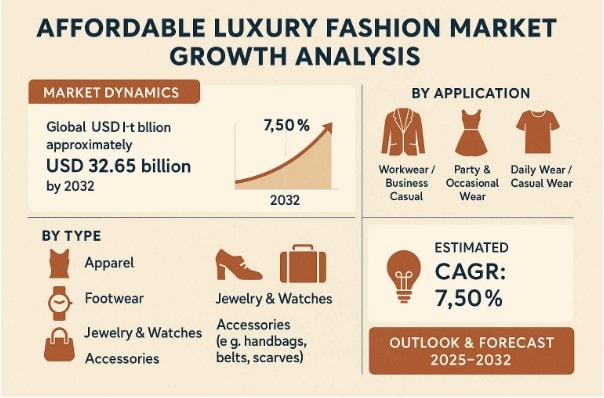
Global Affordable Luxury Fashion market reached approximately USD 17.03 billion. Displaying strong forward momentum, the industry is projected to grow at a CAGR of 7.50%, achieving an estimated USD 32.65 billion by 2032. This sustained growth reflects shifting consumer expectations, rising global incomes, and the continued expansion of premium lifestyle purchasing.
Several factors support the market’s upward trajectory:
1. Growing Middle-Class Purchasing Power
Emerging economies—especially across Asia-Pacific, the Middle East, and parts of Latin America—have witnessed substantial income growth, enabling consumers to purchase branded fashion at accessible price points.
3. Social Media & Influencer Culture
Platforms such as Instagram, TikTok, and YouTube strongly influence purchasing. Affordable luxury brands capitalize on digital storytelling that resonates with millennial and Gen Z shoppers, who seek authenticity and aesthetic appeal.
4. Shift Toward Quality Over Quantity
Post-pandemic, consumers have gravitated toward timeless, versatile pieces rather than fast-fashion disposability. Affordable luxury provides the “sweet spot” between cost and long-term value.
5. Expansion of Omnichannel Retailing
Brands have successfully expanded their reach via:
- Direct-to-consumer ecommerce platforms
- Online marketplaces
- Premium department stores
- Boutique outlets
This has strengthened global penetration and increased overall market accessibility.
Regional Analysis
The global affordable luxury fashion market shows strong diversity in regional performance, driven by demographic profiles, cultural preferences, income levels, and market maturity.
North America
North America represents one of the largest markets due to high consumer spending power, brand-conscious behavior, and strong penetration of iconic contemporary labels such as Michael Kors, Coach, and Kate Spade. The U.S. marketplace is highly competitive yet remains a hub for innovation, marketing excellence, and premium lifestyle retail.
Middle East & Africa
The Middle East shows substantial interest in aspirational fashion, driven by affluent youth demographics and rapid retail expansion in markets such as the UAE and Saudi Arabia. Africa, while still developing, has emerging hotspots in South Africa and Nigeria for premium contemporary brands.
Latin America
Latin America displays growing consumer appetite for accessible luxury, particularly in Brazil, Argentina, Mexico, and Chile. Economic fluctuations have historically impacted purchasing behaviors, but demand continues to rise for mid-tier luxury offerings.
Competitor Analysis
The affordable luxury fashion market is dominated by a mix of U.S., UK, and European brands known for distinctive identity, craftsmanship, and lifestyle storytelling. Competition revolves around brand visibility, price positioning, design innovation, sustainability commitments, and omnichannel experiences.
Get Full Report https://www.intelmarketresearch.com/Affordable-Luxury-Fashion-Market-905
Key competitive strategies include:
- Digital-first marketing
- Limited-edition collaborations
- Sustainable sourcing
- Lifestyle-oriented brand expansion
- Iconic product lines such as bags, dresses, and ready-to-wear staples
Brands like Coach and Michael Kors maintain strong global presence, while newer entrants such as Ganni and Reformation emphasize sustainability and eco-conscious production.
Global Affordable Luxury Fashion: Market Segmentation Analysis
This report provides a deep insight into the global Affordable Luxury Fashion, covering all its essential aspects. This ranges from a macro overview of the market to micro details of the market size, competitive landscape, development trend, niche market, key market drivers and challenges, SWOT analysis, value chain analysis, etc.
The analysis helps the reader to shape the competition within the industries and strategies for the competitive environment to enhance the potential profit. Furthermore, it provides a simple framework for evaluating and assessing the position of the business organization.
The report structure also focuses on the competitive landscape of the Global Affordable Luxury Fashion. This report introduces in detail the market share, market performance, product situation, operation situation, etc., of the main players, which helps the readers in the industry to identify the main competitors and deeply understand the competition pattern of the market.
In a word, this report is a must-read for industry players, investors, researchers, consultants, business strategists, and all those who have any kind of stake or are planning to foray into the Affordable Luxury Fashion in any manner.
Market Segmentation (by Application)
- Apparel
- Footwear
- Accessories
- Handbags
- Others
Market Segmentation (by Type)
- Premium Clothing
- Designer Accessories
- Luxury Footwear
- Handcrafted Goods
- Others
Key Company
- Tory Burch
- Michael Kors
- Coach
- Ted Baker
- Ganni
- Diane von Furstenberg
- Lucky Brand
- Polo Ralph Lauren
- Kate Spade
- Reformation
- COS
- Mara Hoffman
- Marc Jacobs
Geographic Segmentation
- North America
- Europe
- Asia-Pacific
- Latin America
- Middle East & Africa
FAQ Section
What is the current market size of the Affordable Luxury Fashion market?
As of 2023, the global Affordable Luxury Fashion market is valued at USD 17.03 billion.
Which are the key companies operating in the Affordable Luxury Fashion market?
Major brands include Tory Burch, Michael Kors, Coach, Ted Baker, Ganni, Kate Spade, Marc Jacobs, and others listed above.
What are the key growth drivers in the Affordable Luxury Fashion market?
Primary drivers include rising middle-income spending, premiumization, social media influence, sustainability trends, and increasing global omnichannel retail penetration.
Which regions dominate the Affordable Luxury Fashion market?
North America and Europe lead the market, while Asia-Pacific is the fastest-growing region.
What are the emerging trends in the Affordable Luxury Fashion market?
Notable trends include sustainability-led design, digital-first branding, minimalistic aesthetics, and expansion of accessible premium collections.
Get Full Report https://www.intelmarketresearch.com/Affordable-Luxury-Fashion-Market-905
About Us
Intel Market Research is a leading provider of strategic intelligence, offering actionable insights in information technology, digital media solutions, and communication infrastructure. Our research capabilities include:
- Real-time competitive benchmarking
- Global technology adoption monitoring
- Country-specific regulatory and market analysis
- Over 500+ technology reports annually
Trusted by Fortune 500 companies, our insights empower decision-makers to drive innovation with confidence.
🌐 Website: https://www.intelmarketresearch.com
📞 International: +1 (332) 2424 294
📞 Asia-Pacific: +91 9169164321
🔗 LinkedIn: Follow Us