Introduction
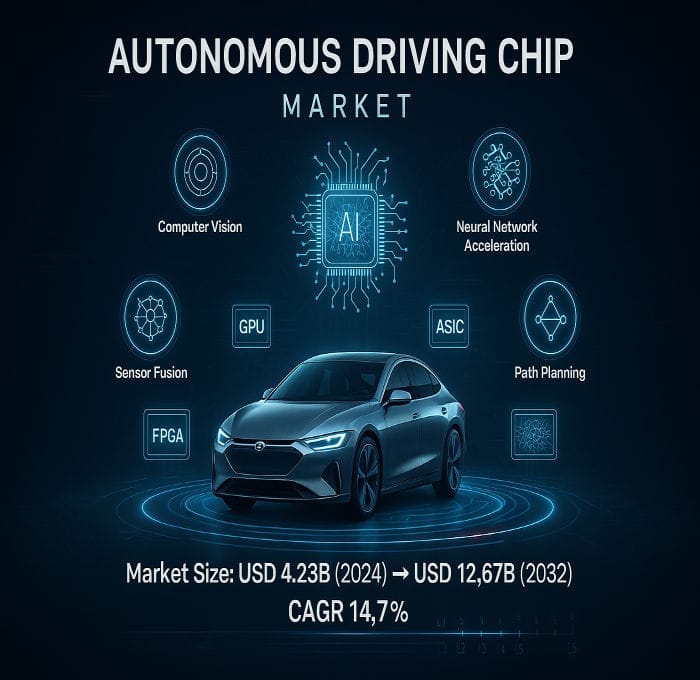
The Autonomous Driving Chip Market, valued at USD 4.23 billion in 2024, is projected to expand to USD 12.67 billion by 2032, growing at a strong CAGR of 14.7% from 2025 to 2032. Autonomous driving semiconductors form the computational backbone of next-generation mobility, enabling real-time perception, decision-making, and execution.
𝐃𝐨𝐰𝐧𝐥𝐨𝐚𝐝 𝐅𝐑𝐄𝐄 𝐒𝐚𝐦𝐩𝐥𝐞 𝐑𝐞𝐩𝐨𝐫𝐭: https://semiconductorinsight.com/download-sample-report/?product_id=97531
Emerging Trends Shaping the Market
AI-Driven Chip Design Enhances Autonomous Capabilities
AI-powered design tools are enabling chipmakers to optimize architectures for higher throughput and lower latency—critical for Level 3–Level 5 autonomous vehicles. These tools reduce design cycles while enabling chips to process increasingly complex neural networks, supporting up to 300 TOPS for advanced self-driving systems.
Rise of 5nm and 7nm Process Nodes
The shift toward ultra-efficient fabrication technologies is transforming the performance envelope of automotive chips. Leading vendors are deploying 7nm and 5nm nodes, delivering superior power efficiency—an essential factor for electric vehicles where energy consumption directly impacts driving range.
3D Packaging and Heterogeneous Integration
To meet rising AI compute demands, semiconductor firms are accelerating adoption of 3D IC packaging. Chipsets integrating CPUs, GPUs, and dedicated AI accelerators into a single module are reducing communication delays while optimizing sensor fusion, perception, and decision-making functions.
Edge Computing Takes Center Stage
Autonomous vehicles are increasingly relying on edge processing to minimize cloud dependence. As sensor volumes grow, autonomous driving chips must manage massive data sets locally, enabling real-time situational awareness even in low-connectivity environments.
Regulatory Push Toward High-Automation Vehicles
Global policies—from Euro 7 standards to China’s NEV roadmap—are fast-tracking the deployment of autonomous solutions. Regulatory clarity is prompting OEMs to upgrade onboard computing hardware at an accelerated pace.
Key Market Drivers and Growth Factors
- AI and Machine Learning Breakthroughs:
Real-time processing of multi-sensor data, including LiDAR, radar, and cameras, requires chips with extreme computational power, driving demand for next-generation AI accelerators. - Government Initiatives and Safety Regulations:
Investments in smart mobility infrastructure and mandates for advanced driver-assistance systems (ADAS) are creating fertile ground for autonomous chip adoption. - Premium Vehicle Demand Rises:
Luxury and EV brands are integrating sophisticated self-driving functions, with over 65% of consumers in developed markets prioritizing autonomous features in high-end vehicles. - Industrial and Commercial Autonomy Growth:
Autonomous trucking, mining vehicles, and agricultural equipment are adopting durable, high-performance chips, opening new revenue pathways beyond passenger cars.
𝐆𝐞𝐭 𝐅𝐮𝐥𝐥 𝐑𝐞𝐩𝐨𝐫𝐭 𝐇𝐞𝐫𝐞: https://semiconductorinsight.com/report/autonomous-driving-chip-market/
Strategic Developments by Key Players
Leading players are reshaping the competitive landscape through integrated hardware–software ecosystems, vertical integration, and AI collaboration:
- NVIDIA Corporation continues to strengthen its lead with the DRIVE platform, securing partnerships with more than 25 global automakers.
• Qualcomm Technologies expands its Snapdragon Ride portfolio and boosts market reach through strategic acquisitions such as Veoneer.
• Mobileye (Intel Subsidiary) achieves broad deployment with EyeQ series chips across nearly 40 million vehicles.
• Tesla, Inc. advances in-house semiconductor development with its Full Self-Driving (FSD) chip powering all new models.
• Horizon Robotics and Black Sesame Technologies capture growing share within China’s rapidly expanding autonomous ecosystem.
• Texas Instruments, Renesas Electronics, and Infineon Technologies AG continue investing in functional safety enhancements for ASIL-compliant automotive chips.
These companies demonstrate how alliances, custom silicon design, and multi-architecture integration are becoming defining strategies for long-term leadership.
Segment Analysis: Who Leads the Market?
By Type
The ASIC segment dominates, driven by its exceptional efficiency and ability to handle AI-intensive workloads. GPUs and FPGAs remain relevant in modular autonomous platforms but trail ASIC adoption in mass-market production vehicles.
By Application
Passenger cars lead the market, supported by rapid integration of L2+ and L3 autonomous features in premium vehicles. Commercial vehicles follow, propelled by advancements in autonomous trucking and fleet automation.
By Processing Type
Neural Network Accelerators record the fastest growth as deep-learning–based perception becomes essential for accurate scene understanding. Computer vision processors and sensor fusion units remain vital components of the processing stack.
By Autonomy Level
L3 systems are seeing strong adoption, while L4 autonomy gains momentum through pilot deployments in logistics, robo-taxis, and industrial automation.
𝐃𝐨𝐰𝐧𝐥𝐨𝐚𝐝 𝐅𝐑𝐄𝐄 𝐒𝐚𝐦𝐩𝐥𝐞 𝐑𝐞𝐩𝐨𝐫𝐭: https://semiconductorinsight.com/download-sample-report/?product_id=97531
Technological Advancements Impacting Growth
Can AI-Driven Lithography Redefine Semiconductor Yield Rates?
Innovations in computational lithography are streamlining chip production, enabling higher yield and reliability for automotive-grade semiconductors.
Additional Breakthroughs:
- Nanofabrication and Packaging:
Advanced cleanroom automation ensures consistent production of chips capable of withstanding extreme automotive temperature cycles. - Automotive-Grade Reliability Enhancements:
Improvements in heat dissipation, ruggedized packaging, and functional safety certifications (ISO 26262) ensure chip performance under harsh conditions. - Quantum-Inspired Algorithms:
Early-stage R&D is exploring quantum-enhanced optimization for real-time decision-making in higher-level autonomous systems.
Why This Report Matters
This market analysis provides comprehensive insights covering 2024–2032 estimations, in-depth competitive intelligence, technology roadmaps, segment-level forecasts, and opportunity mapping across global automotive, commercial, and industrial applications. Stakeholders gain actionable understanding of how AI, regulation, and semiconductor innovation will reshape autonomous mobility.
𝐆𝐞𝐭 𝐅𝐮𝐥𝐥 𝐑𝐞𝐩𝐨𝐫𝐭 𝐇𝐞𝐫𝐞: https://semiconductorinsight.com/download-sample-report/?product_id=97531
Conclusion
As autonomous mobility transitions from emerging technology to mainstream adoption, the semiconductor ecosystem will play a decisive role.
Success will depend on aligning innovation with safety, sustainability, and strategic partnerships to stay competitive in a rapidly evolving global landscape.
Contact Us:
🌐 Website: https://semiconductorinsight.com/
📞 International: +91 8087 99 2013
🔗 LinkedIn: Follow Us