Introduction
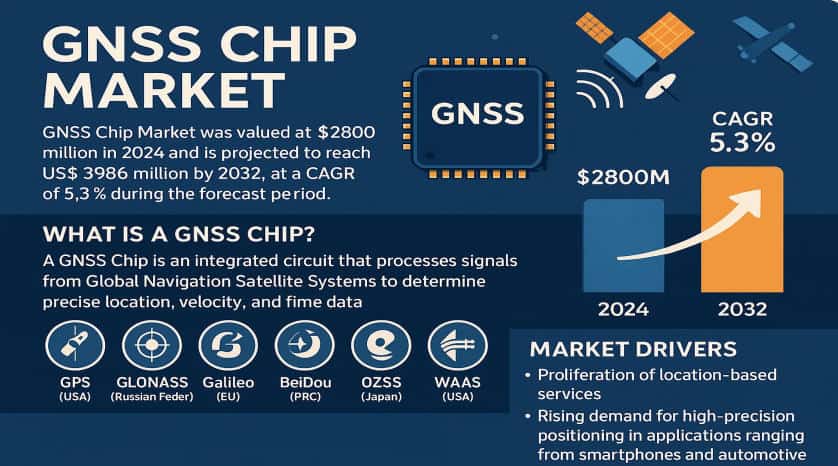
According to semiconductorinsight GNSS Chip Market is entering a critical phase of expansion, climbing from USD 2.8 billion in 2024 to USD 3.986 billion by 2032, supported by a steady 5.3% CAGR. As satellite navigation becomes integral to modern mobility, logistics, and timing applications, the industry is witnessing a surge in innovation and strategic investment. The semiconductor industry continues to redefine global innovation, with this market showing robust expansion and technological disruption.
Download Sample Report https://semiconductorinsight.com/download-sample-report/?product_id=122967
Emerging Trends Shaping the Market
AI-Enabled Positioning Algorithms
Artificial intelligence is rapidly enhancing GNSS signal processing, enabling more accurate navigation in challenging environments such as dense cities, tunnels, or hostile weather. GNSS chipmakers are integrating AI accelerators to deliver faster triangulation and improved reliability, setting new performance benchmarks.
Rise of Multi-Frequency, Multi-Constellation Support
Advanced GNSS chips now combine GPS, GLONASS, BeiDou, Galileo, and QZSS on a single architecture. This multi-band capability is becoming indispensable in telecom, precision agriculture, and industrial robotics—driving adoption across both consumer and enterprise applications.
3D Packaging and Miniaturization
With IoT and wearables demanding smaller form factors, 3D packaging, fan-out wafer-level techniques, and tighter SoC integration are reshaping GNSS chip design. These innovations reduce power consumption and enable seamless placement in compact devices.
Automotive-Grade Positioning for ADAS
Automotive OEMs are shifting toward high-accuracy GNSS modules that support lane-level positioning for ADAS and autonomous driving. This trend significantly boosts demand for chips with enhanced safety, reliability, and redundancy features.
Sustainability in Semiconductor Manufacturing
GNSS chip manufacturers are accelerating cleanroom optimization, water recycling, and energy-efficient fabrication—aligning next-gen navigation solutions with broader sustainability commitments across the semiconductor ecosystem.
Key Market Drivers and Growth Factors
- Expansion of IoT, smart mobility, and connected device ecosystems
- Rising adoption of GNSS modules in automotive safety and ADAS systems
- Strong demand for ultra-low-power chips in wearables, drones, and asset tracking
- Increasing reliance on precision timing for 5G, cloud infrastructure, and data centers
- Continuous growth in consumer navigation, including smartphones, fitness devices, and AR/VR platforms
Strategic Developments by Key Players
Global semiconductor leaders are strengthening their positioning through R&D acceleration, strategic partnerships, and portfolio expansion:
- Qualcomm continues to embed advanced GNSS capability across its Snapdragon platforms, focusing on power-efficient and high-accuracy mobile positioning.
- Broadcom is expanding its multi-frequency GNSS offering, targeting premium smartphones and industrial automation.
- MediaTek is enhancing its chipsets with improved navigation accuracy for smart mobility and IoT solutions.
- u-blox is investing heavily in timing and automotive-grade GNSS modules, reinforcing its footprint in industrial and transportation sectors.
- STMicroelectronics is optimizing GNSS technology for low-power applications to meet the needs of wearables and smart consumer devices.
- Intel leverages GNSS integration to strengthen location services in connected computing platforms.
- Furuno Electric maintains a strong position in timing-critical GNSS modules used in telecom infrastructure.
- Unicore Communications is expanding multi-constellation chipsets to address fast-growing APAC markets.
Our comprehensive Market report is ready with the latest trends, growth opportunities, and strategic analysis https://semiconductorinsight.com/report/gnss-chip-market/
Segment Analysis: Who Leads the Market?
The GNSS chip industry is segmented across device type, application, and region, revealing clear leadership patterns.
- Consumer electronics remains the largest segment, driven by smartphones, wearables, and navigation devices.
- Automotive applications are the fastest-growing, supported by ADAS deployment and autonomous driving pilots.
- Industrial and enterprise solutions show strong traction due to robotics, precision agriculture, and logistics.
Geographically, Asia-Pacific dominates the GNSS chip market, propelled by strong semiconductor ecosystems in China, Taiwan, South Korea, and Japan. North America follows with robust R&D activity and automotive innovation, while Europe advances through mobility regulation and timing applications.
Technological Advancements Impacting Growth
Can AI-Driven Lithography Redefine Semiconductor Yield Rates?
As fabrication nodes shrink and performance requirements intensify, AI-assisted nanofabrication is improving yield predictability and accelerating GNSS chip development cycles. Cleanroom automation and advanced metrology further boost quality and consistency.
Nanometer-Scale RF Enhancements
GNSS chips now feature highly optimized RF front-ends capable of mitigating interference and jamming—critical for aviation, shipping, and defense applications.
Quantum-Secure Positioning
Emerging security frameworks inspired by quantum-resistant cryptography are being explored to protect GNSS-dependent systems from spoofing and cyber threats.
Why This Report Matters
This market intelligence provides strategic depth for investors, engineers, and decision-makers by delivering:
- Market estimations from 2024–2032
- Forecasted adoption trends across key applications
- Competitive intelligence on global GNSS chip manufacturers
- Opportunity mapping aligned with next-generation navigation solutions
The insights enable stakeholders to evaluate growth opportunities, plan technology roadmaps, and navigate evolving market dynamics.
Download Sample Report https://semiconductorinsight.com/download-sample-report/?product_id=122967
Forward Insight
As the semiconductor landscape evolves at record speed, stakeholders must align innovation with sustainability and strategic foresight to remain competitive. With GNSS increasingly embedded in every layer of global mobility and connectivity, the industry stands at the cusp of unprecedented transformation.
Call to Action
Explore the full report for in-depth forecasts, player analysis, and technology insights at Semiconductor Insights.