Introduction
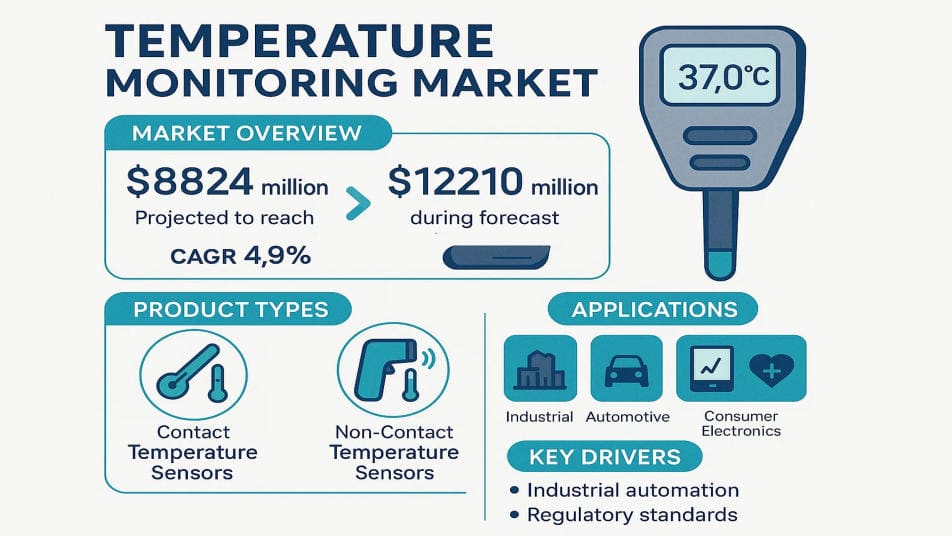
According to semiconductorinsight global Temperature Monitoring Market, valued at USD 8.82 billion in 2024, is projected to reach USD 12.21 billion by 2032, reflecting a steady CAGR of 4.9%. The semiconductor industry continues to redefine global innovation, with sensor-driven technologies becoming indispensable across industrial automation, automotive systems, electronics, and energy management. Between 2025 and 2032, temperature monitoring solutions stand at the center of reliability, safety, and intelligent system optimization.
Download Sample Report https://semiconductorinsight.com/download-sample-report/?product_id=122963
Emerging Trends Shaping the Market
AI-Enabled Thermal Intelligence
The incorporation of AI into temperature sensors and monitoring platforms is enabling predictive heat-mapping, automated diagnostics, and real-time thermal analytics. This shift elevates system reliability across semiconductor fabs, data centers, and EV powertrains—areas where precision temperature control directly influences performance and device lifespan.
Next-Gen Semiconductor Materials Push Sensor Capabilities
Advancements in wide bandgap materials such as SiC and GaN are driving demand for thermal systems that can withstand higher operating temperatures. These innovations boost sensor resolution, accuracy, and robustness, expanding use cases in renewable power systems and high-density electronics.
3D Packaging and Compact Thermal Management
As 3D semiconductor packaging becomes mainstream, the need for compact, high-precision thermal solutions is accelerating. Embedded sensors in stacked architectures enable more intelligent thermal balancing, helping prevent overheating in edge devices, mobile systems, and advanced computing hardware.
Sustainability and Energy Efficiency as Design Priorities
Manufacturers are shifting toward ultra-low-power temperature monitoring components. From industrial automation to consumer electronics, the push toward carbon-efficient systems is reshaping material choices, production techniques, and sensor calibration methods.
Key Market Drivers and Growth Factors
- Rising integration of temperature sensors in EV batteries, charging systems, and power electronics
• Increased deployment of industrial automation systems requiring thermal diagnostics
• Expanding use of temperature monitoring in semiconductor fabrication and cleanroom operations
• Growth in consumer electronics with higher processing density and thermal sensitivity
• Strengthening emphasis on safety and compliance in pharmaceuticals, food storage, and logistics
Strategic Developments by Key Players
Industry leaders are intensifying R&D and forming strategic collaborations to enhance sensor accuracy, ruggedness, and intelligence.
Emerson Electric Co. is reinforcing its automation portfolio with smart industrial monitoring systems that support high-reliability operations across oil, gas, and manufacturing environments.
Sensata Technologies, Inc. continues investing in automotive-grade temperature sensors to support electrification and advanced driver assistance systems (ADAS).
Amphenol Corporation is expanding its thermal product lines to meet rising demand in industrial robotics and medical devices.
TE Connectivity Ltd. is focusing on micro-sensing innovation for compact electronics, enhancing precision across high-temperature applications.
Texas Instruments Incorporated is accelerating the development of advanced analog temperature sensors optimized for efficiency in data centers and edge computing.
Molex, LLC is enhancing its connectivity-sensor ecosystems, particularly for smart factories and mission-critical infrastructure.
Honeywell International Inc., Siemens AG, and ABB Ltd. are strengthening their industrial IoT platforms with integrated thermal intelligence, while Panasonic Holdings Corporation continues advancing solid-state sensing technologies.
Our comprehensive Market report is ready with the latest trends, growth opportunities, and strategic analysis https://semiconductorinsight.com/report/temperature-monitoring-market/
Segment Analysis: Who Leads the Market?
By Type
Contact-based sensors maintain dominance due to high adoption in manufacturing, automotive systems, and electronics, while non-contact infrared sensors are rapidly gaining traction for advanced automation and high-precision testing environments.
By Application
Industrial automation leads global deployments, driven by safety compliance and predictive maintenance. The healthcare and pharmaceutical sectors follow, benefiting from increasingly stringent regulatory requirements for temperature-controlled environments.
By Region
Asia-Pacific leads the market, supported by extensive electronics production ecosystems in China, South Korea, Japan, and Taiwan. Robust semiconductor manufacturing growth continues to fuel demand for precision thermal monitoring solutions across fabs, assembly plants, and test facilities.
Technological Advancements Impacting Growth
Can AI-Driven Lithography Redefine Semiconductor Yield Rates?
AI-powered thermal mapping is emerging as a valuable tool in lithography, identifying subtle temperature deviations that impact pattern accuracy and defect density. The result is a more stable and predictable fabrication process.
Nanofabrication, improved MEMS sensor architectures, and cleanroom automation are also reshaping the landscape. Innovations such as solid-state thermal sensors and self-calibrating systems are enhancing the stability required for high-performance semiconductor devices.
For additional authoritative insights on semiconductor innovation, readers can visit IEEE Technology Standards (external link).
Why This Report Matters
This comprehensive outlook offers a forward-focused view of the market from 2024–2032, combining quantitative projections with qualitative intelligence. Stakeholders gain access to competitive landscapes, technology trajectories, investment opportunities, and strategic pathways shaping the next generation of temperature monitoring solutions. With sensor innovation influencing thermal stability across industries, accurate forecasting and market visibility are essential for long-term planning.
Download Sample Report https://semiconductorinsight.com/download-sample-report/?product_id=122963
Closing Insight
As global reliance on high-density electronics, industrial automation, and electrified transportation grows, thermal intelligence is becoming a core design pillar. Stakeholders who align innovation with sustainability, precision, and strategic foresight will be best positioned to lead in the evolving semiconductor ecosystem.
Call-to-Action
Explore the full market analysis, growth forecast, and competitive insights at Semiconductor Insights