Introduction
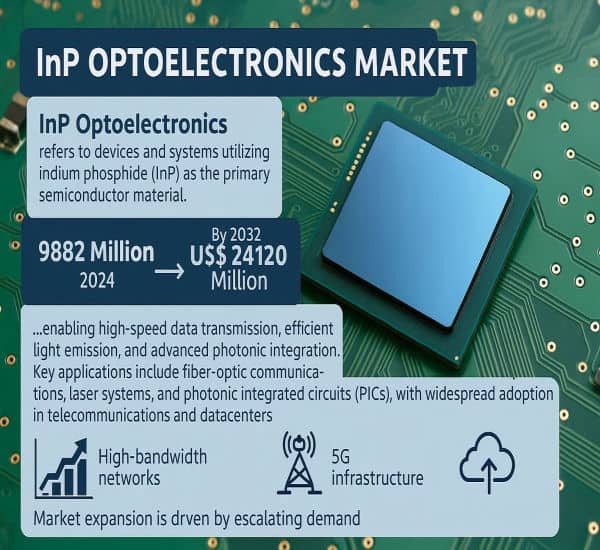
Global InP optoelectronics market was valued at USD 9,882 million in 2024 and is projected to reach USD 24,120 million by 2032, posting a 9.7% CAGR over the forecast period. This semiconductor segment is central to next-generation optical networking and datacenter interconnects, enabling higher speeds and lower power per bit.
𝐃𝐨𝐰𝐧𝐥𝐨𝐚𝐝 𝐅𝐑𝐄𝐄 𝐒𝐚𝐦𝐩𝐥𝐞 𝐑𝐞𝐩𝐨𝐫𝐭: https://semiconductorinsight.com/download-sample-report/?product_id=117963
Emerging Trends Shaping the Market
- AI-driven chip design — Machine learning tools are accelerating photonic device optimization by cutting prototyping cycles and improving tunability for InP lasers and modulators. This reduces development risk and speeds commercialization for 100G–800G transceivers.
- Photonic integrated circuits (PICs) and monolithic integration — Moving from discrete assemblies to InP-based PICs consolidates lasers, modulators and detectors on a single die. The result: smaller modules, lower power, and simpler assembly — all critical for co-packaged optics in hyperscale switches.
- 3D packaging and co-packaged optics — Advanced multi-die packaging and co-placement of optics with switch ASICs reduce interconnect loss and latency, unlocking new system architectures for AI accelerators and high-density datacenters.
- Sustainability and supply-chain localization — Regional foundry investments and capacity expansions are reducing geographic risk while improving energy efficiency metrics, making locally sourced InP production an operational priority for cloud and telco buyers.
Key Market Drivers and Growth Factors
- Exploding data traffic from cloud, AI workloads and 5G pushes demand for higher-speed optical transceivers (100G, 400G, 800G).
- InP’s superior high-frequency performance makes it the preferred platform for DFB and EML devices in metro and long-haul deployments.
- PIC foundry maturation and improved design automation lower entry barriers and accelerate time-to-market for integrated solutions.
- Datacenter modernization prioritizes compact, power-efficient optical modules, boosting adoption of InP laser diodes and photodetectors.
- Wavelength specialization (1310 nm for metro, 1550 nm for long haul) shapes differentiated product strategies and supplier positioning.
𝐆𝐞𝐭 𝐅𝐮𝐥𝐥 𝐑𝐞𝐩𝐨𝐫𝐭 𝐇𝐞𝐫𝐞: https://semiconductorinsight.com/report/inp-optoelectronics-market/
Strategic Developments by Key Players
Notable companies driving strategic moves include: Lumentum; Coherent (II-VI); Broadcom; Sumitomo Electric; Furukawa Electric; Applied Optoelectronics; MACOM.
These players are pursuing R&D in high-power and quantum-dot lasers, capacity expansions at PIC foundries, vertical integration of assembly and test, targeted acquisitions to broaden portfolios, and partnerships with hyperscalers to validate co-packaged optics. Mid-sized and specialist vendors continue to carve niches in medical, defense and sensing through focused roadmaps and assembly expertise.
Segment Analysis: Who Leads the Market?
- By type: Fabry-Perot (FP) devices retain substantial share because of cost advantages, while DFB and EML segments grow faster for higher-speed, long-reach applications.
- By application: Telecommunications remains the largest revenue source, but datacenter interconnects are the fastest accelerating segment due to AI and cloud demand.
- By component: Laser diodes drive revenue, with photodetectors and modulators supporting system performance.
- By region: Asia-Pacific dominates, supported by strong fabrication ecosystems in Taiwan, South Korea and Japan; North America and Europe maintain design leadership and specialized foundry services.
𝐃𝐨𝐰𝐧𝐥𝐨𝐚𝐝 𝐅𝐑𝐄𝐄 𝐒𝐚𝐦𝐩𝐥𝐞 𝐑𝐞𝐩𝐨𝐫𝐭: https://semiconductorinsight.com/download-sample-report/?product_id=117963
Technological Advancements Impacting Growth
Can AI-Driven Lithography Redefine Yield Rates? Early deployments of closed-loop AI process control show potential to reduce variability and boost throughput in photonic manufacturing. Advances in epitaxy, quantum-dot lasers on InP substrates, and automated cleanroom systems improve device uniformity and thermal stability, enabling higher modulation speeds and better field reliability.
Why This Report Matters
This analysis delivers actionable intelligence for executives, product planners and investors by providing:
- Market estimations and revenue forecasts for 2024–2032;
- Competitive intelligence on vendor strategies and capability gaps;
- Technology roadmaps linking PIC, laser and wavelength trends to product opportunity;
- Opportunity mapping that identifies high-growth segments such as datacenters, 1310 nm metro and co-packaged optics.
𝐆𝐞𝐭 𝐅𝐮𝐥𝐥 𝐑𝐞𝐩𝐨𝐫𝐭 𝐇𝐞𝐫𝐞: https://semiconductorinsight.com/report/inp-optoelectronics-market/
Conclusion
As the semiconductor landscape accelerates, success will favor firms that align integrated PIC design, scalable foundry partnerships and wavelength-targeted product strategies. Market winners will be those who combine technical excellence with operational scale and sustainability commitments.
Contact Us:
🌐 Website: https://semiconductorinsight.com/
📞 International: +91 8087 99 2013
🔗 LinkedIn: Follow Us
