Introduction
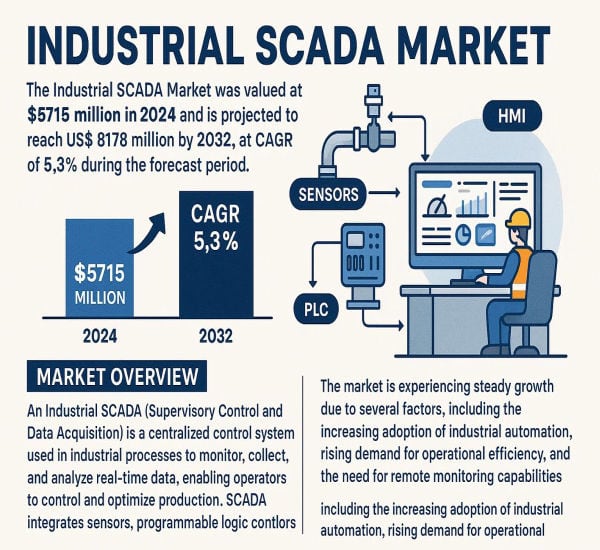
The Industrial SCADA (Supervisory Control and Data Acquisition) Market, valued at USD 5,715 million in 2024, is projected to rise to USD 8,178 million by 2032, expanding at a CAGR of 5.3%. As industries accelerate automation, adopt digital ecosystems, and transition to Industry 4.0, SCADA systems have become indispensable to real-time control, operational visibility, and infrastructure resilience.
𝐃𝐨𝐰𝐧𝐥𝐨𝐚𝐝 𝐅𝐑𝐄𝐄 𝐒𝐚𝐦𝐩𝐥𝐞 𝐑𝐞𝐩𝐨𝐫𝐭: https://semiconductorinsight.com/download-sample-report/?product_id=117503
Emerging Trends Shaping the Market
Integration of IIoT and Cloud-Native Architectures
The fusion of IIoT and cloud platforms is revolutionizing SCADA capabilities by enabling high-speed data collection, centralized monitoring, and predictive maintenance. This transition from isolated on-premise systems to connected digital frameworks strengthens analytics, improves decision-making, and enhances remote operations across industrial environments.
AI-Enhanced Automation and Predictive Intelligence
SCADA platforms increasingly combine AI and machine learning to transform raw industrial data into actionable insights. AI-driven models identify abnormal patterns, forecast system failures, and optimize resource consumption. This trend shifts SCADA from reactive monitoring to intelligent, autonomous process management.
Advanced Cybersecurity for Critical Infrastructure
Growing connectivity exposes industrial systems to sophisticated cyber risks. As a result, cybersecurity-infused SCADA systems—featuring encryption, multi-factor authentication, and anomaly detection—are becoming standard. This trend is essential as industries modernize grids, pipelines, and transportation infrastructure.
Rise of Edge Computing for Real-Time Industrial Control
Edge processors embedded within SCADA architectures are improving response speed and system reliability. By processing data locally—close to pumps, transformers, and machinery—edge-enabled SCADA reduces latency and enhances continuity in mission-critical environments.
Human-Machine Interface (HMI) Modernization
HMI designs are shifting toward immersive visual dashboards, touch-driven interfaces, and AR-assisted troubleshooting. These upgraded interfaces simplify operator workflows and increase situational awareness across complex industrial ecosystems.
Key Market Drivers and Growth Factors
- Rapid industrial automation and Industry 4.0 adoption are fueling SCADA deployment across manufacturing and process industries.
• Energy optimization initiatives in power, oil & gas, and water management boost demand for real-time monitoring and load balancing.
• Massive investments in critical infrastructure—from smart grids to urban transit—create long-term opportunities for advanced SCADA solutions.
• Growing emphasis on operational efficiency and sustainability drives adoption of SCADA-driven performance monitoring.
• Expansion of remote and distributed assets, including renewables and pipeline networks, necessitates centralized control systems.
𝐆𝐞𝐭 𝐅𝐮𝐥𝐥 𝐑𝐞𝐩𝐨𝐫𝐭 𝐇𝐞𝐫𝐞: https://semiconductorinsight.com/report/industrial-scada-market/
Strategic Developments by Key Players
Leading companies are strengthening their portfolios through IIoT integration, cybersecurity enhancements, and strategic acquisitions.
• Siemens AG continues to expand its cloud-native SCADA ecosystem, emphasizing advanced analytics and resilient automation.
• ABB Ltd. is enhancing its digital power infrastructure solutions with AI-enabled monitoring tools.
• Schneider Electric focuses on cyber-secure, scalable SCADA offerings tailored for energy and water utility modernization.
• Emerson Electric Co. has advanced its DeltaV™ platform with integrated SCADA modules that enhance remote asset surveillance.
• Rockwell Automation invests heavily in intuitive HMIs and strategic partnerships with cloud service providers.
• Honeywell International is expanding its cybersecurity portfolio to safeguard industrial control systems.
• Yokogawa Electric Corporation is strengthening its smart operations ecosystem through IIoT-enabled supervisory control systems.
Segment Analysis: Who Leads the Market?
By Type
Hardware dominates the market due to its essential role in enabling communication, control, and field-level connectivity. PLCs, RTUs, and HMIs form the core foundation for industrial automation frameworks.
By Application
The oil & gas industry leads, driven by the extensive use of SCADA in pipeline surveillance, refinery automation, and leak detection. Power & energy follow closely due to increasing grid modernization efforts.
By Deployment
On-premise SCADA remains dominant, especially in critical infrastructure where data sovereignty, security, and operational control are paramount. However, cloud-based and hybrid models are gaining momentum as industries embrace remote and distributed operations.
By Component
The supervisory system segment holds the largest share as it acts as the command hub for data acquisition, visualization, and system-wide control, enabling seamless integration with PLCs, RTUs, and communication networks.
𝐃𝐨𝐰𝐧𝐥𝐨𝐚𝐝 𝐅𝐑𝐄𝐄 𝐒𝐚𝐦𝐩𝐥𝐞 𝐑𝐞𝐩𝐨𝐫𝐭: https://semiconductorinsight.com/download-sample-report/?product_id=117503
Technological Advancements Impacting Growth
Can AI-Driven Analytics Reshape Industrial Uptime?
The integration of AI into SCADA platforms is reducing unplanned downtime, improving quality management, and enabling predictive maintenance weeks in advance. These advancements significantly increase asset utilization and reduce operational risk.
Cybersecurity-Embedded SCADA Architectures
Modern SCADA deployments embed multi-layered cybersecurity frameworks to protect against evolving threats—an essential requirement as utilities and industries transition to interconnected digital systems.
Interoperable and Modular System Designs
Flexible, modular SCADA designs are enabling rapid integration with field devices, cloud platforms, and edge hardware, lowering implementation barriers and future-proofing industrial operations.
Why This Report Matters
This comprehensive market study provides:
• Detailed market estimations and forecasts from 2024–2032
• Competitive intelligence across global and regional players
• Strategic insights into technological transformations and investment patterns
• Granular segmentation analysis to identify high-growth opportunities
• Industry-wide trend mapping and actionable growth recommendations
𝐆𝐞𝐭 𝐅𝐮𝐥𝐥 𝐑𝐞𝐩𝐨𝐫𝐭 𝐇𝐞𝐫𝐞: https://semiconductorinsight.com/report/industrial-scada-market/
Conclusion
As global industries accelerate their digital transformation efforts, SCADA systems will remain pivotal to operational intelligence, infrastructure resilience, and automation-led growth. Stakeholders who align innovation with cybersecurity, sustainability, and data-driven strategies will shape the next era of industrial modernization.
Contact Us:
🌐 Website: https://semiconductorinsight.com/
📞 International: +91 8087 99 2013
🔗 LinkedIn: Follow Us