Introduction
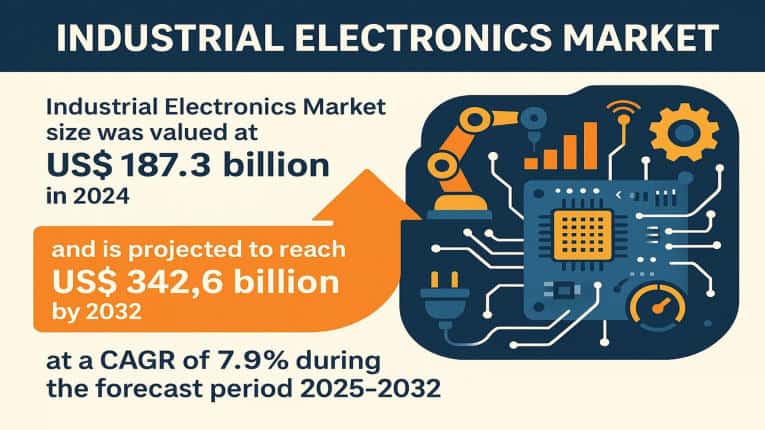
According to semiconductorinsight semiconductor industry continues to redefine global innovation, with the Industrial Electronics Market emerging as one of the fastest-expanding segments. Valued at US$ 187.3 billion in 2024, the market is projected to reach US$ 342.6 billion by 2032, sustaining a healthy 7.9% CAGR. As industries accelerate toward automation, electrification, and intelligent manufacturing, industrial electronics are becoming foundational to global production ecosystems from 2025 to 2032.
Download Sample Report https://semiconductorinsight.com/download-sample-report/?product_id=90947
Emerging Trends Shaping the Market
AI-Driven Automation Accelerates Factory Modernization
Artificial intelligence is rapidly transforming industrial environments by enabling predictive maintenance, real-time diagnostics, and autonomous decision-making. In this market, AI-integrated controllers, power modules, and sensing systems are becoming indispensable for manufacturers aiming to minimize downtime and increase throughput.
Wide-Bandgap Semiconductors Gain Momentum
The rise of SiC and GaN technologies is reshaping industrial power systems. These advanced materials enhance energy efficiency across motor drives, power supplies, and industrial inverters—key components supported by players such as Infineon Technologies and STMicroelectronics. The shift toward electrified industrial infrastructure further amplifies demand.
Advanced Robotics Redefine Production Lines
Collaborative robots and high-precision automation systems are pushing industrial electronics suppliers to innovate faster. Microcontrollers, high-speed signal processors, and ruggedized sensors are being redesigned to manage complex robotic workflows in sectors like automotive and heavy engineering.
Edge Computing Enhances Real-Time Industrial Intelligence
With industries deploying millions of smart devices, edge computing is now central to processing critical data with low latency. Companies are integrating advanced microprocessors and connectivity modules to support decentralized decision-making within factories.
Sustainability and Energy Optimization Move to the Forefront
Manufacturers are prioritizing power-efficient components, recyclable materials, and optimized thermal systems. This sustainability shift directly influences design strategies in power electronics, semiconductors, and industrial control systems.
Key Market Drivers and Growth Factors
- Rapid adoption of automation technologies across manufacturing, energy, and logistics
• Expansion of electric mobility ecosystems requiring efficient industrial power electronics
• Rising demand for smart factories with integrated sensing and connectivity
• Increased investments in industrial robotics and high-speed control systems
• Growing need for energy-efficient electronics in global sustainability initiatives
Strategic Developments by Key Players
Industry leaders are aggressively expanding portfolios and manufacturing capabilities to stay competitive:
- ABB Ltd. is strengthening its automation systems with digitally enhanced industrial controllers, boosting adoption in heavy industries.
- Mitsubishi Electric Corporation continues to invest in advanced power modules and industrial automation hardware to support intelligent manufacturing.
- Rockwell Automation, Inc. is enhancing its industrial software and connected control systems, pushing deeper into smart factory ecosystems.
- Infineon Technologies AG expands its leadership in power semiconductors, particularly SiC-based devices used in high-efficiency industrial drives.
- Vishay Intertechnology, Inc. focuses on robust passive components and semiconductors engineered for demanding industrial conditions.
- Microchip Technology Inc. accelerates innovations in microcontrollers and analog solutions tailored for industrial computing and motor control.
- Texas Instruments Incorporated broadens its industrial analog and embedded processing offerings with improved energy management capabilities.
- STMicroelectronics N.V. invests in next-generation power electronics that support industrial electrification and smart energy systems.
- NXP Semiconductors N.V. strengthens its edge processing and connectivity solutions enabling secure industrial communication frameworks.
Our comprehensive Market report is ready with the latest trends, growth opportunities, and strategic analysis https://semiconductorinsight.com/report/industrial-electronics-market/
Segment Analysis: Who Leads the Market?
Power Electronics Segment Shows Strongest Growth
Power modules, industrial inverters, and high-efficiency switching devices dominate due to expanding uses in automation, renewable energy, and heavy machinery.
Automation and Control Systems Remain Core Revenue Contributors
Programmable logic controllers (PLCs), industrial sensors, and motion control systems continue to lead adoption as industries transition to fully connected production environments.
Asia-Pacific Maintains Its Leadership Position
Asia-Pacific leads the global market, benefiting from robust manufacturing clusters in China, Japan, Taiwan, and South Korea. The region’s expanding semiconductor supply chain and automation investments bolster its dominance through 2032.
North America Advances Through Digital Transformation
The U.S. drives strong demand for industrial robotics, smart factories, and electrification technologies, supported by high R&D spending and leading semiconductor manufacturers.
Technological Advancements Impacting Growth
Can AI-Driven Lithography Redefine Semiconductor Yield Rates?
AI-enhanced lithography and automated inspection systems are improving wafer yields, which supports the production of high-performance industrial electronics. These advances strengthen reliability for components used in mission-critical environments.
Nanofabrication Pushes Device Efficiency Forward
Shrinking geometries and improved material engineering allow industrial semiconductors to deliver greater processing power within smaller, more energy-efficient footprints.
Cleanroom Automation Enhances Manufacturing Precision
Robotic wafer handling, automated process control, and contamination-reduction systems ensure high-quality industrial-grade electronics are produced consistently at scale.
Why This Report Matters
This market assessment offers actionable insights for semiconductor stakeholders by delivering:
- Detailed market estimations from 2024–2032
• Competitive intelligence on global industrial electronics leaders
• Segment-wise growth opportunities
• Technology and investment trends shaping the next decade
For readers seeking strategic clarity, the report highlights where innovation intersects with market expansion and how companies can align resources with the fastest-growing segments.
Download Sample Report https://semiconductorinsight.com/download-sample-report/?product_id=90947
Future Outlook
As industrial ecosystems evolve with unprecedented speed, innovation and sustainability will dictate leadership. Companies that integrate advanced semiconductors, intelligent automation, and energy-efficient designs will ultimately define the next era of industrial transformation.
Call-to-Action
Explore the full report for in-depth forecasts, segment insights, and technology analysis at Semiconductor Insights.