Introduction
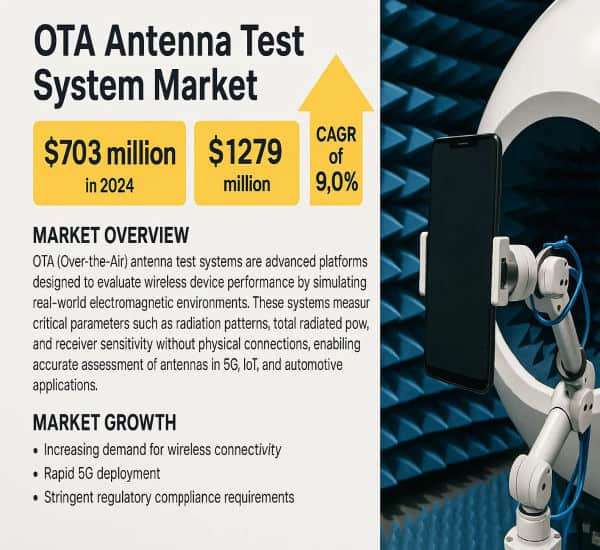
The OTA (Over-the-Air) Antenna Test System Market, valued at $703 million in 2024, is set to reach $1,279 million by 2032, expanding at a robust 9.0% CAGR. As 5G networks, IoT ecosystems, and connected vehicles increasingly depend on high-precision antenna performance, OTA testing has become mission-critical for global telecom and electronics industries. The semiconductor industry continues to redefine global innovation, with this market showing rapid expansion and deep technological disruption across wireless communication.
𝐃𝐨𝐰𝐧𝐥𝐨𝐚𝐝 𝐅𝐑𝐄𝐄 𝐒𝐚𝐦𝐩𝐥𝐞 𝐑𝐞𝐩𝐨𝐫𝐭: https://semiconductorinsight.com/download-sample-report/?product_id=117797
Emerging Trends Shaping the Market
AI-Driven Wireless Performance Optimization Gains Momentum
AI is transforming antenna testing workflows by predicting radiation behavior, automating pattern validation, and accelerating certification cycles. This is especially valuable in 5G mmWave devices, where small design variations can drastically alter beamforming efficiency. OTA systems integrated with AI now reduce pre-certification testing time, strengthening the competitive edge for telecom OEMs.
Advanced Lithography and Precision RF Engineering Enable 5G+ Devices
As antenna arrays become more compact and complex—particularly in smartphones, CPEs, and automotive radars—manufacturers are turning to micro-structured RF components created via advanced lithography. These next-generation components require highly accurate OTA validation to ensure performance across sub-6 GHz and mmWave bands.
Compound Semiconductor Integration Boosts OTA Testing Needs
Rising use of GaN and InP-based RF amplifiers and high-frequency components is intensifying the need for precise OTA systems. These materials enable higher bandwidth and lower latency, but also introduce new complexities in radiation behavior, demanding enhanced far-field and near-field testing methodologies.
3D Packaging and Phased-Array Innovation Transform Antenna Validation
With multi-layer 3D packages and phased-array antennas becoming mainstream in smartphones, automotive radars, and satellite links, OTA systems must validate increasingly dense antenna configurations. Miniaturized chambers and compact antenna test ranges (CATR) are now central to testing next-generation smart devices.
Sustainability and Equipment Efficiency Enter the Testing Ecosystem
New compact OTA systems are reducing energy consumption and floor-space requirements. Test labs are shifting toward modular systems that can be upgraded for 6G-era frequencies, supporting long-term sustainability goals in the electronics testing sector.
Key Market Drivers and Growth Factors
- Rapid 5G deployment, with over 40% of operators adopting 5G by 2024, is pushing demand for far-field and mmWave testing solutions.
• IoT expansion toward 30 billion devices by 2030 necessitates continuous antenna validation for consumer, industrial, and automotive IoT.
• Stricter global regulatory standards are increasing requirements for radiation pattern validation and total radiated power testing.
• Growth of connected and autonomous vehicles (V2X) creates strong pull for OTA systems capable of validating multi-antenna configurations.
• Aerospace and satellite communication modernization is driving the need for high-precision OTA testing for UAVs, LEO constellations, and avionics.
𝐆𝐞𝐭 𝐅𝐮𝐥𝐥 𝐑𝐞𝐩𝐨𝐫𝐭 𝐇𝐞𝐫𝐞: https://semiconductorinsight.com/report/ota-antenna-test-system-market/
Strategic Developments by Key Players
Global leaders are advancing next-generation OTA test systems through R&D investments, mergers, and technology partnerships:
- Keysight Technologies maintains leadership with a 21% market share driven by high-end 5G and mmWave OTA platforms.
- Rohde & Schwarz is expanding compact antenna test range (CATR) solutions tailored for automotive radar and 5G devices.
- Anritsu continues to strengthen its position through cost-effective test systems suitable for mid-volume electronics manufacturers.
- LitePoint is focusing on integrated solutions for Wi-Fi 7, IoT, and short-range communication devices.
- Microwave Vision Group is expanding its global presence in far-field chambers for satellite and aerospace applications.
- National Instruments (Emerson) and Spirent Communications are pursuing acquisitions to enhance end-to-end OTA testing ecosystems.
- Shenzhen General Test System and Beijing Zhongke Kemei are gaining international momentum with competitively priced solutions for smartphone makers.
𝐃𝐨𝐰𝐧𝐥𝐨𝐚𝐝 𝐅𝐑𝐄𝐄 𝐒𝐚𝐦𝐩𝐥𝐞 𝐑𝐞𝐩𝐨𝐫𝐭: https://semiconductorinsight.com/download-sample-report/?product_id=117797
Segment Analysis: Who Leads the Market?
By Type:
The Far Field segment dominates due to the rising need for mmWave and beamforming testing in 5G devices. Near-field systems are gaining traction, especially in high-volume IoT manufacturing.
By Application:
Wireless Communication leads overall demand, driven by global 5G rollout and Wi-Fi device expansion. Automotive electronics and aerospace segments are accelerating as V2X and satellite communication adoption rises.
By End User:
Telecommunication equipment manufacturers remain the largest adopters as they validate radios, CPEs, IoT nodes, and base station components. Automotive OEMs and aerospace firms follow with increasing investments in advanced RF validation.
By Technology:
5G Testing holds the largest share and is expected to outpace all other segments as mmWave deployments expand. Wi-Fi and Bluetooth testing remain essential for connected consumer devices.
𝐆𝐞𝐭 𝐅𝐮𝐥𝐥 𝐑𝐞𝐩𝐨𝐫𝐭 𝐇𝐞𝐫𝐞: https://semiconductorinsight.com/report/ota-antenna-test-system-market/
Technological Advancements Impacting Growth
Can AI-Driven RF Modeling Redefine OTA Testing Accuracy?
AI-powered RF analytics are enabling predictive modeling of antenna performance, significantly reducing chamber time and improving yield rates. When combined with nanofabrication, automated calibration, and advanced measurement algorithms, OTA systems are becoming more efficient and more accurate.
Emerging trends include:
• Automated robotics inside OTA chambers
• Ultra-compact CATR systems for smartphones and automotive radar
• Quantum-calibrated sensors that improve measurement precision
• Software-defined test frameworks enabling multi-standard validation
These technologies are shaping the next wave of wireless performance validation, especially for 6G, satellite systems, and phased-array antennas.
Why This Report Matters
This study provides stakeholders:
• Detailed market estimations for 2024–2032
• Technology and competitive insights across global OTA system manufacturers
• Growth projections across 5G, IoT, automotive, and aerospace applications
• Opportunity mapping in fast-expanding mmWave and near-field testing categories
• Analysis of global supply chain shifts and localized manufacturing trends
The report delivers actionable intelligence for equipment manufacturers, telecom companies, and investors navigating rapid wireless transformation.
𝐃𝐨𝐰𝐧𝐥𝐨𝐚𝐝 𝐅𝐑𝐄𝐄 𝐒𝐚𝐦𝐩𝐥𝐞 𝐑𝐞𝐩𝐨𝐫𝐭: https://semiconductorinsight.com/download-sample-report/?product_id=117797
Conclusion
As wireless connectivity accelerates toward 5G Advanced, 6G, and autonomous mobility, OTA antenna testing will remain central to ensuring performance, reliability, and regulatory compliance. Companies that align with emerging RF innovations and advanced testing methodologies will be best positioned to lead in the next era of global communication.
Contact Us:
🌐 Website: https://semiconductorinsight.com/
📞 International: +91 8087 99 2013
🔗 LinkedIn: Follow Us