Introduction
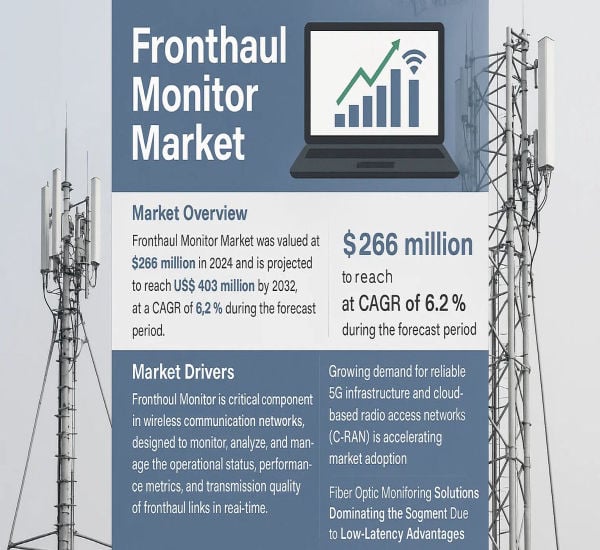
Global fronthaul monitor market was valued at USD 266 million in 2024 and is projected to reach USD 403 million by 2032, expanding at a CAGR of 6.2%. As 5G deployments accelerate worldwide, monitoring solutions have become indispensable for ensuring the performance and stability of modern radio access networks. The push toward cloud-based and virtualized telecom architectures further elevates the need for high-precision fronthaul oversight.
𝐃𝐨𝐰𝐧𝐥𝐨𝐚𝐝 𝐅𝐑𝐄𝐄 𝐒𝐚𝐦𝐩𝐥𝐞 𝐑𝐞𝐩𝐨𝐫𝐭: https://semiconductorinsight.com/download-sample-report/?product_id=118032
Emerging Trends Shaping the Market
AI-Powered Network Intelligence Becomes a Core Requirement
Artificial intelligence is rapidly transforming fronthaul monitoring, enabling automated anomaly detection, predictive maintenance, and real-time optimization. As cloud-RAN and open RAN ecosystems expand, AI-driven analytics help operators maintain signal integrity across increasingly dynamic and distributed fronthaul environments.
Advanced Fiber and Optoelectronic Technologies Drive Next-Gen Monitoring
The rising dominance of fiber-based fronthaul links — now exceeding 65% of global connections — is accelerating innovation in optical sensing, DWDM/CWDM monitoring, and photonic integration. These advancements support ultra-low-latency data paths essential for 5G and future 6G networks.
Edge Computing Reshapes Fronthaul Topology Requirements
The proliferation of edge data centers introduces new monitoring challenges, requiring continuous performance visibility across interconnected fronthaul and midhaul segments. As processing shifts closer to users, monitoring systems are evolving to provide granular insights into jitter, latency, and packet loss in real time.
3D Packaging & Semiconductor Integration Enhance Network Equipment Reliability
Telecom equipment manufacturers increasingly adopt advanced chip packaging, such as 2.5D/3D ICs and silicon photonics, to improve fronthaul node performance. These technologies enhance energy efficiency, collapse board footprint, and reduce parasitic losses — strengthening the capabilities of next-generation monitoring hardware.
Sustainability and Energy Efficiency Gain Infrastructure Priority
As operators expand 5G infrastructure, power optimization and hardware durability have become strategic imperatives. Fronthaul monitors are being redesigned with low-power architectures, recyclable materials, and improved thermal management to meet global sustainability targets.
Key Market Drivers and Growth Factors
- Rapid 5G Rollouts: Rising deployment of distributed RAN and massive MIMO increases demand for real-time fronthaul visibility.
• Fiber Network Expansion: Heavy investments in fiber infrastructure amplify the need for precision optical monitoring tools.
• Open RAN Adoption: Multi-vendor ecosystems require sophisticated interoperability and performance tracking.
• Virtualized Network Functions: Cloud-native telecom systems necessitate software-defined, scalable monitoring architectures.
• Growing Emphasis on Network Reliability: Operators seek predictive performance assurance to minimize service disruptions and maintain QoS.
𝐆𝐞𝐭 𝐅𝐮𝐥𝐥 𝐑𝐞𝐩𝐨𝐫𝐭 𝐇𝐞𝐫𝐞: https://semiconductorinsight.com/report/fronthaul-monitor-market/
Strategic Developments by Key Players
Leading industry players continue to strengthen their portfolios through R&D, digital transformation initiatives, and strategic collaborations.
• Keysight Technologies expands its dominance with advanced PathWave and FieldFox platforms optimized for 5G and O-RAN testing.
• VIAVI Solutions boosts its capabilities through acquisitions and AI-enhanced monitoring suites.
• EXFO accelerates predictive analytics integration across its fiber and fronthaul monitoring product lines.
• Spirent Communications invests heavily in cloud-native platforms such as VisionWorks 2.0 for automated O-RAN validation.
• Anritsu Corporation strengthens its foothold with high-precision optical and signal quality analyzers.
• Additional competition comes from Nokia, Huawei, Artiza Networks, Xena Networks, Intel, PRIMUS IT, and ZPSYS, each contributing niche strengths in fronthaul, midhaul, and fiber network assurance.
Segment Analysis: Who Leads the Market?
By Type:
Fiber optic monitoring dominates due to unparalleled bandwidth capacity and stability. DWDM and CWDM solutions continue to rise in adoption as operators modernize fronthaul architectures. Microwave and millimeter-wave monitoring retain value for rural, temporary, and legacy installations.
By Application:
The telecommunications industry accounts for the largest share, driven by 5G and advanced 4G LTE deployments. Satellite communications and industrial automation represent emerging segments requiring high-reliability infrastructure.
By End User:
Network operators lead adoption, fueled by modernization roadmaps and growing reliance on cloud-based network orchestration. Test equipment manufacturers and government organizations follow closely, supporting compliance, national security, and infrastructure resilience.
By Deployment Mode:
Cloud-based solutions are gaining traction as operators pursue remote diagnostics, automation, and cost-efficient scaling, while hybrid environments remain critical for large multi-layer networks.
𝐃𝐨𝐰𝐧𝐥𝐨𝐚𝐝 𝐅𝐑𝐄𝐄 𝐒𝐚𝐦𝐩𝐥𝐞 𝐑𝐞𝐩𝐨𝐫𝐭: https://semiconductorinsight.com/download-sample-report/?product_id=118032
Technological Advancements Impacting Growth
Can AI-Driven Monitoring Redefine Network Resilience?
Machine learning is dramatically improving the accuracy of signal degradation detection and enabling operators to predict failures before they occur. Combined with nanofabrication and cleanroom automation, modern monitoring hardware now supports higher frequencies, wider bandwidths, and more complex O-RAN deployments.
Advances in silicon photonics, low-loss optical waveguides, and real-time network telemetry further enhance fronthaul visibility enabling operators to meet the stringent demands of 5G URLLC and future 6G ecosystems.
Why This Report Matters
This market assessment provides:
• Comprehensive projections from 2024 to 2032
• Competitive landscape intelligence across major global players
• Growth insights tied to fiber deployments, C-RAN migration, and open RAN adoption
• Actionable opportunity mapping for vendors, operators, integrators, and investors
𝐆𝐞𝐭 𝐅𝐮𝐥𝐥 𝐑𝐞𝐩𝐨𝐫𝐭 𝐇𝐞𝐫𝐞: https://semiconductorinsight.com/report/fronthaul-monitor-market/
Conclusion
As telecom networks evolve toward cloud-native, software-defined architectures, fronthaul monitoring will shift from an operational tool to a strategic enabler of network resilience and service quality. Stakeholders who align innovation with scalability and sustainability will lead the next wave of infrastructure transformation.
Contact Us:
🌐 Website: https://semiconductorinsight.com/
📞 International: +91 8087 99 2013
🔗 LinkedIn: Follow Us