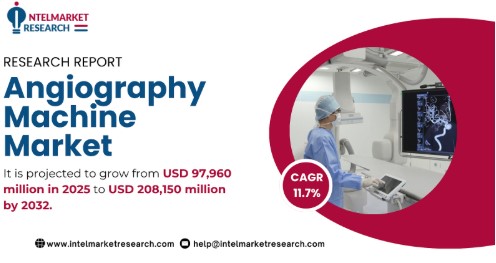
According to a new report from Intel Market Research, Global angiography machine market is entering a period of accelerated transformation, with the sector valued at USD 97.96 billion in 2024 and projected to climb to USD 108.52 billion in 2025, eventually reaching USD 208.15 billion by 2031. This reflects a strong CAGR of 11.7% over the forecast horizon.
Get FREE Sample of this Report at https://www.intelmarketresearch.com/download-free-sample/9999/angiography-machine-market
Recent Developments in the Angiography Machine Market
The angiography machine market is characterized by a rapid surge in technological integration, primarily driven by the need for enhanced precision and patient safety in minimally invasive procedures. The most significant development is the widespread integration of Artificial Intelligence (AI) and Machine Learning algorithms into imaging systems. AI is used for real-time image enhancement, automatic detection of vascular abnormalities (like blockages or stenosis), and automated measurements, which substantially reduces human error and improves diagnostic accuracy. Furthermore, there is a strong focus on Hybrid Operating Rooms (ORs) that integrate advanced angiography systems (like C-arms) with CT or MR imaging, allowing surgeons to perform complex procedures, such as stent placements and neurovascular interventions, with continuous, comprehensive, and high-resolution image guidance in a single setting.
Major Distribution for Angiography Machines
The distribution of high-value angiography machines operates on a highly specialized, global Business-to-Business (B2B) model. The primary channel involves direct sales and long-term service contracts from a few dominant global medical device Original Equipment Manufacturers (OEMs), such as Siemens Healthineers, GE Healthcare, and Philips Healthcare. These companies sell directly to Hospitals, Specialized Cardiac and Vascular Centers, and Diagnostic/Imaging Centers, which are the largest end-users due to the high purchasing power and need for complex installation and technical training. Distribution success is heavily reliant on providing comprehensive after-sales support, clinical training, and ongoing software and hardware upgrades to ensure the machines remain state-of-the-art and compliant with stringent healthcare regulations.
Get the Complete Report & TOC at https://www.intelmarketresearch.com/medical-devices/9999/angiography-machine-market
Emerging Market Trends
Advanced multimodal imaging becomes a clinical standard.
Hospitals are increasingly integrating X-ray angiography with CT and MR solutions to achieve comprehensive vascular visualization. This multimodal shift is improving diagnostic accuracy and shortening treatment cycles, especially in cardiac and neurological care.
Rise of minimally invasive and image-guided interventions.
Growing demand for catheter-based procedures is pushing health providers to upgrade to high-precision angiography systems. The technology’s role in reducing procedure times and postoperative complications is turning it into a preferred modality for both routine and complex interventions.
Integration of AI for real-time image enhancement.
Manufacturers are introducing AI-powered tools capable of improving image resolution, automated vessel mapping, and predictive analytics. These enhancements are aiding clinicians in faster decision-making an increasingly critical factor in stroke and trauma care.
Shift toward mobile and hybrid operating rooms.
Hybrid OR configurations equipped with angiography machines are expanding globally, enabling surgeons to perform open and image-guided procedures within the same environment. This trend is especially pronounced in major cardiac centers throughout Asia and Europe.
Key Market Drivers
A combination of demographic, clinical, and technological forces is shaping demand. Rising global cardiovascular and neurological disease prevalence continues to be the primary driver, prompting hospitals to upgrade diagnostic infrastructure. At the same time, the shift toward value-based healthcare is encouraging investments in high-precision imaging systems that can reduce readmission rates and improve surgical outcomes.
Regulatory support for safer, minimally invasive care is also accelerating market penetration. Technological innovations particularly in detector sensitivity, radiation minimization, and AI-driven imaging are further expanding use cases across oncology and peripheral vascular medicine. These advances collectively underscore the sector’s robust long-term growth trajectory.
Get the Complete Report & TOC at https://www.intelmarketresearch.com/medical-devices/9999/angiography-machine-market
Competitive Landscape: Leading Players
The angiography machine market is shaped by established global manufacturers advancing R&D and clinical partnerships. GE Healthcare, Siemens Healthineers, and Philips continue to dominate through next-generation fixed and mobile systems designed for hybrid surgical environments. Canon Medical Systems Corporation and Shimadzu Corporation are strengthening their portfolios with enhanced CT and MR angiography solutions, appealing to high-volume diagnostic centers.
Meanwhile, companies such as Boston Scientific, Medtronic, Cordis, and Terumo are expanding integrated device-and-imaging ecosystems to support interventional cardiology and vascular procedures. Abbott Laboratories and B. Braun Melsungen AG are also increasing their presence through targeted product enhancements and global distribution expansion. Across the board, leading manufacturers are focusing on AI-enabled imaging, low-dose radiation technology, and interoperability with surgical robotics platforms.
Segment Analysis & Regional Outlook
By Type, X-ray angiography remains the dominant modality due to its established clinical use and strong adoption in cardiovascular diagnostics. CT angiography is expanding rapidly as hospitals seek faster, non-invasive vascular imaging. Magnetic resonance angiography and MR-CT hybrid systems are gaining traction for radiation-sensitive patient groups and complex neurological assessments.
By Application, the cardiology segment leads global demand, supported by rising cardiovascular disease rates and expanded use of minimally invasive procedures. Neurology and oncology are experiencing steady growth as advanced imaging becomes integral to tumor mapping and cerebrovascular intervention. Peripheral vascular intervention is emerging as a key high-growth segment, particularly in aging populations.
Get the Complete Report & TOC at https://www.intelmarketresearch.com/medical-devices/9999/angiography-machine-market
Regionally, North America maintains a strong position due to advanced healthcare infrastructure and high procedural volumes. Europe is experiencing renewed investment in hybrid ORs and diagnostic modernization. However, Asia-Pacific is the fastest-growing region overall, supported by expanding hospital networks, increasing chronic disease prevalence, and significant capital investment in imaging technologies.
About Us
Intel Market Research is a leading provider of strategic intelligence, offering actionable insights in information technology, digital media solutions, and communication infrastructure. Our research capabilities include:
- Real-time competitive benchmarking
- Global technology adoption monitoring
- Country-specific regulatory and market analysis
- Over 500+ technology reports annually
Trusted by Fortune 500 companies, our insights empower decision-makers to drive innovation with confidence.
🌐 Website: https://www.intelmarketresearch.com
📞 International: +1 (332) 2424 294
📞 Asia-Pacific: +91 9169164321
🔗 LinkedIn: Follow Us