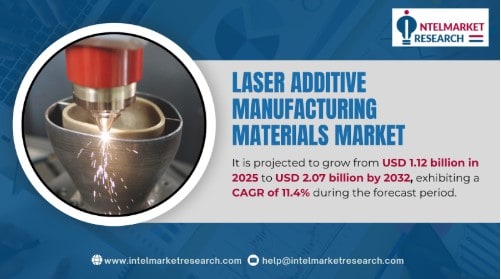
According to a new report from Intel Market Research, Global Laser Additive Manufacturing Materials market is charting a robust growth trajectory. Valued at USD 989 million in 2024, the market is projected to expand to USD 2.07 billion by 2031, registering a CAGR of 11.4% during the forecast period.
Get FREE Sample of this Report at https://www.intelmarketresearch.com/download-free-sample/9485/laser-additive-materials-market
Recent Developments in the Laser Additive Manufacturing Materials Market
The Laser Additive Manufacturing (LAM) materials market is undergoing a rapid expansion driven by the demand for high-performance, application-specific powders. A key development is the aggressive focus on novel and hybrid materials, moving beyond standard titanium and aluminum to include complex alloys like high-entropy alloys (HEAs), advanced ceramics, and custom metal-matrix composites. These materials are being specifically engineered for use in high-stress, high-temperature environments, such as aerospace turbine components and nuclear reactors. Furthermore, there is significant innovation in powder quality and standardization, with manufacturers employing advanced atomization techniques and post-processing methods to ensure superior flowability, purity, and particle size distribution, which is critical for achieving consistent, defect-free parts in high-reliability applications.
Major Distribution for Laser Additive Manufacturing Materials
The distribution of Laser Additive Manufacturing materials is a highly specialized, global Business-to-Business (B2B) process. The primary channel involves direct sales from specialized metal powder producers and chemical companies (like Höganäs, Carpenter Technology, and Sandvik) to end-use manufacturers in the aerospace, medical, and automotive sectors that own and operate their own LAM systems. This distribution is heavily reliant on technical consulting and certification, as the powder quality must meet stringent industry standards (e.g., aerospace qualifications). A growing secondary channel involves Additive Manufacturing Service Bureaus and Contract Manufacturers who purchase the powders and provide on-demand part production services, effectively acting as intermediaries that distribute the material’s benefits to a wider industrial client base.
Get the Complete Report & TOC at https://www.intelmarketresearch.com/materials-and-chemicals/9485/laser-additive-materials-market
Emerging Market Trends
- Digital Transformation in Manufacturing
The integration of advanced digital tools and automation in additive manufacturing is accelerating production efficiency. Companies leveraging real-time monitoring, predictive maintenance, and digital twin technologies are reducing lead times and optimizing material usage.
- Sustainability and Eco-Friendly Materials
With sustainability taking center stage, manufacturers are increasingly adopting low-waste production methods and recyclable or biodegradable materials. This ESG-driven innovation is influencing procurement strategies, particularly in Europe and North America.
- Diversification Across End-Use Industries
While aerospace and healthcare remain high-value applications, the automotive sector is witnessing rapid material adoption. Customized components, lightweight designs, and faster prototyping cycles are driving material deand across automotive supply chains.
- Material Innovation and Customization
Emerging technologies in plastics, ceramics, and metals enable manufacturers to meet increasingly specific requirements. Innovations in high-strength alloys, biocompatible polymers, and advanced ceramics are supporting precision-driven applications, from surgical instruments to aerospace components.
Key Market Drivers
Rising industrial automation, coupled with growing demand for lightweight, high-performance components, underpins market expansion. Favorable regulatory environments and government incentives in regions such as Europe and Asia-Pacific are also fueling growth. Additionally, cost efficiencies achieved through reduced material waste and faster prototyping cycles are encouraging wider adoption among SMEs and large enterprises alike.
Get the Complete Report & TOC at https://www.intelmarketresearch.com/materials-and-chemicals/9485/laser-additive-materials-market
Competitive Landscape: Leading Players
Global leaders such as 3D Systems Corporation (U.S.), GE Additive (U.S.), Renishaw plc (U.K.), SLM Solutions Group AG (Germany), EOS GmbH (Germany), Arcam AB (Sweden), Materialise NV (Belgium), Farsoon Technologies (China), and voxeljet AG (Germany) are actively shaping the market. Strategic investments include R&D initiatives for novel material development, regional expansions in Asia-Pacific, and partnerships to integrate additive manufacturing into supply chains. For instance, GE Additive continues to advance metal powder technologies, while Renishaw focuses on high-precision ceramic applications.
Segment Analysis & Regional Outlook
By material type, metals dominate the market, accounting for a significant share due to their use in aerospace and automotive components. Plastics and ceramics are also gaining traction, especially in healthcare and industrial tooling.
By application, aerospace remains the high-revenue segment, while automotive and healthcare are emerging as the fastest-growing sectors.
Regionally, Asia-Pacific is the powerhouse for production and adoption, driven by industrial expansion in China, Japan, and South Korea. North America maintains leadership in R&D and advanced prototyping, while Europe emphasizes sustainable and high-precision applications.
Technological Advancements & Strategic Insights
Can AI-Powered Material Design Transform Manufacturing Efficiency?
AI and machine learning are being deployed to optimize material formulations, predict component performance, and streamline production workflows. Digital simulations reduce trial-and-error cycles, enabling manufacturers to scale high-value applications faster while minimizing resource consumption.
Key Benefits of the Report
Investors and industry leaders can leverage insights from the report to:
- Access detailed market forecasts from 2024–2032
- Benchmark against global competitors and leading strategies
- Understand segment-level revenue contributions and trends
- Identify emerging opportunities in materials and applications
Expert Perspective
As industries continue embracing digital transformation, the Laser Additive Manufacturing Materials market is set to evolve rapidly. Innovation, sustainability, and strategic deployment of advanced materials are redefining production paradigms. Companies that align material capabilities with application-specific requirements are poised to gain a competitive edge in the next decade.
Get the Complete Report & TOC at https://www.intelmarketresearch.com/materials-and-chemicals/9485/laser-additive-materials-market
Call-to-Action
Gain comprehensive insights, forecasts, and data tables on the Laser Additive Manufacturing Materials Market by exploring the complete report at Intel Market Research.
About Us
Intel Market Research is a leading provider of strategic intelligence, offering actionable insights in information technology, digital media solutions, and communication infrastructure. Our research capabilities include:
- Real-time competitive benchmarking
- Global technology adoption monitoring
- Country-specific regulatory and market analysis
- Over 500+ technology reports annually
Trusted by Fortune 500 companies, our insights empower decision-makers to drive innovation with confidence.
🌐 Website: https://www.intelmarketresearch.com
📞 International: +1 (332) 2424 294
📞 Asia-Pacific: +91 9169164321
🔗 LinkedIn: Follow Us