Introduction
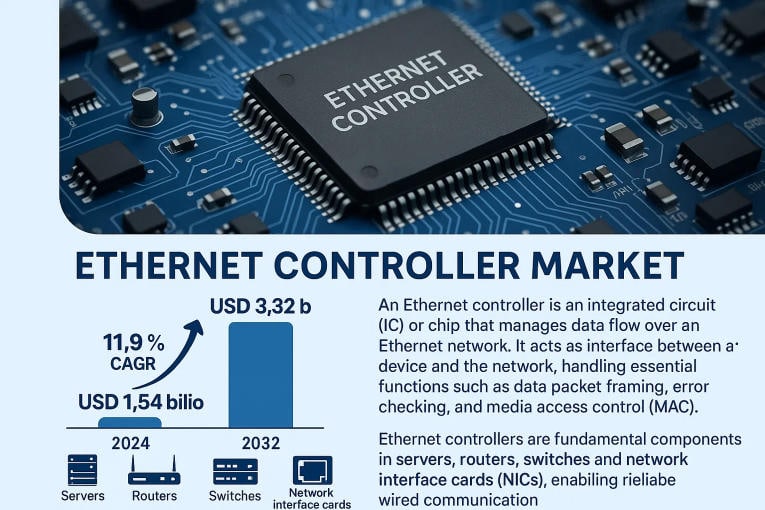
According to semiconductorinsight Ethernet Controller Market is set to experience remarkable growth, rising from USD 1.54 billion in 2024 to an estimated USD 3.32 billion by 2032, with a CAGR of 11.9%. This surge underscores the increasing significance of Ethernet controllers in networking, data centers, and IoT applications. The semiconductor industry continues to redefine global innovation, with this market showing robust expansion and technological disruption.
Download Sample Report https://semiconductorinsight.com/download-sample-report/?product_id=122766
Emerging Trends Shaping the Ethernet Controller Market
AI-Optimized Network Performance
AI-driven network management is becoming central to Ethernet controllers, enabling predictive traffic routing and enhanced latency optimization. These controllers support smarter enterprise and data center infrastructures, driving adoption across cloud and edge computing.
Integration with 5G Infrastructure
As 5G networks expand globally, Ethernet controllers are increasingly designed for ultra-fast, low-latency backhaul connections. This trend fuels demand for high-performance controllers capable of supporting next-generation mobile networks.
Energy-Efficient and Sustainable Designs
Sustainability is influencing chip design, with low-power Ethernet controllers emerging for both data centers and industrial IoT applications. Energy efficiency is becoming a core differentiator among leading semiconductor providers.
Advanced Packaging Innovations
3D packaging and system-in-package (SiP) technologies enhance performance density, allowing Ethernet controllers to integrate multiple network functions on a single die, improving both speed and thermal efficiency.
Key Market Drivers and Growth Factors
- Data Center Expansion: Rapid cloud adoption and server proliferation increase the need for high-speed, reliable Ethernet controllers.
- IoT Proliferation: Connected devices demand efficient network ICs to manage massive data flows.
- High-Speed Networking Requirements: Enterprises and telecom operators are investing in controllers supporting 10G, 25G, and 100G Ethernet standards.
- Industrial Automation: Smart factories and Industry 4.0 initiatives rely on robust Ethernet connectivity for real-time monitoring.
Strategic Developments by Key Players
The market’s growth is shaped by leading semiconductor companies:
- Broadcom Inc.: Expanding its portfolio with multi-gigabit Ethernet solutions and targeted R&D investments.
- Intel Corporation: Launching next-generation network interface controllers optimized for data center AI workloads.
- Marvell Technology Group Ltd.: Strengthening Ethernet offerings with integrated switching and low-latency controllers.
- Mellanox Technologies (NVIDIA): Focusing on high-performance interconnects following NVIDIA acquisition.
- Microchip Technology Inc.: Enhancing industrial Ethernet controller adoption with embedded system solutions.
- Realtek Semiconductor Corp.: Broadening consumer and small-business Ethernet IC presence with cost-effective designs.
These strategic moves highlight innovation, mergers, and targeted product launches as drivers of competitive advantage.
Our comprehensive Market report is ready with the latest trends, growth opportunities, and strategic analysis https://semiconductorinsight.com/report/ethernet-controller-market/
Segment Analysis: Who Leads the Market?
By type, controllers supporting 10G and 25G Ethernet dominate due to growing enterprise and data center requirements. Application-wise, data centers and cloud service providers are key consumers, while industrial automation networks are rapidly emerging. Geographically, Asia-Pacific leads the market, supported by mature semiconductor ecosystems in Taiwan, South Korea, and Japan, while North America and Europe drive high-end R&D and AI-integrated solutions.
Technological Advancements Impacting Growth
Can AI-Driven Network Controllers Redefine Performance Metrics?
AI integration in Ethernet controllers enables predictive network optimization, reducing congestion and improving packet throughput. Additionally, advances in nanofabrication and low-power design allow denser, faster, and more energy-efficient chips. Combined with automation in cleanroom processes, these innovations enhance production yields and scalability for high-demand applications.
Why This Report Matters
This Ethernet Controller Market report provides actionable insights for investors, OEMs, and technology strategists:
- Market estimations (2024–2032): Understand projected growth and CAGR implications.
- Competitive intelligence: Benchmark performance and strategies of top players.
- Growth forecasts: Identify key adoption drivers across regions and applications.
- Opportunity mapping: Detect emerging segments and technology trends for targeted investment.
For additional insights on semiconductor networking technologies, visit Semiconductor Insights and reference authoritative sources such as IEEE Xplore.
Download Sample Report https://semiconductorinsight.com/download-sample-report/?product_id=122766
Forward-Looking Insight
As Ethernet connectivity becomes increasingly critical for data-intensive applications, market participants must align technological innovation with sustainability, AI integration, and strategic foresight to maintain competitive advantage.
Call-to-Action
Explore the full Ethernet Controller Market report for in-depth forecasts, player profiles, and emerging technology insights at Semiconductor Insights.