Introduction
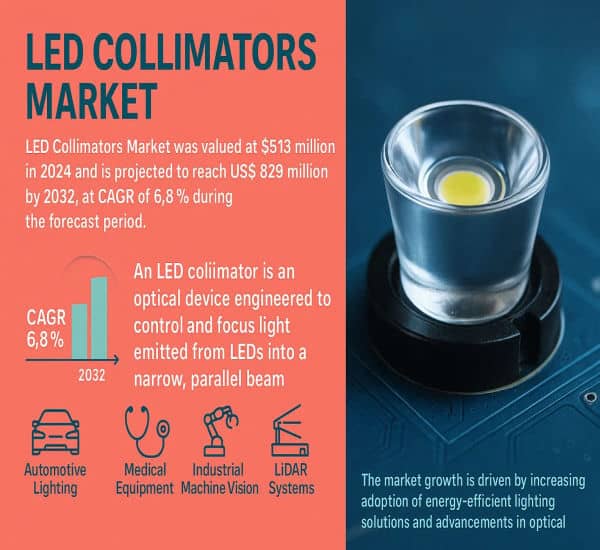
The LED Collimators Market, valued at USD 513 million in 2024, is projected to reach USD 829 million by 2032, expanding at a 6.8% CAGR. As precision optics become indispensable in automotive lighting, medical devices, LiDAR, and next-generation displays, this segment is emerging as a crucial enabler of efficient, directional LED illumination. The semiconductor industry continues to redefine global innovation, with this market showing robust expansion and technological disruption through advanced optical engineering.
𝐃𝐨𝐰𝐧𝐥𝐨𝐚𝐝 𝐅𝐑𝐄𝐄 𝐒𝐚𝐦𝐩𝐥𝐞 𝐑𝐞𝐩𝐨𝐫𝐭: https://semiconductorinsight.com/download-sample-report/?product_id=117869
Emerging Trends Shaping the Market
AI-Enhanced Optical Design Accelerates Development
AI-driven simulation platforms are reshaping how LED collimators are prototyped and optimized. Machine-learning models now shorten optical design cycles by predicting beam uniformity, minimizing hot spots, and refining refractive/reflective geometries. This trend is especially transformative for automotive ADB systems and LiDAR modules, where beam precision directly influences safety and detection accuracy.
Breakthroughs in Freeform & Advanced Optical Surfaces
Advanced lithography and micro-structured freeform optics are enabling ultra-compact collimators with superior beam control. These innovations allow 94–96% transmission efficiency—significantly higher than previous generations—supporting applications in AR displays, surgical lights, and compact sensors.
Rise of Compound Semiconductor-Driven Lighting Modules
The broader shift toward compound semiconductors such as GaN and InP is improving LED output performance. As LEDs achieve higher brightness and thermal efficiency, demand for collimators engineered for high-intensity, narrow beams grows. This synergy is accelerating adoption in machine vision systems and industrial automation.
3D Packaging & Integrated Optics Gain Momentum
Miniaturized optical modules using 3D packaging are becoming a preferred solution in consumer electronics and automotive sensors. By integrating lenses, reflectors, and LED chips into a single package, manufacturers reduce thermal resistance and improve beam consistency—key requirements in EV headlights and advanced driver-assistance systems.
Sustainability and Recyclable Optics
Lightweight hybrid polymer-glass composites are reducing material footprints by up to 30%. These eco-optimized materials maintain heat resistance up to 120°C, supporting a sustainability shift across lighting and semiconductor supply chains.
Key Market Drivers and Growth Factors
- Global shift toward energy-efficient lighting is accelerating LED adoption, boosting the need for precise collimators that minimize scattered light and maximize lumen output.
• Automotive lighting expansion, including ADB systems, EV lighting modules, and daytime running lamps, continues to be a primary growth force.
• LiDAR proliferation in autonomous systems is increasing demand for high-precision narrow-beam collimators.
• Growing use of surgical and medical lighting equipment, a $12 billion segment, requires superior beam shaping and high-CRI illumination.
• Regulatory pressure to phase out inefficient lighting systems is pushing commercial and municipal infrastructure toward LED-based solutions.
𝐆𝐞𝐭 𝐅𝐮𝐥𝐥 𝐑𝐞𝐩𝐨𝐫𝐭 𝐇𝐞𝐫𝐞: https://semiconductorinsight.com/report/led-collimators-market/
Strategic Developments by Key Players
Leading manufacturers are strengthening their portfolios through innovation, vertical integration, and strategic expansion:
- Ledlink Optics Inc. is leveraging vertically integrated manufacturing to deliver automotive-grade reflective and TIR collimators.
- LEDIL Oy continues to expand in the narrow-beam and ultra-uniform optics category, particularly across Asia-Pacific.
- Fraen Corporation is enhancing its precision-molded optical families for high-power LEDs and machine vision.
- Carclo Technical Plastics is broadening its reach through acquisitions that boost its LED collimation engineering capabilities.
- Nichia Corporation is integrating compact collimation features directly into LED packages for medical and automotive lighting.
- OSRAM Opto Semiconductors GmbH is advancing premium optical modules tailored for LiDAR emitters and high-intensity projection lighting.
- Lumileds Holding B.V. continues refining automotive-focused solutions where collimators are essential for achieving regulatory beam patterns.
Segment Analysis: Who Leads the Market?
By Type:
Reflective LED collimators—including parabolic and elliptical variants—command the largest share owing to their superior beam control and efficiency. TIR collimators remain critical for compact, high-power applications, while hybrid designs are gaining traction for LiDAR and AR displays.
By Application:
The automotive lighting segment leads, driven by widespread adoption in headlights, signal systems, and interior modules. Medical devices and machine vision follow, supported by rising demand for precision illumination.
By End User:
Automotive OEMs and consumer electronics manufacturers spearhead consumption, with medical device companies and industrial equipment makers contributing significantly.
𝐃𝐨𝐰𝐧𝐥𝐨𝐚𝐝 𝐅𝐑𝐄𝐄 𝐒𝐚𝐦𝐩𝐥𝐞 𝐑𝐞𝐩𝐨𝐫𝐭: https://semiconductorinsight.com/download-sample-report/?product_id=117869
Technological Advancements Impacting Growth
Can AI-Driven Lithography Redefine Optical Yield Rates?
Next-gen lithographic techniques powered by AI are enabling tighter optical tolerances and micro-structured lens surfaces with ±1° beam angle consistency. These breakthroughs are especially impactful for professional luminaires and aerospace-grade optics requiring ITAR compliance.
Cleanroom automation, nanofabrication tools, and advanced molding technologies are also reducing defect rates and improving alignment precision—vital for integrating collimators into high-density sensor arrays, EV modules, and smart displays.
Why This Report Matters
This study offers readers:
- Comprehensive market assessments for 2024–2032
- Detailed competitive intelligence across global manufacturers
- Technology-led growth forecasts
- Supply chain and regional diversification insights
- Opportunity mapping across automotive, medical, industrial, and consumer sectors
𝐆𝐞𝐭 𝐅𝐮𝐥𝐥 𝐑𝐞𝐩𝐨𝐫𝐭 𝐇𝐞𝐫𝐞: https://semiconductorinsight.com/report/led-collimators-market/
Conclusion
As lighting, sensing, and display ecosystems rapidly evolve, precision optical components such as LED collimators will shape the next era of intelligent illumination. Staying ahead will require aligning technological innovation with resilient supply chains and future-ready design strategies.
Contact Us:
🌐 Website: https://semiconductorinsight.com/
📞 International: +91 8087 99 2013
🔗 LinkedIn: Follow Us