Introduction
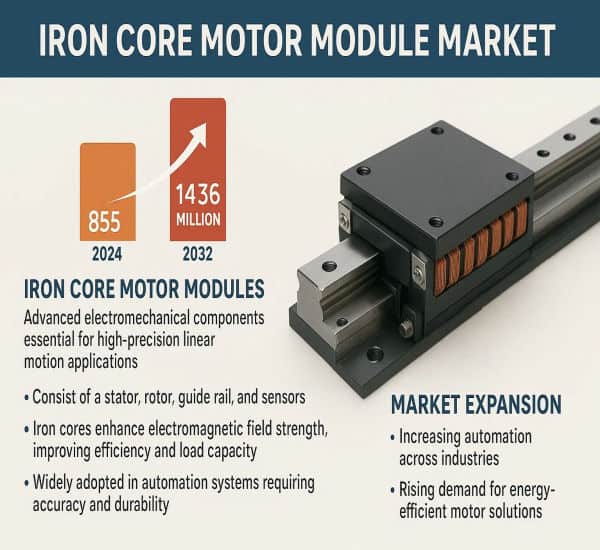
The global Iron Core Motor Module Market, valued at USD 855 million in 2024, is projected to reach USD 1,436 million by 2032, expanding at a CAGR of 7.7%. This high-performance motion control segment is becoming indispensable across industrial automation, medical robotics, and electric mobility. The semiconductor industry continues to redefine global innovation, with this market showing robust expansion and technological disruption driven by precision engineering and energy-efficient motor architectures.
𝐃𝐨𝐰𝐧𝐥𝐨𝐚𝐝 𝐅𝐑𝐄𝐄 𝐒𝐚𝐦𝐩𝐥𝐞 𝐑𝐞𝐩𝐨𝐫𝐭: https://semiconductorinsight.com/download-sample-report/?product_id=117895
Emerging Trends Shaping the Market
Automation & Industry 4.0 Integration
The shift toward hyper-automated factories is accelerating demand for precision motor modules capable of sustaining high-load cycles with exceptional torque density. Advanced iron core motors, often paired with semiconductor-rich motion controllers, now deliver up to 95% operational efficiency, making them a vital element of next-generation assembly lines, CNC systems, and material handling robots.
Rise of Miniaturized Motors for Medical Robotics
Healthcare is transitioning toward compact, ultra-accurate robotic platforms. Iron core modules with positional accuracy under 5 microns are transforming surgical robots, imaging systems, and lab automation devices. These trends mirror innovations seen in semiconductor miniaturization, where smaller components consistently outperform their predecessors.
Electrification of Transportation
With EV production climbing at an estimated 25% CAGR through 2030, specialized iron core motor modules are being adopted in cooling pumps, battery management systems, and automated charging arms. Their high thermal resilience, spanning –40°C to 150°C, mirrors semiconductor-grade reliability requirements increasingly demanded by global automakers.
Modular and Rapid-Install Designs
Borrowing from semiconductor packaging principles, modular motor configurations now reduce installation time by up to 30%. This trend is most visible in emerging APAC manufacturing hubs where localized production and modularity accelerate factory upgrades.
Energy-Efficiency Mandates
As global regulations tighten, the shift toward IE4-class motors is reshaping market design strategies. Iron core motor modules offering 15–20% greater energy efficiency over older brushed alternatives are becoming essential in regions pursuing carbon-aligned industrial policies.
Key Market Drivers and Growth Factors
- Industrial automation boom: Robotics, CNC machines, and conveyor systems increasingly depend on high-torque, precision motor modules.
- Energy-efficiency pressures: IE4 and regional energy mandates accelerate replacement of legacy systems.
- Medical equipment miniaturization: Power-dense motors (1 kW/kg+) enable compact surgical and diagnostic platforms.
- EV and mobility electrification: High thermal stability and vibration resistance expand applications across EV systems.
- Growing R&D investments: Manufacturers advancing cogging-free and high-force-density motors boost performance in heavy-duty applications.
𝐆𝐞𝐭 𝐅𝐮𝐥𝐥 𝐑𝐞𝐩𝐨𝐫𝐭 𝐇𝐞𝐫𝐞: https://semiconductorinsight.com/report/iron-core-motor-module-market/
Strategic Developments by Key Players
Leading companies are expanding portfolios through innovation, automation integration, and collaborations:
- Siemens AG enhances its industrial automation ecosystem with advanced brushless and PMSM modules targeting high-load industrial operations.
- ABB Ltd strengthens its motion control suite with high-efficiency, low-cogging iron core designs aligned with IE4/IE5 initiatives.
- Yaskawa Electric Corporation advances robotics-ready motor modules with rapid response times for semiconductor and high-speed packaging lines.
- Robert Bosch GmbH expands partnerships with automotive OEMs to integrate specialized iron core modules into EV thermal management systems.
- Mitsubishi Electric focuses on high-torque servo modules optimized for precision-oriented Japanese manufacturing hubs.
- Delta Electronics scales competitively priced, energy-efficient modules for APAC-based automation factories.
- Moog Inc. invests in ultra-precise actuation motors aimed at aerospace, medical, and defense research applications.
Segment Analysis: Who Leads the Market?
By Type
The Brushless Motor Module segment holds the dominant share, driven by its energy efficiency, low maintenance, high torque output, and compatibility with PMSM and BLDC architectures. Brushed variants still serve niche legacy or low-cost systems but are steadily losing ground.
By Application
Industrial Production leads the market, powered by robotics, CNC systems, and advanced conveyor automation.
Medical Equipment is the fastest-evolving segment due to rising adoption of surgical robots and compact diagnostic machines.
Transportation gains momentum as EV platforms adopt high-power iron core modules for critical subsystems.
By End User
The Manufacturing sector dominates, supported by soaring automation investments across APAC and Europe.
Electronics & Semiconductor industries follow, utilizing precision motor modules in wafer handling, packaging, and cleanroom robotics.
Regional Outlook
Asia-Pacific commands over 45% of global demand, driven by China’s manufacturing scale, South Korea’s automation intensity, and Japan’s robotics leadership. Europe and North America remain strong adopters due to energy-efficiency mandates and high industrial modernization.
𝐃𝐨𝐰𝐧𝐥𝐨𝐚𝐝 𝐅𝐑𝐄𝐄 𝐒𝐚𝐦𝐩𝐥𝐞 𝐑𝐞𝐩𝐨𝐫𝐭: https://semiconductorinsight.com/download-sample-report/?product_id=117895
Technological Advancements Impacting Growth
Can AI-Driven Motion Algorithms Redefine Motor Performance?
AI-enhanced control loops are improving torque ripple suppression, heat distribution, and positional accuracy, enabling motors to dynamically optimize performance like adaptive semiconductor systems.
Nanofabrication-Inspired Motor Optimization
Advances in material science, including high-saturation magnetic alloys and optimized lamination structures, mirror semiconductor nanofabrication approaches where microstructural precision drives macro-level performance gains.
Cleanroom-Ready Motor Architecture
With semiconductor and medical environments demanding contamination-free operation, next-generation motors now incorporate sealed, lubricant-free, low-particulate designs suitable for controlled environments.
Smart Sensing and IoT Integration
Embedded sensors enhance predictive maintenance, allowing operators to monitor vibration, temperature, and load cycles in real time—similar to digital twins used in chip manufacturing.
Why This Report Matters
The report provides:
- Detailed market estimations from 2024–2032
- Strategic mapping of competitive players
- Technology trend analysis across robotics, EVs, and medical systems
- Opportunities for R&D, automation upgrades, and regional expansions
- Actionable insights for investors, OEMs, and industrial automation specialists
𝐆𝐞𝐭 𝐅𝐮𝐥𝐥 𝐑𝐞𝐩𝐨𝐫𝐭 𝐇𝐞𝐫𝐞: https://semiconductorinsight.com/report/iron-core-motor-module-market/
Conclusion
As automation deepens, electrification accelerates, and medical robotics evolves, iron core motor modules will remain central to precision motion engineering. Stakeholders must align innovation with energy efficiency, regulatory compliance, and Industry 4.0 integration to stay competitive.
Contact Us:
🌐 Website: https://semiconductorinsight.com/
📞 International: +91 8087 99 2013
🔗 LinkedIn: Follow Us