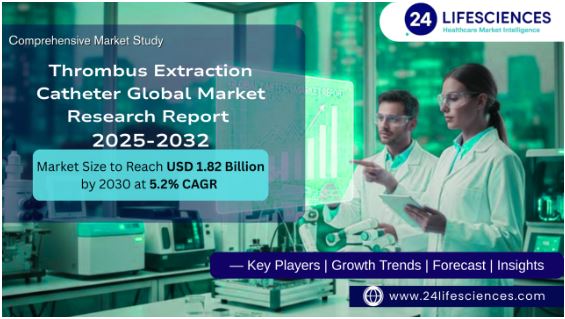
Thrombus Extraction Catheter Market is witnessing steady growth, with the global market valued at USD 1.53 billion in 2023, projected to reach USD 1.82 billion by 2030, reflecting a CAGR of 5.2% during the forecast period (2025–2032). Thrombus extraction catheters are essential medical devices used for the removal of blood clots in acute thrombotic conditions, including ischemic strokes, peripheral arterial disease, deep vein thrombosis, and coronary artery occlusions.
The rising prevalence of cardiovascular and cerebrovascular diseases, increasing incidence of ischemic stroke, growing awareness of minimally invasive therapies, and advanced catheter technologies are driving global demand. These devices are vital in hospitals, stroke centers, and specialized interventional clinics, offering rapid and safe clot removal to reduce morbidity and improve patient outcomes.
Explore the Report Overview – Free Sample Available https://www.24lifesciences.com/download-sample/5559/thrombus-extraction-catheter-market
Market Segmentation and Insights
The Thrombus Extraction Catheter Market is analyzed by type, application, and end-user:
By Type:
- Mechanical Thrombectomy Devices dominate the market, favored for precision clot removal in emergency stroke and coronary interventions. Their widespread adoption is due to proven efficacy, high success rates, and compatibility with existing catheterization lab setups.
- Suction Thrombectomy Devices provide effective clot aspiration and are preferred in peripheral and deep vein applications.
- Ultrasound Accelerated Thrombolysis Devices are emerging rapidly, offering reduced procedural times, enhanced safety, and improved outcomes in complex thrombectomy cases.
By Application:
- Ischemic Stroke represents the largest application segment, driven by the time-sensitive nature of intervention and the growing global burden of cerebrovascular diseases.
- Peripheral Arterial Disease, Deep Vein Thrombosis, and Coronary Artery Occlusions are showing steady growth, supported by advancements in interventional radiology and minimally invasive procedures.
By End User:
- Hospitals & Stroke Centers remain the primary end-users, equipped with 24/7 catheterization labs, neurological support, and acute care infrastructure.
- Ambulatory Surgical Centers are increasingly adopting thrombus extraction technologies for standardized, less complex procedures due to cost-efficiency and convenience.
- Specialty Clinics play a growing role in follow-up interventions and peripheral vascular care, expanding market accessibility.
Download the Full Report for Detailed Insights https://www.24lifesciences.com/thrombus-extraction-catheter-market-5559
Emerging Trends Shaping the Healthcare Market
The Thrombus Extraction Catheter Market is being influenced by several innovations and healthcare trends:
- Integration of AI and Robotics: Artificial intelligence supports precision navigation and automated clot detection, reducing procedural errors and enhancing outcomes.
- Minimally Invasive and Hybrid Procedures: Combining catheter-based thrombectomy with pharmacological therapy improves safety and reduces recovery times.
- Telehealth and Digital Monitoring: Remote patient monitoring enables timely identification of thrombotic events and supports pre- and post-procedure care.
- Sustainable Medical Device Development: Innovations in reusable components and eco-friendly materials are gaining traction within the medical device industry.
These trends are expected to further accelerate the adoption of thrombus extraction catheters through 2032.
Regional Analysis
North America leads the global market due to advanced healthcare infrastructure, early adoption of minimally invasive technologies, and high stroke prevalence. The U.S. accounts for a major share owing to robust interventional cardiology and neurology programs.
Europe is experiencing steady growth, supported by government healthcare initiatives, increasing geriatric populations, and widespread catheterization facilities. Germany, the U.K., and France are key markets.
Asia-Pacific is expected to register significant growth, driven by rising incidence of cardiovascular diseases, growing awareness of stroke management, and expanding hospital infrastructure in China, Japan, and India.
Rest of the World (Latin America, Middle East & Africa) demonstrates moderate growth, fueled by improving healthcare access and increased focus on stroke intervention programs.
Key Players & Competitive Landscape
- Medtronic Plc (Ireland)
- Penumbra Inc. (USA)
- Stryker Corporation (USA)
- Terumo Corporation (Japan)
Download the Full Report for Detailed Insights https://www.24lifesciences.com/thrombus-extraction-catheter-market-5559
Future Trends
The Thrombus Extraction Catheter Market is poised for steady growth, driven by rising incidence of thrombotic events, technological innovations, and increasing adoption of minimally invasive procedures. With a CAGR of 5.2%, the market will continue expanding across hospitals, stroke centers, and specialized clinics worldwide.
Manufacturers investing in AI-assisted navigation, ultrasound thrombolysis, and hybrid catheter systems are expected to capture significant market share. Growing awareness of early stroke intervention and expanding healthcare infrastructure in emerging regions will further drive global adoption
About 24lifesciences
Founded in 2017, 24LifeScience has emerged as a trusted research and analytics partner for organizations operating within the global life sciences and chemical industries. Our core mission is to provide intelligent, future-ready insights that help clients stay ahead in an increasingly complex and innovation-driven market
International: +1(332) 2424 294 | Asia: +91 9425150513 (Asia)
Website: www.24lifesciences.com
Follow us on LinkedIn: www.linkedin.com/company/lifesciences24