Definition
Passive radar, also known as passive coherent location (PCL), is an advanced sensing technology that detects and tracks targets by exploiting existing electromagnetic signals rather than emitting its own. Unlike traditional active radar systems that transmit radio waves, passive radar systems utilize “illuminators of opportunity,” such as commercial broadcast signals (FM radio, TV, cellular 4G/5G signals), Wi-Fi, and satellite communications.
Get Free Report Sample https://www.intelmarketresearch.com/download-free-sample/15661/passive-radar-market
This unique characteristic makes passive radar inherently stealthy, energy-efficient, cost-effective, and difficult to detect or jam. Because it does not transmit, it leaves no electromagnetic signature, significantly improving survivability in contested environments.
Thus, the passive radar market is a fast-evolving domain at the intersection of advanced signal processing, defense modernization, AI-enabled detection algorithms, and energy-efficient surveillance innovations.
Market Size
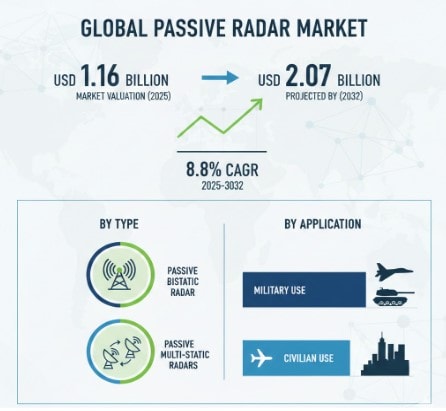
Global passive radar market was valued at USD 1.16 billion in 2025 and is forecasted to reach USD 2.07 billion by 2032, growing at a CAGR of 8.8%. This reflects a strong demand for covert surveillance systems that offer high performance with low operational cost.
Several factors contribute to this growth:
1. Rising Military Modernization Programs
Countries across North America, Europe, and Asia-Pacific are upgrading air-defense systems and integrating passive radar as a key element of layered surveillance architectures. Militaries prefer passive radar because it does not reveal its location, making it valuable for anti-stealth and anti-jamming operations.
2. Proliferation of UAVs and Low-Altitude Threats
The increasing use of drones—both commercial and military—has created demand for radar systems capable of detecting small and low-RCS (radar cross-section) objects. Passive radar, due to its unique sensing approach, effectively tracks slow, small, and low-flying targets.
5. Cross-Industry Adoption
Civil aviation authorities, homeland security agencies, smart-city surveillance projects, and infrastructure security firms are increasingly adopting passive radar for persistent, invisible monitoring operations.
Statistical Overview
- 2025 Market Size: USD 1.16 billion
- 2032 Market Projection: USD 2.07 billion
- CAGR: 8.8%
- Defense Sector Contribution: Approx. 70% of market revenue
- Fastest-Growing Application: UAV detection and counter-drone systems
- Key High-Growth Regions: Asia-Pacific and Europe
With increasing defense budgets and advancements in software-defined radars, signal processing, and artificial intelligence, the passive radar market is positioned for sustained expansion.
Regional Analysis
Global demand for passive radar systems varies significantly by region due to defense priorities, modernization budgets, geopolitical situations, and technological readiness.
North America
North America is one of the dominant markets, driven by major defense contractors and continuous military research. The U.S. is investing in non-emitting surveillance technologies to enhance air-defense networks and counter stealth aircraft. Integration of passive radar into multi-sensor defense systems is a rising trend.
Europe
Europe is another major hub, led by companies like Thales Group, Leonardo, Airbus, and BAE Systems. European countries, especially the U.K., Germany, Italy, and France, are strengthening early-warning systems in response to regional security challenges. The emphasis is on border monitoring and UAV detection solutions.
Asia-Pacific
Asia-Pacific is the fastest-growing region, supported by major defense upgrades in China, India, Japan, and South Korea. Rising geopolitical tensions and territorial disputes increase the demand for stealth surveillance systems. The region also witnesses strong investment in smart-city surveillance and coastal monitoring.
Middle East & Africa
The Middle East is investing heavily in passive radar for border control and UAV threat detection. Nations like Saudi Arabia and the UAE are adopting passive radar for both military and critical infrastructure protection. African adoption is slower but emerging through government modernization programs.
South America
South America shows moderate growth due to budget constraints but increasing concern over border security and illegal aerial activities such as smuggling and unauthorized UAV flights.
Competitor Analysis (in brief)
The passive radar landscape is dominated by major defense and aerospace technology providers. Competition is influenced by product performance, multi-platform integration, AI analytics, and advanced signal-processing capabilities.
Get Full Report Sample https://www.intelmarketresearch.com/passive-radar-market-15661
Key Competitive Strategies
- R&D investments into advanced algorithms and digital receivers
- Partnerships with defense ministries and government agencies
- Integration with command-and-control and multi-sensor surveillance networks
- Expansion into counter-UAV applications
- Focus on stealth detection and long-range tracking technologies
Major players include Leonardo S.p.A., Thales Group, Airbus SE, BAE Systems, Raytheon (RTX), Lockheed Martin, and L3Harris, each leveraging strong defense portfolios and global networks.
Global Passive Radar: Market Segmentation Analysis
This report provides a deep insight into the global Passive Radar, covering all its essential aspects. This ranges from a macro overview of the market to micro details of the market size, competitive landscape, development trend, niche market, key market drivers and challenges, SWOT analysis, value chain analysis, etc.
The analysis helps the reader to shape the competition within the industries and strategies for the competitive environment to enhance the potential profit. Furthermore, it provides a simple framework for evaluating and assessing the position of the business organization. The report structure also focuses on the competitive landscape of the Global Passive Radar. This report introduces in detail the market share, market performance, product situation, operation situation, etc., of the main players, which helps the readers in the industry to identify the main competitors and deeply understand the competition pattern of the market.
In a word, this report is a must-read for industry players, investors, researchers, consultants, business strategists, and all those who have any kind of stake or are planning to foray into the Passive Radar in any manner.
Market Segmentation (by Application)
- Defense Surveillance
- Border Security
- Air Traffic Management
- UAV Detection & Tracking
- Maritime Surveillance
- Critical Infrastructure Protection
- Homeland Security
Market Segmentation (by Type)
- Passive Coherent Location (PCL) Radar
- Passive Bistatic Radar
- Silent Radar Systems
- Multistatic Passive Radar
- Software-Defined Passive Radar
Key Company
- Leonardo S.p.A.
- Thales Group
- Airbus SE
- BAE Systems plc
- Raytheon Company (part of RTX)
- L3Harris Technologies, Inc.
- Lockheed Martin Corporation
- OMNIPOL a.s.
- Advanced Electronics Company (AEC)
- Ramet s.r.o.
Geographic Segmentation
North America
- Europe
- Asia-Pacific
- Middle East & Africa
- South America
FAQ Section
1. What is the current market size of the Passive Radar Market?
The global passive radar market is valued at USD 1.16 billion in 2025 and is projected to reach USD 2.07 billion by 2032.
2. Which are the key companies operating in the Passive Radar Market?
Major companies include Leonardo S.p.A., Thales Group, Airbus SE, BAE Systems, Raytheon (RTX), Lockheed Martin, L3Harris, OMNIPOL, AEC, and Ramet s.r.o.
3. What are the key growth drivers in the Passive Radar Market?
Growth is driven by increasing defense modernization, rising drone threats, expansion of 5G and commercial broadcast signals, demand for stealth surveillance, and cost-efficient radar systems.
4. Which regions dominate the Passive Radar Market?
North America and Europe currently lead, while Asia-Pacific is the fastest-growing region.
5. What are the emerging trends in the Passive Radar Market?
Key trends include AI-enhanced signal processing, integration with counter-UAV systems, multi-sensor surveillance platforms, and expansion into civilian air-traffic and smart-city monitoring applications.
Get Full Report Sample https://www.intelmarketresearch.com/passive-radar-market-15661
About Us
Intel Market Research is a leading provider of strategic intelligence, offering actionable insights in information technology, digital media solutions, and communication infrastructure. Our research capabilities include:
- Real-time competitive benchmarking
- Global technology adoption monitoring
- Country-specific regulatory and market analysis
- Over 500+ technology reports annually
Trusted by Fortune 500 companies, our insights empower decision-makers to drive innovation with confidence.
🌐 Website: https://www.intelmarketresearch.com
📞 International: +1 (332) 2424 294
📞 Asia-Pacific: +91 9169164321
🔗 LinkedIn: Follow Us