Introduction
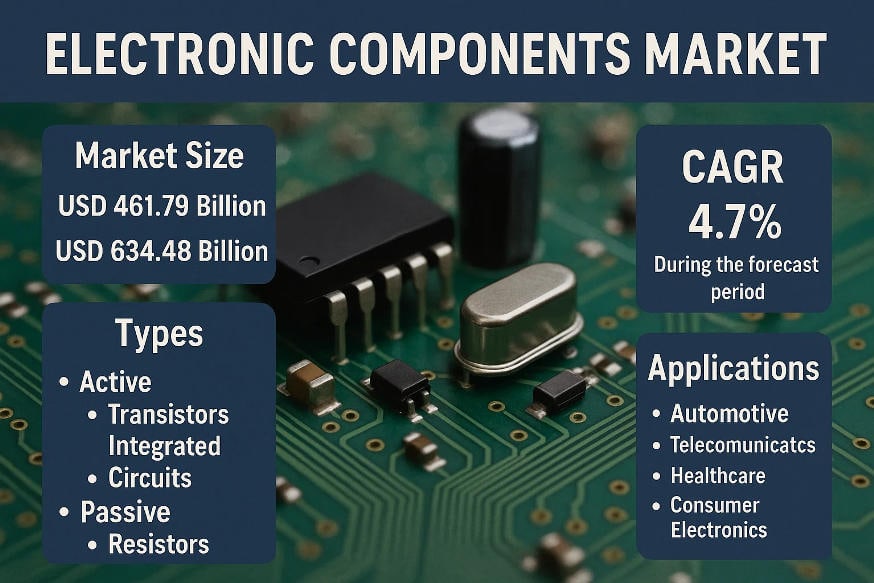
According to semiconductorinsight , the global electronic components market is projected to reach USD 634.48 billion by 2032, up from USD 461.79 billion in 2024, registering a CAGR of 4.7%. This growth underscores the pivotal role electronic components play across consumer electronics, industrial automation, automotive, and communication sectors. The semiconductor industry continues to redefine global innovation, with this market showing robust expansion and technological disruption.
Download Sample Report PDF https://semiconductorinsight.com/download-sample-report/?product_id=122741
Emerging Trends Shaping the Electronic Components Market
AI-Driven Chip Design: Artificial intelligence is transforming chip development cycles, enabling faster design verification and predictive maintenance for critical components. This innovation enhances performance and reduces time-to-market for semiconductor devices.
Advanced Lithography and EUV: Extreme ultraviolet (EUV) lithography allows for smaller, more efficient integrated circuits, directly supporting growth in high-performance computing and 5G infrastructure.
Rise of Compound Semiconductors: Materials like SiC (Silicon Carbide) and GaN (Gallium Nitride) are gaining traction, particularly in electric vehicles (EVs) and power electronics, due to their superior thermal efficiency and durability.
3D Packaging Innovations: Stacked die and 3D packaging techniques improve space utilization and reduce signal latency, which is critical for next-generation memory and processor applications.
Sustainability and Recycling Initiatives: Increasing focus on recycling rare metals and reducing energy consumption in fabrication aligns with global ESG goals while supporting long-term market resilience.
Key Market Drivers and Growth Factors
- EV and Renewable Energy Demand: Growth in electric vehicles drives the adoption of SiC and GaN semiconductors for power management systems.
- AI, 5G, and IoT Proliferation: Rapid deployment of AI servers, IoT devices, and 5G base stations fuels demand for high-performance electronic components.
- Industrial Automation Expansion: Factories worldwide are integrating smart sensors, actuators, and controllers, expanding the need for reliable electronic components.
- Consumer Electronics Upgrades: Smartphones, wearable tech, and AR/VR devices continue to require smaller, faster, and more efficient components.
Strategic Developments by Key Players
Leading companies are actively driving the market through R&D and strategic expansions:
- Texas Instruments Inc.: Expanding analog and embedded processing portfolios to support automotive and industrial growth.
- Murata Manufacturing Co., Ltd.: Investing in compact, high-frequency components for next-gen IoT and mobile devices.
- ABB Ltd.: Strengthening industrial automation solutions with integrated semiconductor devices.
- STMicroelectronics N.V.: Launching advanced power semiconductors and sensor solutions.
- NXP Semiconductors N.V.: Accelerating connected car and secure automotive component development.
- Kyocera Corporation: Enhancing ceramics and electronic packaging for high-reliability applications.
- Omron Corporation & Amphenol Corporation: Expanding sensor and interconnect solutions across industrial and automotive sectors.
- Infineon Technologies AG: Focusing on energy-efficient power semiconductors and cybersecurity-enabled components.
Our comprehensive report is ready with the latest trends, growth opportunities, and strategic analysis https://semiconductorinsight.com/report/electronic-components-market/
Segment Analysis: Who Leads the Market?
By Type: Passive components dominate due to high-volume demand in consumer electronics, while active components are growing rapidly in automotive and industrial automation.
By Application: Automotive, industrial automation, and telecommunications are top applications, with consumer electronics sustaining high growth in APAC.
By Region: Asia-Pacific leads, driven by Taiwan, South Korea, and Japan’s robust fabrication ecosystems. North America and Europe focus on innovation in high-performance and specialized components.
Technological Advancements Impacting Growth
Can AI-Driven Lithography Redefine Semiconductor Yield Rates? Advanced AI models are improving lithography accuracy, reducing defects, and enhancing chip yields.
Nanofabrication and Quantum Chip Development: Pushing the limits of Moore’s Law, nanofabrication enables ultra-compact chips for AI, HPC, and quantum computing applications.
Cleanroom Automation and Smart Manufacturing: Automated cleanroom solutions improve quality control and accelerate production cycles, crucial for high-reliability components.
Why This Report Matters
This market analysis provides actionable insights for investors, manufacturers, and technology strategists by offering:
- Market projections from 2024–2032
- Competitive intelligence and key player strategies
- Opportunities for innovation in semiconductor and electronic component sectors
- Segmentation insights to identify high-growth areas
Download Sample Report PDF https://semiconductorinsight.com/download-sample-report/?product_id=122741
Forward-Looking Insight
As the electronic components landscape evolves at unprecedented speed, companies must align innovation with sustainability, AI integration, and strategic foresight to maintain a competitive edge. Growth will increasingly favor players that combine technological excellence with agile market adaptation.