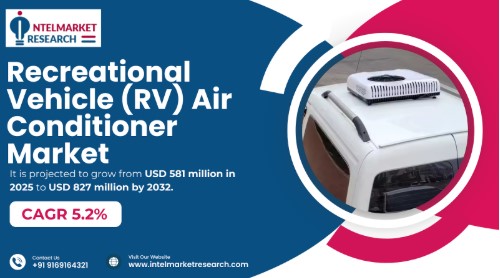
According to a new report from Intel Market Research, Global recreational vehicle (RV) air conditioner market is entering a period of steady expansion. Valued at USD 581 million in 2024, the market is projected to reach USD 827 million by 2032, reflecting a CAGR of 5.2%.
Get FREE Sample of this Report at https://www.intelmarketresearch.com/download-free-sample/12102/recreational-vehicle-air-conditioner-market
Recent Developments in the RV Air Conditioner Market
The RV air conditioner market is rapidly evolving, driven by the dual consumer demand for off-grid capability and smart technology. A major development is the aggressive focus on inverter-driven, variable-speed compressors coupled with specialized designs for solar-ready and low-power units, essential for the growing “boondocking” (off-grid camping) trend. These innovations offer significantly quieter operation and ultra-high energy efficiency, which is crucial for maximizing the limited power available from battery and solar systems on modern RVs. Concurrently, manufacturers are integrating Wi-Fi and Bluetooth connectivity, allowing users to remotely monitor and control the cooling settings via smartphone apps, enhancing convenience and aligning the RV experience with modern smart home expectations.
Rising adoption of customizable RVs, hybrid travel lifestyles, and sustained growth in outdoor tourism are reshaping expectations for cooling technology in mobile environments.
Emerging Market Trends
1. Rising Demand for Energy-Efficient and Low-Noise Systems
RV manufacturers are increasingly integrating lightweight, low-noise, and energy-efficient AC systems to meet consumer expectations for quieter cabins and reduced power consumption. This shift is especially evident in motorized RVs, where battery management and comfort are becoming decisive purchase factors.
2. Electrification and Hybrid RV Platforms
As hybrid and electric RV models gain traction, AC systems compatible with low-voltage platforms are becoming essential. Companies are focusing on inverters, DC-powered compressors, and smart cooling modules that optimize energy use without compromising cooling performance.
3. Smart Connectivity and Remote Monitoring
Wi-Fi and Bluetooth-enabled RV air conditioners are emerging as premium features, allowing users to regulate cabin temperatures via mobile apps. This reflects a broader shift toward connected outdoor experiences and integrated onboard electronics.
4. Expansion of Premium Adventure and Off-Grid Travel
The surge in off-grid and adventure-ready RVs is boosting demand for durable AC units capable of running on solar, auxiliary batteries, or portable generators. Manufacturers are responding with ruggedized units designed for varying climatic conditions.
5. OEM Customization and Aftermarket Growth
Customization continues to dominate the aftermarket landscape, with RV owners upgrading factory-installed ACs for higher airflow, faster cooling, and improved energy efficiency. This trend is strengthening competition among global suppliers.
Get the Complete Report & TOC at https://www.intelmarketresearch.com/automotive-and-transportation/12102/recreational-vehicle-air-conditioner-market
Key Market Drivers
Growing participation in road tourism, rising disposable incomes, and renewed interest in mobile living are key contributors to market expansion. In North America and Europe, the increasing popularity of RV rentals and subscription-based ownership models is accelerating AC unit replacement cycles. Technological adoption in compressor design, refrigerant efficiency, and digital controls is further supporting high-value aftermarket sales.
Sustainability measures in vehicle cooling systems especially the move toward lower-GWP refrigerants are influencing OEM procurement strategies. Meanwhile, rapid RV production growth in China and Australia continues to widen the global demand base.
Competitive Landscape: Leading Players
The market features a strong mix of multinational HVAC companies and specialized RV component manufacturers. Key players include:
- Dometic Group – Expanding its product range with energy-efficient rooftop and under-bench ACs tailored for motorhomes and caravans.
- Airxcel (Coleman-Mach) – Known for high-capacity rooftop units, the company continues investing in power-optimized models for larger RVs.
- Truma – Strengthening its footprint in lightweight, compact cooling systems ideal for towable RVs.
- Webasto Group – Integrating advanced climate-control technologies into RV and specialty vehicle segments.
- ASA Electronics (Advent) – Enhancing aftermarket presence with easy-installation AC units and digital control solutions.
- Furrion, Houghton, Gree Electric Appliances, RecPro, Telair International, KME Group, and Kaiman Refrigeration Equipment round out a competitive global field focused on performance optimization and region-specific product innovations.
Segment Analysis & Regional Outlook
By Type
- Top-Mounted Type: Dominates market share due to ease of installation and compatibility with most RV formats.
- Bottom Type: Gaining momentum in premium RVs requiring concealed climate systems.
- Others: Includes portable and customized systems targeting niche segments.
By Application
- Towable RVs: A significant revenue contributor as trailer-based travel remains popular in North America and Australia.
- Motorized RVs: Expected to grow rapidly as consumer preference shifts toward integrated mobile homes.
Get the Complete Report & TOC at https://www.intelmarketresearch.com/automotive-and-transportation/12102/recreational-vehicle-air-conditioner-market
Regional Overview
North America remains the most influential market, driven by a strong RV ownership culture and robust aftermarket activity. Europe continues to adopt compact RVs and eco-friendly cooling technologies, while Asia-Pacific is emerging as the fastest-growing region, supported by rising RV tourism in China, Japan, and Australia.
Technological Advancements & Strategic Insights
Can AI-Powered Controls Transform RV Cooling Systems?
Manufacturers are experimenting with AI-driven thermostats, adaptive cooling cycles, and predictive temperature management. These systems can analyze weather conditions, humidity, and power availability to optimize AC usage in real-time. Innovations in inverter technology and lightweight composite materials are also helping reduce fuel consumption and operational noise.
Key Benefits of the Report
- Comprehensive market insights covering 2024–2032
- Detailed segmentation by type, application, and region
- Benchmarking of key players and competitive strategies
- Strategic recommendations for investors, OEMs, and aftermarket suppliers
Expert Perspective
As the RV ecosystem evolves, demand for smart, sustainable, and energy-efficient cooling solutions continues to rise. Over the next decade, the integration of digital features, electrification-ready architectures, and adaptable cooling technologies is expected to shape competitive positioning across global markets.
Get the Complete Report & TOC at https://www.intelmarketresearch.com/automotive-and-transportation/12102/recreational-vehicle-air-conditioner-market
Call-to-Action
Gain access to detailed insights, data tables, and forecasts by exploring the complete report at Intel Market Research.
About Us
Intel Market Research is a leading provider of strategic intelligence, offering actionable insights in information technology, digital media solutions, and communication infrastructure. Our research capabilities include:
- Real-time competitive benchmarking
- Global technology adoption monitoring
- Country-specific regulatory and market analysis
- Over 500+ technology reports annually
Trusted by Fortune 500 companies, our insights empower decision-makers to drive innovation with confidence.
🌐 Website: https://www.intelmarketresearch.com
📞 International: +1 (332) 2424 294
📞 Asia-Pacific: +91 9169164321
🔗 LinkedIn: Follow Us