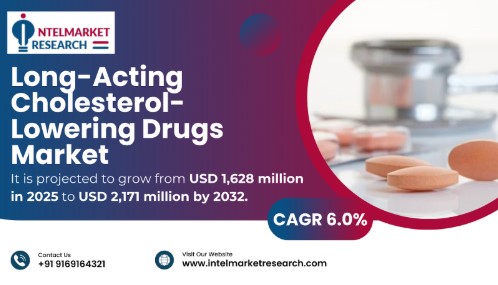
According to a new report from Intel Market Research, Global long-acting cholesterol-lowering drugs market Valued at USD 1,529 million in 2024, the sector is projected to reach USD 1,628 million in 2025 and ultimately climb to USD 2,171 million by 2032, reflecting a 6.0% CAGR throughout the forecast period.
Get FREE Sample of this Report at https://www.intelmarketresearch.com/download-free-sample/6618/long-acting-cholesterol-lowering-drugs-market
Recent Developments in the Long-Acting Cholesterol-Lowering Drugs Market
The long-acting cholesterol-lowering drug market is experiencing a profound shift away from daily oral pills toward highly effective, infrequent dosing regimens. The most significant development is the widespread adoption of Small Interfering RNA (siRNA) and Monoclonal Antibody (mAb) therapies, particularly those targeting the PCSK9 protein. For instance, the approval of the siRNA drug inclisiran has revolutionized the market by offering patients effective LDL cholesterol reduction with a biannual (twice-yearly) subcutaneous injection after the initial loading doses. This ultra-long-acting approach drastically improves patient adherence compared to daily medication, addressing a critical public health challenge and expanding the therapeutic options available for high-risk patients who struggle to reach target cholesterol levels on traditional oral statin therapy.
Driven by rapid innovation and evolving therapeutic needs across cardiology, diabetes care, and metabolic health, the market is undergoing a significant transformation in both product development and competitive strategy.
Emerging Market Trends
- Shift Toward Long-Acting and Combination Therapies
Pharmaceutical manufacturers are increasingly prioritizing long-acting formulations that improve adherence and reduce dosing frequency. This shift aligns with global healthcare strategies aimed at managing chronic diseases more efficiently, particularly among aging populations with polypharmacy burdens.
- Rise of PCSK9 Inhibitors and Novel Lipid-Modifying Technologies
PCSK9 inhibitors continue to gain traction as clinicians demand more potent and predictable LDL-C reduction options. The trend is supported by continuous advancements in monoclonal antibodies, small interfering RNA (siRNA) therapies, and gene-editing platforms under exploration by leading biotechnology firms.
- Expanding Applications Beyond Hyperlipidemia
While hyperlipidemia remains the core treatment segment, demand is increasing among patients with hypertension, diabetes, and multi-factor cardiovascular risks. This broadening application base is reshaping how healthcare providers approach long-term lipid management.
- Rapid R&D Activity Within the Asia-Pacific Biopharmaceutical Ecosystem
China and Australia are emerging as innovation hubs, leveraging advanced biologics manufacturing, accelerated clinical pathways, and expanding investor interest in metabolic disease therapeutics.
Key Market Drivers
Rising cardiovascular disease (CVD) prevalence is the primary driver accelerating market adoption. As LDL-C reduction remains central to global CVD management guidelines, healthcare systems are expanding access to high-efficacy lipid-lowering agents.
Another major driver is technological progress in biologics and genetic therapies. Clinical results from next-generation approaches including RNA-targeting and CRISPR-based LDL receptor modulation are generating strong commercial optimism among investors and healthcare providers.
Additionally, the rising economic burden of chronic disease management is encouraging broader adoption of long-acting therapies, which reduce hospitalizations, improve medication adherence, and enhance long-term outcomes.
Competitive Landscape: Leading Players
Global pharmaceutical leaders are investing heavily in cholesterol-lowering innovation, with strategies focused on biologics, gene editing, and extended-release formulations.
- Novartis AG continues to expand its cardiovascular portfolio through advanced lipid-lowering biologics and pipeline assets targeting long-term LDL reduction.
- Amgen Inc., a dominant force in PCSK9 inhibitors, maintains its competitive edge through continuous clinical expansion and strategic partnerships across digital therapeutics and AI-assisted cardiology tools.
- Sanofi is strengthening market share through broad geographic reach and optimized supply chain integration in North America and Europe.
- Verve Therapeutics is at the forefront of gene-editing therapies, advancing single-course treatments that aim to transform LDL-C control.
- Jiangsu Hengrui Pharmaceuticals, Innovent Biologics, and Junshi Biosciences are accelerating biologics innovation across the Asia-Pacific region, contributing to growing global competition.
- Akesobio Australia Pty Ltd continues to expand its monoclonal antibody pipeline, reflecting rising biopharmaceutical R&D momentum within Oceania.
Segment Analysis & Regional Outlook
By Type, the market is segmented into Statins, PCSK9 Inhibitors, Bile Acid Sequestrants, and Others. Long-acting statins remain widely prescribed due to broad clinical familiarity, but PCSK9 inhibitors represent the fastest-growing segment due to superior LDL-C lowering and emerging clinical endorsements.
By Application, Hyperlipidemia accounts for the largest share, while diabetes and hypertension segments are expanding steadily as cross-discipline cardiovascular risk management becomes standard practice.
Regional Outlook:
- North America leads in adoption due to strong insurer coverage and ongoing innovation in biologics.
- Europe follows with robust clinical guidelines and high patient awareness.
- Asia-Pacific is set to experience the fastest growth, driven by expanding patient pools, improved healthcare infrastructure, and rapid commercialization of novel biologics.
Technological Advancements & Strategic Insights
Can AI-Powered Analytics Reshape Future Market Forecasting?
AI-enabled drug discovery, digital risk assessment tools, and predictive analytics are influencing how companies design long-term cholesterol therapies. These technologies support faster clinical trial design, real-world evidence collection, and targeted patient engagement factors that will shape competitive advantage over the next decade.
Innovations in RNA-based drugs, gene-editing platforms, and precision cardiology are expected to redefine therapeutic pathways, positioning long-acting agents as critical components of future cardiovascular treatment frameworks.
Key Benefits of the Report
- Comprehensive revenue forecasts for 2024–2032
- Analysis of competitive positioning across major pharmaceutical companies
- Strategic insights into long-acting drug technologies
- In-depth coverage of type and application segments
- Regional growth mapping and investment opportunities
Expert Perspective
Global healthcare systems are entering a new era of cardiometabolic management, with long-acting cholesterol-lowering drugs poised to play a central role. As innovation accelerates across genetic therapies, biologics, and precision medicine, this market will continue to expand, driven by increasing CVD burdens and rising expectations for long-term outcomes.
Call-to-Action
Explore deeper insights, data tables, and strategic forecasts by accessing the complete analysis at Intel Market Research
About Us
Intel Market Research is a leading provider of strategic intelligence, offering actionable insights in information technology, digital media solutions, and communication infrastructure. Our research capabilities include:
- Real-time competitive benchmarking
- Global technology adoption monitoring
- Country-specific regulatory and market analysis
- Over 500+ technology reports annually
Trusted by Fortune 500 companies, our insights empower decision-makers to drive innovation with confidence.
🌐 Website: https://www.intelmarketresearch.com
📞 International: +1 (332) 2424 294
📞 Asia-Pacific: +91 9169164321
🔗 LinkedIn: Follow Us