Introduction
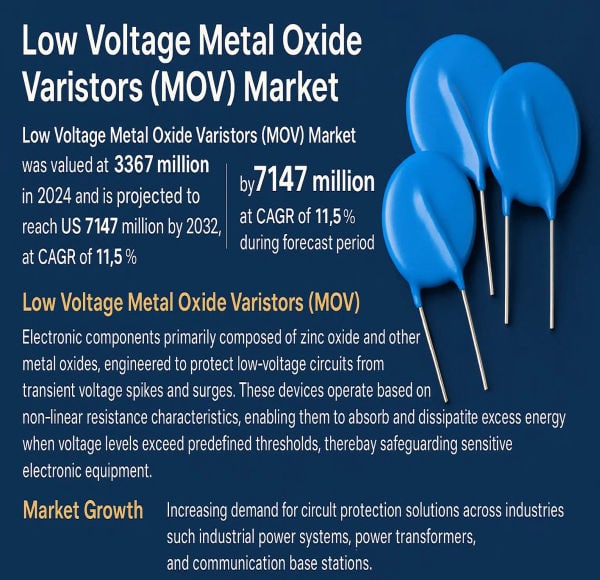
The low voltage Metal Oxide Varistors (MOV) market, valued at USD 3,367 million in 2024, is poised for rapid expansion — projected to reach USD 7,147 million by 2032 at a compound annual growth rate (CAGR) of 11.5%. This surge reflects growing demand for reliable surge suppression across consumer electronics, automotive electrification, and modernized power systems. The semiconductor industry continues to redefine global innovation, with this market showing robust expansion and technological disruption.
𝐃𝐨𝐰𝐧𝐥𝐨𝐚𝐝 𝐅𝐑𝐄𝐄 𝐒𝐚𝐦𝐩𝐥𝐞 𝐑𝐞𝐩𝐨𝐫𝐭: https://semiconductorinsight.com/download-sample-report/?product_id=117639
Emerging Trends Shaping the Market
- AI-driven chip design: Machine learning tools that optimize component layouts and failure prediction are accelerating the development of smaller, higher-performance electronics. For MOVs, AI-enabled design helps engineers specify varistor characteristics that better match transient profiles in EVs, inverters, and compact PCBs.
• Advanced lithography and EUV: Continued miniaturization of semiconductors increases component density on boards, elevating the need for compact, high-performance surge protection. Surface Mount Technology (SMT) MOVs benefit directly from these packaging advances by fitting into space-constrained assemblies.
• Rise of compound semiconductors (SiC, GaN): Power electronics built on SiC and GaN operate at higher voltages and switching speeds, creating new transient behaviors. MOVs must adapt in materials and response times to protect these next-generation power modules.
• 3D packaging innovations: Through-silicon vias and stacked die configurations concentrate thermal and electrical stress; reliable surge suppression at the board and module level becomes a critical reliability enabler.
• Sustainability and component circularity: As OEMs pursue greener supply chains, MOV manufacturers are under pressure to improve material sourcing, reduce waste in manufacturing, and support end-of-life recycling strategies for electronic assemblies.
Key Market Drivers and Growth Factors
- Rising demand for surge protection in electronic devices drives MOV adoption across consumer electronics and telecommunications.
• Infrastructure modernization and smart grid rollouts increase procurement of protection devices for monitoring and control equipment.
• Renewable energy integration — solar and wind deployments — boosts demand for MOVs in inverters, transformers, and energy storage systems.
• Automotive electrification requires robust protection for battery management, charging stations, and onboard power electronics.
• Miniaturization trends and the shift to SMT mounting types favor compact varistor designs compatible with automated assembly.
𝐆𝐞𝐭 𝐅𝐮𝐥𝐥 𝐑𝐞𝐩𝐨𝐫𝐭 𝐇𝐞𝐫𝐞: https://semiconductorinsight.com/report/low-voltage-metal-oxide-varistors-mov-market/
Strategic Developments by Key Players
Littelfuse, Inc.; TDK Electronics AG; Panasonic Corporation; KYOCERA AVX; Bourns, Inc.; Vishay Intertechnology Inc.; Eaton Corporation PLC; Nippon Chemi-Con Corporation; Guangdong Uchi Electronics; Dongguan Tianrui Electronics; INPAQ Technologies; Walsin Technology.
These companies are strengthening positions through diversified product portfolios, targeted R&D investments, and manufacturing scale. Multinational incumbents are leveraging global distribution networks and material science expertise, while regional manufacturers — especially in China and Taiwan — compete on cost and supply responsiveness, accelerating product availability for emerging markets.
Segment Analysis: Who Leads the Market?
By type: Surface Mount Technology (SMT) dominates as device miniaturization and automated assembly drive preference for compact varistors.
By application: Industrial power systems and power transformers account for the largest share, given wide use in grid and factory equipment.
By end user: Electronics manufacturing and energy & utilities lead demand, with telecommunications and automotive following closely.
By region: Asia-Pacific leads due to dense electronics fabrication ecosystems in Taiwan, South Korea, Japan, and China’s large manufacturing base; North America and Europe show strong uptake in renewables and EV infrastructure.
𝐃𝐨𝐰𝐧𝐥𝐨𝐚𝐝 𝐅𝐑𝐄𝐄 𝐒𝐚𝐦𝐩𝐥𝐞 𝐑𝐞𝐩𝐨𝐫𝐭: https://semiconductorinsight.com/download-sample-report/?product_id=117639
Technological Advancements Impacting Growth
Can AI-Driven Lithography Redefine Semiconductor Yield Rates? Advances in nanofabrication, cleanroom automation, and predictive analytics are improving device yields and enabling tighter tolerances. For MOVs, innovations in material chemistry (zinc oxide composites) and packaging allow faster clamp times and smaller footprints. Predictive maintenance tools powered by AI enable system-level surge risk assessment, shifting some demand from reactive replacement to proactive protection planning.
Why This Report Matters
This market report delivers actionable intelligence for stakeholders seeking clarity in a rapidly evolving protection-components space. It provides:
• Market estimations and forecasts from 2024–2032 (USD 3.367B → USD 7.147B; CAGR 11.5%).
• Competitive intelligence covering multinational leaders and nimble regional players.
• Segment-level analysis (type, application, end-user) to pinpoint where demand concentrates.
• Opportunity mapping for OEMs, distributors, and material suppliers anticipating growth in EVs, renewables, and smart grids.
𝐆𝐞𝐭 𝐅𝐮𝐥𝐥 𝐑𝐞𝐩𝐨𝐫𝐭 𝐇𝐞𝐫𝐞: https://semiconductorinsight.com/report/low-voltage-metal-oxide-varistors-mov-market/
Conclusion
As electronics proliferate and power ecosystems become more dynamic, MOVs will remain a fundamental if often invisible line of defense. Stakeholders must balance innovation in materials and packaging with sustainability and supply-chain resilience to capture the next wave of demand.
Contact Us:
🌐 Website: https://semiconductorinsight.com/
📞 International: +91 8087 99 2013
🔗 LinkedIn: Follow Us