Introduction
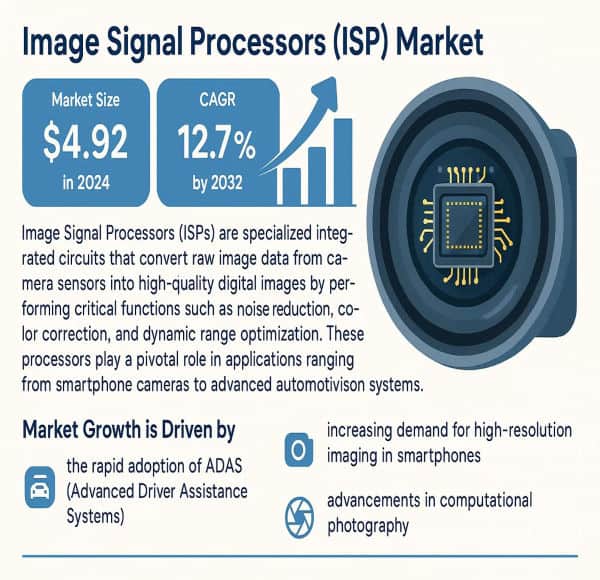
Image Signal Processors (ISPs) are set for pronounced growth, expanding from US$4.92 billion in 2024 to an estimated US$11.38 billion by 2032 at a 12.7% CAGR. Demand is accelerating across premium smartphones, automotive ADAS platforms, and AI-enabled surveillance systems, driving innovation in on-device intelligence and power efficiency. “The semiconductor industry continues to redefine global innovation, with this market showing robust expansion and technological disruption.
𝐃𝐨𝐰𝐧𝐥𝐨𝐚𝐝 𝐅𝐑𝐄𝐄 𝐒𝐚𝐦𝐩𝐥𝐞 𝐑𝐞𝐩𝐨𝐫𝐭: https://semiconductorinsight.com/download-sample-report/?product_id=107127
𝐆𝐞𝐭 𝐅𝐮𝐥𝐥 𝐑𝐞𝐩𝐨𝐫𝐭 𝐇𝐞𝐫𝐞: https://semiconductorinsight.com/report/image-signal-processors-isp-market/
Emerging Trends Shaping the Market
AI-driven chip design
Machine learning is now integral to silicon design, producing ISP cores that embed neural accelerators and optimize image pipelines for adaptive noise suppression, HDR fusion, and scene-aware tuning. This trend tightens the loop between sensor capabilities and perceived image quality.
3D packaging innovations
Heterogeneous integration and 3D packaging bring ISPs, NPUs, and high-bandwidth memory into compact system-on-chip assemblies, reducing latency and power while enabling richer computational photography and real-time analytics in constrained form factors.
Edge-native AI and NPUs
The migration of inference workloads to the edge is driving ISPs to include dedicated neural processing units for tasks like object detection and facial recognition. On-device AI minimizes bandwidth use and supports privacy-preserving analytics in cameras and vehicles.
Sustainability and recyclability
Manufacturers are optimizing energy-per-inference and selection of recyclable materials as production scales. Sustainability considerations are influencing node choices, packaging, and lifecycle strategies across the ISP supply chain.
Multi-exposure and computational fusion
Advanced fusion techniques—combining multiple sensor captures using AI—are improving low-light performance and dynamic range without compromising frame rates, a crucial requirement for consumer and automotive imaging.
Key Market Drivers and Growth Factors
- Surging smartphone camera complexity: Flagship devices with 50MP+ sensors and multi-lens arrays require sophisticated ISPs for computational photography and image fusion.
- Automotive ADAS and autonomy: Vehicles equipped with 6–12 cameras demand low-latency, automotive-grade ISPs validated to strict reliability standards.
- Proliferation of smart surveillance: 4K/8K deployments with edge analytics are creating demand for ISPs optimized for real-time video understanding.
- Edge computing and bandwidth constraints: On-device processing reduces reliance on cloud infrastructure, favoring integrated ISP+NPU solutions.
- Power efficiency and miniaturization: IoT and wearable camera modules require ultra-low-power ISP designs.
𝐆𝐞𝐭 𝐅𝐮𝐥𝐥 𝐑𝐞𝐩𝐨𝐫𝐭 𝐇𝐞𝐫𝐞: https://semiconductorinsight.com/report/image-signal-processors-isp-market/
Strategic Developments by Key Players
STMicroelectronics — Expanding automotive-focused ISP offerings and scaling collaborations with OEMs.
ON Semiconductor — Broadening edge imaging solutions to bridge industrial and security markets.
Arm Limited — Licensing ISP and neural IP to accelerate integration across SoC vendors.
Qualcomm — Embedding advanced ISP blocks in mobile SoCs to deliver flagship computational photography.
Samsung Electronics — Co-designing sensors and ISP stacks with camera module partners.
VeriSilicon & THine Electronics — Gaining share with specialized, low-power AI-capable ISP cores for mobile and IoT deployments.
These players are pursuing targeted R&D, partnerships, and product integrations to capture fast-growing verticals.
Segment Analysis: Who Leads the Market?
- By Application: Consumer electronics (smartphones, cameras) leads revenue, followed by automotive and security.
- By Type: Up to 10 MP ISPs dominate unit volumes in budget and embedded markets; >10 MP ISPs account for higher ASPs in premium devices.
- By Architecture: Integrated ISPs (SoC-integrated) outpace discrete solutions thanks to space, power, and cost efficiency.
- By Region: Asia-Pacific leads production and demand, driven by robust fabrication ecosystems in Taiwan, South Korea, China, and Japan.
𝐃𝐨𝐰𝐧𝐥𝐨𝐚𝐝 𝐅𝐑𝐄𝐄 𝐒𝐚𝐦𝐩𝐥𝐞 𝐑𝐞𝐩𝐨𝐫𝐭: https://semiconductorinsight.com/download-sample-report/?product_id=107127
Technological Advancements Impacting Growth
Can AI-driven lithography redefine yield rates? Emerging AI-assisted process control and nanofabrication techniques are tightening tolerances and improving yield, shortening design cycles for high-performance ISPs. Concurrently, on-chip NPUs are shifting value from raw sensor performance to perceptual-quality enhancements delivered through software-hardware co-design.
Why This Report Matters
This press-ready analysis delivers concise, actionable intelligence for product managers, investors, and OEMs navigating a market defined by fast-paced technical change. It provides market estimations for 2024–2032, competitive profiling, technology roadmaps, and opportunity mapping across automotive, consumer, and surveillance segments.
𝐆𝐞𝐭 𝐅𝐮𝐥𝐥 𝐑𝐞𝐩𝐨𝐫𝐭 𝐇𝐞𝐫𝐞: https://semiconductorinsight.com/report/image-signal-processors-isp-market/
Conclusion
As imaging and intelligence converge, ISPs are transitioning from single-purpose signal pipelines to adaptive, AI-first platforms. Companies that couple technological innovation with sustainability and system-level integration will lead market share gains in the coming decade.
Contact Us:
🌐 Website: https://semiconductorinsight.com/
📞 International: +91 8087 99 2013
🔗 LinkedIn: Follow Us