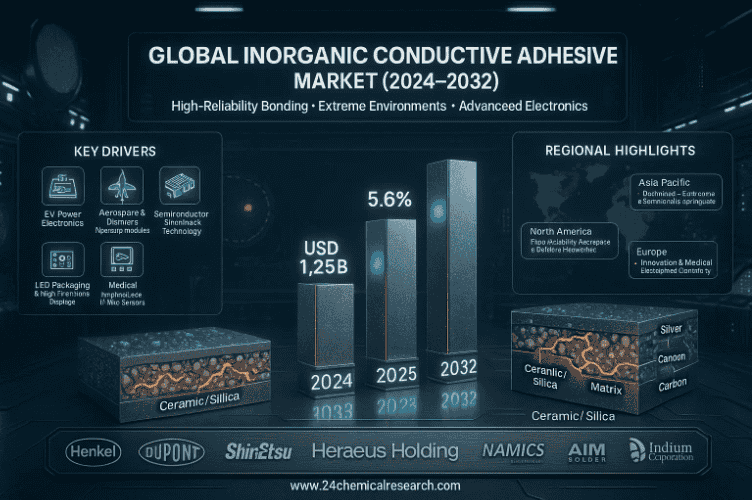
Global Inorganic Conductive Adhesive market is experiencing significant expansion, with its valuation reaching USD 1.18 billion in 2024. Industry analysis projects the market will grow from USD 1.25 billion in 2025 to USD 1.76 billion by 2032, exhibiting a CAGR of 5.6% during the forecast period. These advanced materials, featuring conductive fillers (silver, copper, carbon) in an inorganic matrix (silica, ceramic), provide critical electrical connectivity and robust mechanical bonding, excelling in high-temperature, high-humidity, and chemically aggressive environments where organic adhesives fail.
Inorganic Conductive Adhesive market occupies a high-performance niche within the broader electronics materials sector. Its superior reliability under extreme conditions makes it indispensable for mission-critical applications in aerospace, automotive, and advanced electronics, driving demand as technology pushes operational boundaries.
Download FREE Sample Report: https://www.24chemicalresearch.com/download-sample/265949/global-inorganic-conductive-adhesive-market-2024-2030-16
Market Overview & Regional Analysis
Asia-Pacific is the dominant manufacturing and consumption region, driven by the massive electronics production ecosystem, particularly for automotive electronics, consumer devices, and LED packaging in China, Japan, South Korea, and Taiwan. This leadership is anchored by proximity to end-use device assembly.
North America and Europe represent high-value, innovation-driven markets characterized by significant demand from the aerospace, defense, and medical device sectors, where reliability in extreme conditions is paramount. These regions are centers for R&D in next-generation formulations. South America and the Middle East & Africa show emerging but growing demand linked to industrialization and automotive sector growth.
Key Market Drivers and Opportunities
Increasing demand for high-reliability electronics in automotive (especially electric vehicles), aerospace, and defense applications is the primary consumption driver, as these sectors require stable electrical connections under thermal cycling, vibration, and harsh environmental exposure.
Growth in power electronics and wide-bandgap semiconductors (SiC, GaN) for EVs and renewable energy presents a significant demand vector, as these devices operate at higher temperatures, necessitating adhesives with superior thermal stability. Furthermore, expansion in LED packaging and display technologies, and development of new applications in medical implants and sensors operating in vivo create opportunities for specialized, biocompatible formulations.
Challenges & Restraints
High cost of materials, especially for silver-filled adhesives which are the performance leaders, poses a significant hurdle, limiting adoption to applications where the performance premium is justified and driving efforts in copper or carbon-based alternatives.
Complex processing requirements (e.g., high-temperature curing, precise dispensing) and brittleness compared to organic adhesives act as restraints, impacting manufacturing ease and requiring careful design for mechanical stress. Additionally, competition from advanced solders and sintered silver pastes in some high-power applications, and the technical complexity of formulating for specific properties present ongoing market challenges.
Market Segmentation by Filler Type
- Silver-Filled
- Copper-Filled
- Carbon/Graphene-Filled
- Other (Nickel, etc.)
Market Segmentation by Application
- Die Attach & Semiconductor Packaging
- Automotive Electronics
- Aerospace & Defense Electronics
- Medical Devices & Implants
- LED & Display Assembly
Market Segmentation by End-Use Industry
- Electronics & Semiconductor
- Automotive & Transportation
- Aerospace & Defense
- Healthcare
- Industrial
Download FREE Sample Report: https://www.24chemicalresearch.com/download-sample/265949/global-inorganic-conductive-adhesive-market-2024-2030-16
Competitive Landscape
The market features global specialty chemical and electronics material leaders:
- Henkel AG & Co. KGaA (Germany)
- DuPont de Nemours, Inc. (US)
- Shin-Etsu Chemical Co., Ltd. (Japan)
- Heraeus Holding GmbH (Germany)
- NAMICS Corporation (Japan)
- AIM Solder (US)
- Indium Corporation (US)
Report Scope
This analysis provides comprehensive coverage of the global Inorganic Conductive Adhesive market from 2024 to 2030, with projections to 2032, including:
- Market size estimations and detailed multi-year forecasts
- In-depth segmentation by filler type, application, end-use industry, and matrix chemistry
- Analysis of regional electronics and advanced manufacturing hubs, and sector-specific demand drivers
- Evaluation of key performance properties (conductivity, thermal stability, CTE), curing mechanisms, and dispensing technologies
- Competitive benchmarking of key players, their technology portfolios, and focus application areas
The research methodology incorporated analysis of trends in automotive electrification, aerospace modernization, and power electronics. Market dynamics were evaluated through the analysis of strong drivers from high-reliability sectors, promising opportunities in new technologies, and the significant cost and processing challenges that characterize this performance-driven market.
Get Full Report Here: https://www.24chemicalresearch.com/reports/265949/global-inorganic-conductive-adhesive-market-2024-2030-16
CONTACT US :
International: +1(332) 2424 294 | Asia: +91 9169162030
Website: https://www.24chemicalresearch.com/
Follow us on LinkedIn: https://www.linkedin.com/company/24chemicalresearch
SEE MORE SIMILAR REPORT :
Water based Printing Inks Market
United States Overflow Channel Gratings Market
Nuclear Grade Zirconium Market
Plastic Electronic Packaging Materials Market
Silicone Sealant Caulk Market