Introduction
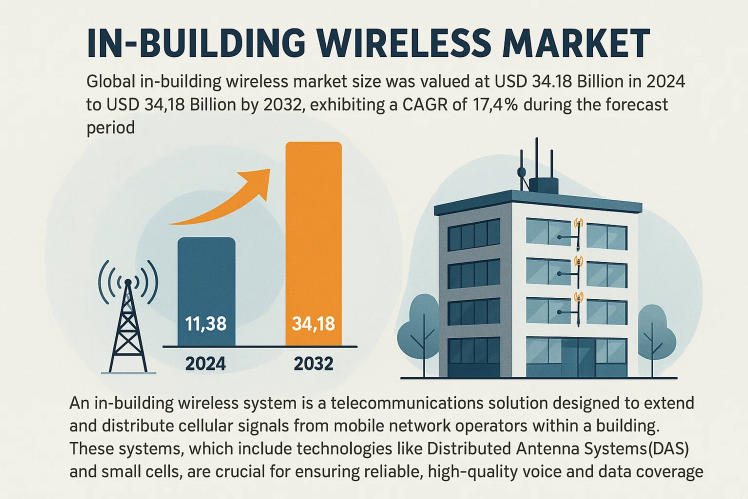
According to semiconductorinsight, the global In-Building Wireless Market is entering a phase of accelerated transformation, expanding from USD 11.38 billion in 2024 to USD 34.18 billion by 2032, supported by a powerful 17.4% CAGR. The semiconductor industry continues to redefine global innovation, with this market showing robust expansion and technological disruption. As enterprise networks grow more complex and indoor connectivity becomes indispensable, advanced wireless systems are rapidly reshaping how modern buildings operate.
Download Sample Report PDF https://semiconductorinsight.com/download-sample-report/?product_id=122774
Emerging Trends Shaping the Market
AI-Optimized Indoor Connectivity
Artificial intelligence is becoming central to capacity planning, signal optimization, and predictive maintenance within large indoor facilities. By enabling autonomous management of distributed antenna systems (DAS) and small-cell deployments, AI boosts performance and reduces downtime—driving stronger adoption across commercial and industrial buildings.
5G-Ready Architecture and Ultra-Dense Networks
The shift to 5G is pushing enterprises to upgrade legacy networks with solutions that support high-bandwidth, low-latency requirements. In-building wireless systems aligned with 5G standards are enabling seamless indoor mobility for IoT, AR/VR, and mission-critical operations, resulting in large-scale modernizations throughout corporate campuses and malls.
Next-Wave Neutral Host Models
A rising number of property owners are partnering with neutral host providers to deploy multi-carrier indoor coverage infrastructure. This model reduces upfront investment while delivering scalable connectivity for tenants—especially critical in airports, hospitals, and stadiums.
Energy-Efficient and Sustainable Network Design
Sustainability goals are driving the adoption of power-optimized amplifiers, low-emission radio units, and intelligent energy-management systems. The trend aligns with global carbon-reduction mandates and appeals to enterprises seeking green-certified building operations.
Hybrid Cloud-Based Network Management
Cloud-enabled orchestration tools are becoming standard for monitoring and configuring indoor wireless assets. These platforms centralize visibility across multiple buildings, making them vital for organizations pursuing unified digital infrastructure.
Key Market Drivers and Growth Factors
- Growing demand for seamless indoor 5G connectivity across high-density commercial environments
- Rapid expansion of IoT devices in smart buildings, manufacturing units, and logistics operations
- Surge in data consumption within offices, educational institutions, and public venues
- Rising need for mission-critical wireless systems in healthcare and emergency response facilities
- Increasing investment in digital transformation and modernization of large real-estate portfolios
Strategic Developments by Key Players
Industry leaders are stepping up innovation investments, collaborating with telecom operators, and expanding their indoor wireless portfolios:
- CommScope continues strengthening its DAS and small-cell solutions to support 5G enterprise deployments.
- Corning is advancing fiber-based in-building wireless solutions designed for high-capacity digital buildings.
- AT&T is accelerating neutral host partnerships while enhancing indoor 5G availability for enterprises.
- Ericsson is expanding radio solutions optimized for dense indoor traffic and private 5G use cases.
- Cobham is developing high-performance signal-enhancement technologies for secure indoor coverage.
- TE Connectivity is enhancing its connectivity components for more robust and scalable wireless architecture.
- Nokia (Alcatel-Lucent) is enabling 5G private wireless networks that gain strength from indoor small-cell deployments.
- Huawei is investing in next-generation indoor digital systems tailored for high-throughput 5G applications.
These players are shaping competitive dynamics through product innovation, strategic alliances, and modernization of indoor network frameworks.
Our comprehensive report is ready with the latest trends, growth opportunities, and strategic analysis https://semiconductorinsight.com/report/in-building-wireless-market/
Segment Analysis: Who Leads the Market?
The market spans multiple segments across technology, end-use, and deployment models:
- Technology Type: DAS continues to dominate due to its reliability in large environments, while small cells are gaining traction for cost-effective 5G rollouts.
- End-Use Application: Commercial buildings lead adoption, supported by rapid modernization of corporate offices, retail spaces, and hospitality venues.
- Regional Outlook: North America maintains a strong lead owing to advanced telecom infrastructure and early 5G rollouts. Europe follows with rising smart-building deployments, while Asia-Pacific is emerging as a high-growth hub driven by extensive urban development and expanding enterprise networks.
Technological Advancements Impacting Growth
Can AI-Driven Network Tuning Redefine Indoor Wireless Performance?
AI-enhanced tuning is now capable of analyzing real-time indoor traffic patterns, automatically adjusting power levels and handovers to create a more efficient wireless environment.
Automation, advanced RF planning tools, private 5G systems, and fiber-deep architectures are further elevating indoor wireless experiences. Innovations such as automated interference detection, digital twin modeling, and self-configuring small-cell systems are setting new benchmarks for indoor connectivity reliability.
For broader insights on wireless innovation, organizations can explore authoritative resources like IEEE for emerging standards.
Why This Report Matters
This market study empowers stakeholders with:
- Detailed market estimations covering 2024–2032
- Competitive intelligence on top wireless technology innovators
- Insight into high-growth opportunities across enterprise and commercial deployments
- Strategic foresight to plan investments in next-generation indoor connectivity
Combined, these insights equip decision-makers to navigate a fast-evolving wireless ecosystem with clarity.
Download Sample Report PDF https://semiconductorinsight.com/download-sample-report/?product_id=122774
Forward Momentum
As indoor connectivity becomes a core component of digital infrastructure, enterprises and network providers must align their strategies with emerging wireless technologies. The organizations that successfully integrate next-gen systems with sustainability and long-term scalability will lead the future of indoor communications.
Explore Related Outgoing Coverage in semicoductorinsight Domain
https://semiconductorinsight.com/report/dsp-development-board-and-kits-market/
https://semiconductorinsight.com/report/global-visible-light-metalens-market/
https://semiconductorinsight.com/report/global-integrated-gas-supply-system-market/
https://semiconductorinsight.com/report/head-mounted-display-hmd-market/
https://semiconductorinsight.com/report/sic-thermal-process-equipment-market/
https://semiconductorinsight.com/report/vacuum-wafer-chucks-market/