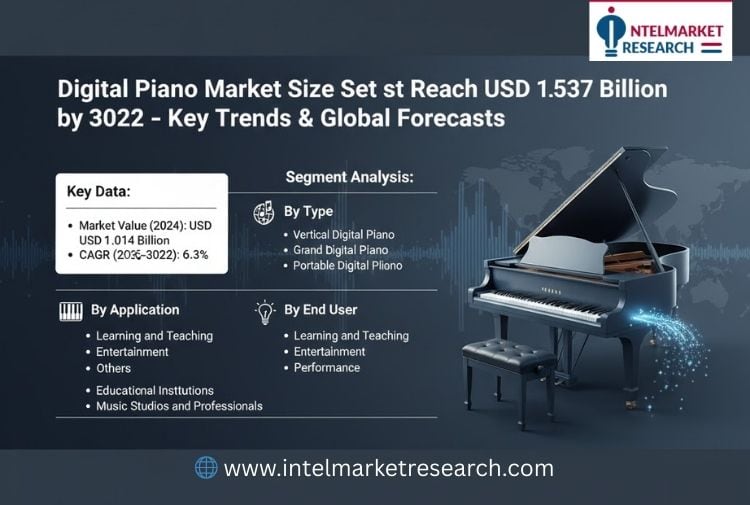
The global digital piano market is entering a period of steady expansion across major regions. According to new industry insights, the market was valued at USD 1.014 billion in 2024 and is expected to climb to USD 1.537 billion by 2032, reflecting a CAGR of 6.3% during the forecast period. The shift toward accessible music education, home-based entertainment, and advanced instrument technologies is reshaping demand dynamics across households, institutions, and professional studios.
Download Sample PDF:-https://www.intelmarketresearch.com/download-free-sample/13023/digital-piano-market
Emerging Market Trends Reshaping Global Demand
1. Growth of At-Home Music Learning
The surge in self-learning culture—intensified during and after the pandemic—is reshaping global consumption patterns. Easier access to online tutorials and structured digital learning platforms has broadened participation in music education, particularly among younger age groups and adult hobbyists. This trend continues to influence sales across both entry-level and mid-tier digital piano categories.
2. Advancements in Sound Sampling and Hybrid Models
Manufacturers are prioritizing highly accurate sound engines and weighted key systems. Multi-layer sound sampling, extended dynamic ranges, and hybrid acoustic-digital actions are enabling digital pianos to closely emulate premium grand pianos. These improvements are widening their appeal among trained musicians who previously favored acoustic instruments.
3. Integration with Smart Devices and Digital Studios
USB, Bluetooth MIDI, and app connectivity have become standard features as creators increasingly rely on mobile tools for production and practice. This integration supports the rise of the creator economy, where musicians produce high-quality content from home studios, shortening the distance between performer and audience.
4. Expanding Middle-Class Consumption in Asia-Pacific
Large population bases in India, China, and Southeast Asia are driving substantial new demand. Government-backed music education programs and rising disposable incomes are creating long-term opportunities for market penetration across schools, academies, and private learning centers.
Download Sample PDF:-https://www.intelmarketresearch.com/download-free-sample/13023/digital-piano-market
Key Market Drivers
The digital piano market continues to grow as consumers seek instruments that balance affordability, portability, and professional-grade features. Three major drivers stand out:
Music Education Momentum
Educational curricula in several regions are increasingly incorporating structured music programs. Consumption reached 906 thousand units in 2023, signaling strong participation across emerging economies. The growing emphasis on creative skills is expected to sustain market expansion throughout the next decade.
Technological Innovation
From multi-gigabyte sound libraries to AI-assisted learning systems, technological improvements are at the core of the market. Premium models now include realistic hammer actions, tactile key surfaces, sound modeling of historic concert pianos, and advanced acoustic projection technologies.
Home Entertainment & Lifestyle Shifts
As households invest more in personal development and leisure experiences, digital pianos have become a preferred instrument for home environments. Their space-saving design, silent practice modes, and minimal maintenance requirements make them attractive compared with acoustic alternatives.
Get Full Report:- https://www.intelmarketresearch.com/digital-piano-market-13023
Competitive Landscape: Leading Players
The global digital piano market remains moderately consolidated, with several long-established companies shaping product innovation, software ecosystems, and global distribution. Key players include:
- Yamaha
- CASIO
- KORG
- KAWAI
- Roland
- Guangzhou Pearl River Piano Group
- Samick
- Ringway Tech
- Clavia
- YOUNG CHANG
- Xinghai Piano Group
Yamaha, which held a 32.6% global market share in 2016, remains influential across all price segments. The company continues to expand its hybrid digital-acoustic series, integrate connected-learning platforms, and partner with education technology providers. CASIO, KORG, and Roland are focusing on portable models, professional synthesizer-grade engines, and stage performance systems to capture diverse consumer bases worldwide.
Segment Analysis & Regional Outlook
By Type
- Vertical Digital Piano
- Grand Digital Piano
- Portable Digital Piano
Portable and vertical models remain the bestselling categories due to their appeal among home learners and institutional buyers.
By Application
- Learning and Teaching
- Entertainment
- Performance
- Others
Educational applications continue to dominate volume shares, while performance-grade digital pianos are gaining steady traction among professionals seeking hybrid features.
By End User
- Households
- Educational Institutions
- Music Studios and Professionals
Households represent the fastest-growing end user segment, supported by digital literacy and increased demand for self-learning tools.
Regional Trends
North America
Strong consumer purchasing power and well-developed retail channels support stable growth across premium and mid-range models.
Europe
The region’s classical music heritage reinforces demand for high-fidelity and hybrid digital pianos suited for performance and practice.
Asia-Pacific
Expected to outpace all other regions in growth, driven by expanding middle-class demographics and rising spending on extracurricular learning.
Latin America, Middle East & Africa
These emerging markets show increasing adoption, fueled by urbanization and growing aspirational value associated with musical education and performance arts.
Technological Advancements & Strategic Insights
Can AI-Powered Learning Tools Reshape the Future of Digital Pianos?
AI-enabled feedback systems, smart learning modules, and connected apps are transforming how students progress in their musical training. By analyzing tempo, pressure, accuracy, and timing in real time, AI tools enhance learner engagement and reduce dependency on in-person lessons. These technological shifts are expected to accelerate adoption among beginners and redefine manufacturer strategies.
The interplay between hardware innovation and digital ecosystems music apps, recording platforms, and cloud-based sound libraries continues to create new business opportunities for manufacturers.
Key Benefits of Accessing the Full Report
- Comprehensive global and regional forecasts (2025–2032)
- Competitive benchmarking and market share insights
- Strategic recommendations for manufacturers and investors
- Trends in distribution channels and consumer purchasing patterns
- Detailed segmentation by type, application, end user, and geography
Download Sample PDF:-https://www.intelmarketresearch.com/download-free-sample/13023/digital-piano-market
Get Full Report:- https://www.intelmarketresearch.com/digital-piano-market-13023
About Intel Market Research
Intel Market Research is a leading provider of strategic intelligence, offering actionable insights in biotechnology, pharmaceuticals, and healthcare infrastructure. Our research capabilities include:
- Real-time competitive benchmarking
- Global clinical trial pipeline monitoring
- Country-specific regulatory and pricing analysis
- Over 500+ healthcare reports annually
Trusted by Fortune 500 companies, our insights empower decision-makers to drive innovation with confidence.
🌐 Website: https://www.intelmarketresearch.com
📞 International: +1 (332) 2424 294
📞 Asia-Pacific: +91 9169164321
🔗 LinkedIn: Follow Us