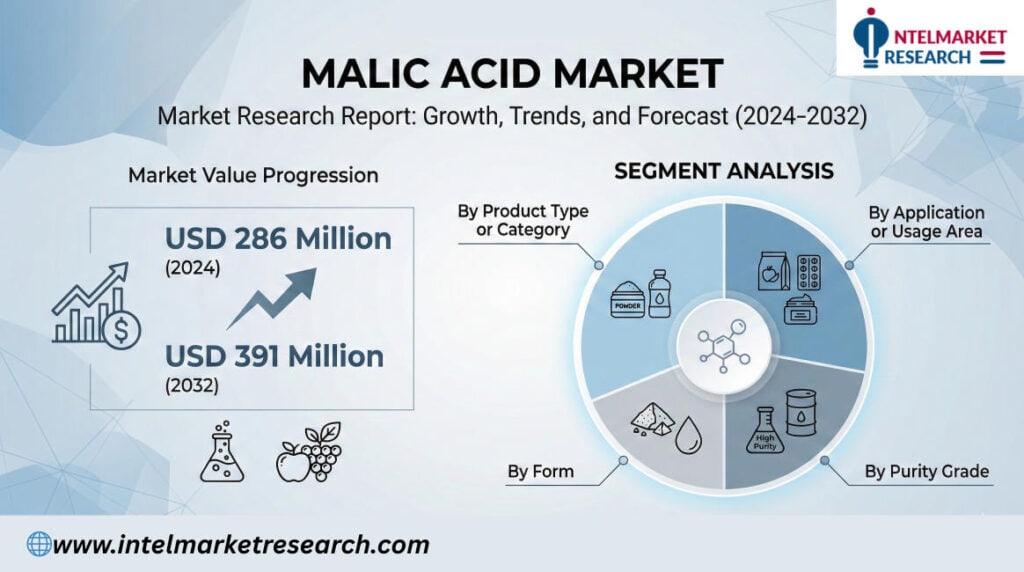
Driven by evolving product formulations and shifts in consumer tastes, the global Malic Acid market is undergoing measurable change. The latest industry assessment shows the market valued at USD 286 million in 2024, with projections indicating an increase to USD 391 million by 2032, expanding at a CAGR of 4.9% during 2025–2032.
Download FREE Sample Report (2025-2032 Forecasts Included):
https://www.intelmarketresearch.com/download-free-sample/12259/mali-c-acid-2025-2032-537
A key trend shaping this trajectory is the growing role of malic acid as both an acidity regulator and a flavor enhancer—particularly within processed foods and beverages. Its role in pharmaceutical tablet formulations adds another layer of demand, underscoring its versatile positioning across diverse industries.
Emerging Market Trends
The malic acid market is closely tied to evolving consumer preferences. One noticeable shift is the move toward tart-forward flavor profiles, particularly in flavored beverages, candy formulations, and functional drink concentrates. Producers are incorporating malic acid not only to achieve sharper, long-lasting sour notes but also to stabilize taste profiles at varying pH levels.
Awareness surrounding clean-label ingredients is also reshaping product formulations. Malic acid—widely associated with natural fruit-derived acidity—fits neatly into reformulation strategies aimed at replacing synthetic-tasting additives. While the majority of commercial malic acid is produced through chemical synthesis, its presence in fruits reinforces consumer acceptance, especially in bakery fillings, fruit concentrates, and liquid mixes.
Another noteworthy trend is incremental adoption within pharmaceutical manufacturing, particularly coated and effervescent tablets where pH stability is essential. As over-the-counter nutritional products gain traction, malic acid’s role as an excipient has become more pronounced.
Get Full Market Intelligence Report (Detailed 2024-2032 Analysis):
https://www.intelmarketresearch.com/mali-c-acid-market-12259
Key Market Drivers
Demand for malic acid remains anchored to the food and beverage sector, which currently accounts for roughly 75% of total usage. Whether in carbonated drinks, concentrated syrups, sour candies, or packaged foods, the need for flavor control and extended taste retention sustains long-term growth expectations.
The pharmaceutical segment adds additional momentum. Malic acid, functioning as both an acidifying agent and dispersion aid, enhances tablet disintegration properties. As drug formulations expand in emerging regions, this complementary demand is likely to reinforce market stability.
However, pricing dynamics for maleic anhydride—the primary feedstock—introduce cost-side challenges. Market participants continue to evaluate supply chain diversification as pricing fluctuations directly affect manufacturing economics. Regulatory complexities surrounding food additives also require ongoing compliance effort, particularly in fast-growing cross-border markets.
Competitive Landscape: Leading Players
Industry leadership is consolidated, with five organizations accounting for over 73% of global supply. The landscape is shaped by established production infrastructure and long-term commercial relationships.
Notable companies cited include:
- Fuso Chemical
- Bartek
- Isegen
- Polynt
- Thirumalai Chemicals
- Yongsan Chemicals
- Tate & Lyle
Recent strategies include capacity expansions to meet rising demand, exploration of more sustainable production pathways, and diversification into value-added applications such as personal care formulations. Continuous process optimization—particularly in terms of hydration efficiency and purification—remains an area of investment among market leaders.
Get Full Market Intelligence Report (Detailed 2024-2032 Analysis):
https://www.intelmarketresearch.com/mali-c-acid-market-12259
Segment Analysis & Regional Outlook
Type Breakdown:
The commercial market remains dominated by DL-Malic Acid, accounting for approximately 95% of total output, due to its cost efficiency and performance consistency across industrial applications. L-Malic Acid, derived naturally, retains niche applications related to high-purity functional foods.
Application Segmentation:
- Food & Drink – The commanding segment with widespread use in beverages, confectionery, and processed foods.
- Pharmaceutical – Growing as tablet manufacturers prioritize acidity regulators.
- Chemical Industry and Other Uses – Serve specialized needs in coatings, textile treatment, and pH stabilization.
Regional Overview:
China continues to influence global direction, holding a 24% share due to strong domestic capacity and downstream consumption. North America remains a mature and regulated market, while Europe benefits from well-established pharma and food industries. Asia-Pacific demonstrates the most promising growth outlook, driven by urbanization, evolving retail channels, and a shift toward packaged food consumption.
Technological Advancements & Strategic Insights
Increasing emphasis on yield optimization has accelerated improvements in catalytic hydration processes used to convert maleic acid. Enhanced purification technologies are further helping manufacturers meet strict food safety thresholds. The push toward environmentally aligned production is a growing strategic priority, particularly among large suppliers looking to differentiate long-term.
Can AI-Powered Analytics Reshape Future Applications?
While malic acid is a mature ingredient, forecasting models suggest that AI-supported formulation screening could accelerate development cycles within pharmaceuticals and new food blends. As product labs transition toward predictive modeling, malic acid may benefit from accelerated testing of stability and taste outcomes.
Key Benefits of the Report
The full analysis offers:
- Detailed global and regional forecasts (2025–2032)
- Supply chain evaluations and pricing trend assessments
- Comprehensive benchmarking of strategic positions
- Segmentation analysis by type, application, and geograph
Expert Perspective
As food and beverage portfolios diversify and pharmaceutical formulations evolve, the malic acid market is expected to maintain steady performance. The next decade is likely to see incremental shifts rather than abrupt disruption, driven by steady end-use demand, rising consumer acceptance of acidic flavoring agents, and gradual regulatory alignment. Growth will focus not on broad volume spikes but on regional demand maturity and operational efficiency gains.
Get Full Market Intelligence Report (Detailed 2024-2032 Analysis):
https://www.intelmarketresearch.com/mali-c-acid-market-12259
Call to Action
Access the full analysis, including detailed tables, charts, competitive assessments, and region-by-region forecasts, at Intel Market Research .
About Us
Intel Market Research is a leading provider of strategic intelligence, offering actionable insights in information technology, digital media solutions, and communication infrastructure. Our research capabilities include:
- Real-time competitive benchmarking
- Global technology adoption monitoring
- Country-specific regulatory and market analysis
- Over 500+ technology reports annually
Trusted by Fortune 500 companies, our insights empower decision-makers to drive innovation with confidence.
🌐 Website: https://www.intelmarketresearch.com
📞 International: +1 (332) 2424 294
📞 Asia-Pacific: +91 9169164321
🔗 LinkedIn: Follow Us