Introduction
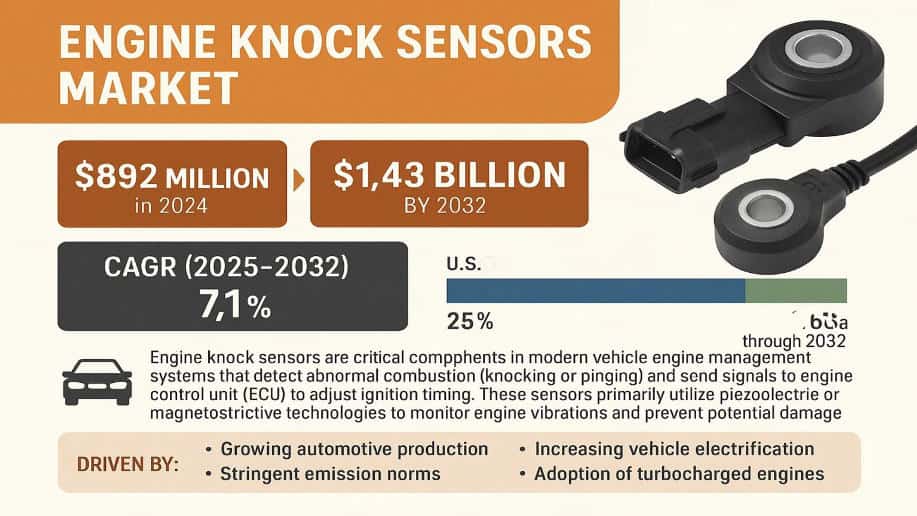
According to semiconductorinsight, the Engine Knock Sensors Market is on a growth trajectory, valued at USD 892 million in 2024 and projected to reach USD 1.43 billion by 2032, expanding at a CAGR of 7.1%. These sensors play a pivotal role in automotive performance, enhancing engine efficiency, reducing emissions, and supporting next-generation powertrains. The semiconductor industry continues to redefine global innovation, with this market showing robust expansion and technological disruption.
Download Sample Report PDF https://semiconductorinsight.com/download-sample-report/?product_id=107120
Emerging Trends Shaping the Engine Knock Sensors Market
AI-Assisted Engine Diagnostics
Artificial intelligence integration in automotive systems enables sensors to detect engine knock patterns more accurately, minimizing misfires and optimizing combustion efficiency.
Advanced Sensor Miniaturization
Miniaturized knock sensors allow for more compact engine designs, reducing weight and improving fuel economy. This trend aligns with global efforts toward lightweight, energy-efficient vehicles.
Integration with Hybrid and EV Powertrains
As hybrid and electric vehicles proliferate, engine knock sensors are being adapted for complex combustion systems, ensuring seamless performance in multi-powertrain architectures.
Enhanced Durability and Material Innovation
New piezoelectric materials and robust designs extend sensor lifespan, supporting the increasing longevity demands of modern engines and reducing maintenance costs.
Key Market Drivers and Growth Factors
- Rising Automotive Production: Growing vehicle sales, particularly in Asia-Pacific, drive sensor adoption.
- Stringent Emission Regulations: Knock sensors help optimize fuel combustion, aligning with stricter global emission standards.
- Demand for Fuel Efficiency: Automakers increasingly deploy advanced sensors to enhance engine efficiency and reduce fuel consumption.
- Technological Upgrades in Engine Management Systems: Modern engines rely on precise knock detection for optimal performance and reduced noise.
Strategic Developments by Key Players
Major players are actively innovating and expanding to maintain competitive positioning:
- Bosch Mobility Solutions (Germany): Focused on R&D for high-precision sensors for hybrid engines.
- Continental AG (Germany): Launched new sensor lines compatible with both conventional and electrified powertrains.
- Hitachi Astemo (Japan): Expanding production capacity to meet growing automotive demand.
- Hella GmbH (Germany): Investing in advanced piezoelectric technologies for improved sensor durability.
- NGK Spark Plugs (Japan): Diversifying product portfolio to cater to emerging hybrid vehicles.
- Delphi Technologies (UK): Partnering with OEMs for integrated engine management solutions.
- Standard Motor Products, Inc. (U.S.): Strengthening distribution networks across North America and Asia-Pacific.
Segment Analysis: Who Leads the Market?
- By Application: Passenger vehicles dominate due to widespread adoption and stringent emission regulations. Commercial vehicles are also increasing sensor integration to enhance engine reliability.
- By Type: Piezoelectric knock sensors remain the most widely deployed due to high sensitivity and durability.
- By Region: Asia-Pacific leads the market, driven by robust automotive manufacturing ecosystems in Japan, South Korea, and China. North America and Europe follow closely, fueled by advanced engine technology adoption.
Technological Advancements Impacting Growth
Can AI-Driven Sensor Calibration Redefine Engine Efficiency?
AI-driven calibration tools are reducing tuning time, enabling sensors to adapt dynamically to engine load, temperature, and fuel type.
Nanomaterial Coatings for Longevity
Innovative nanocoatings improve thermal resistance and corrosion protection, extending sensor life in extreme engine environments.
Integration with Vehicle ECUs
Advanced communication with electronic control units (ECUs) allows real-time knock monitoring, enhancing performance and predictive maintenance.
Why This Report Matters
This market analysis provides actionable insights for industry stakeholders by offering:
- Market estimations and growth forecasts from 2024 to 2032
- Competitive intelligence on key players and strategic movements
- Opportunity mapping for OEMs, Tier-1 suppliers, and aftermarket providers
- Identification of emerging trends and technological disruptions shaping the future of engine knock sensors
Download Sample Report PDF https://semiconductorinsight.com/download-sample-report/?product_id=107120
Forward Insight
As the automotive and semiconductor landscapes evolve at record speed, stakeholders must align sensor innovation with sustainability and strategic foresight to remain competitive in a rapidly shifting market.
Explore Related Outgoing Coverage in semicoductorinsight Domain
https://semiconductorinsight.com/report/glass-substrate-for-mems-market/
https://semiconductorinsight.com/report/mems-mechanics-sensor-market/
https://semiconductorinsight.com/report/doubly-bent-graphite-monochromators-market/
https://semiconductorinsight.com/report/rf-soi-switches-market/
https://semiconductorinsight.com/report/low-capacitance-diodes-for-esd-protection-market/
https://semiconductorinsight.com/report/global-large-size-panel-display-driver-ic-market/
https://semiconductorinsight.com/report/passive-wireless-temperature-sensor-market/