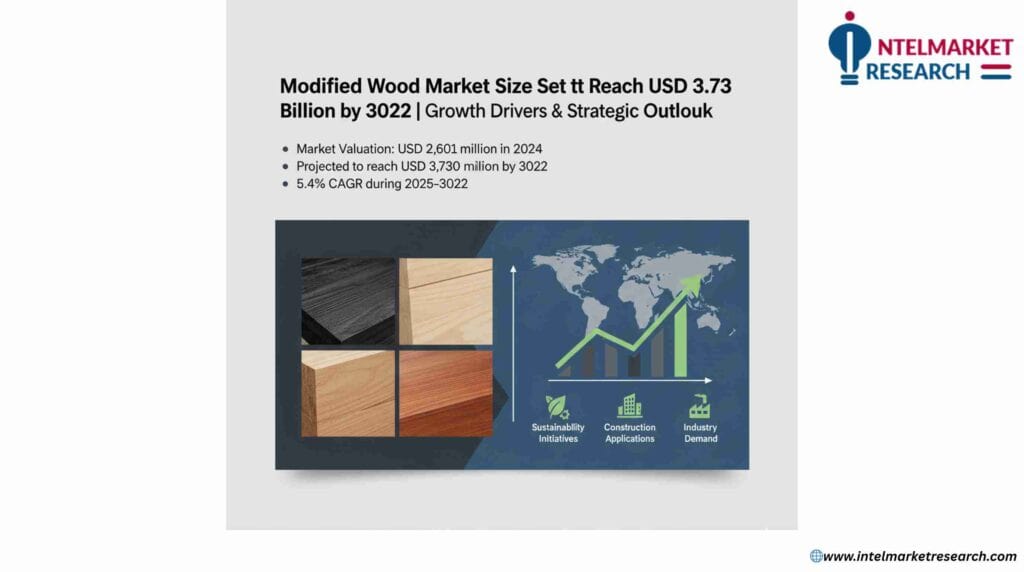
Driven by sustainability priorities and rising construction demand, the global modified wood market is undergoing significant transformation across both developed and emerging regions. Valued at USD 2,601 million in 2024, the market is projected to reach USD 3,730 million by 2032, advancing at a 5.4% CAGR during 2025–2032. Modified wood offers enhanced durability and moisture resistance — qualities increasingly sought after in interior and exterior building projects, as architects, builders, and homeowners favor low-maintenance, long-lasting, and environmentally responsible materials.
Download FREE Sample Report:https://www.intelmarketresearch.com/download-free-sample/12574/modified-wood-2025-2032-778
Emerging Market Trends
One dominant trend reshaping the market is sustainability-driven innovation. Modified wood uses fast-growing timber species, reducing strain on natural forests while offering performance levels comparable to higher-cost hardwoods. This positions modified wood as a viable alternative to tropical hardwoods in decking, siding, and façade applications.
Aesthetic appeal is becoming a central market catalyst. Thermally modified wood delivers deeper hues and improved surface stability without synthetic coatings, attracting premium interior applications, including architectural cladding and decorative paneling.
Growing acceptance of thermally modified wood across North America and Europe reflects a shift toward low-toxicity materials. These products avoid chemical preservatives, aligning with an era of stricter regulatory standards and greener building codes.
Finally, product development is moving toward hybrid treatments combining thermal and chemical processes. These innovations target extreme outdoor environments, opening new markets in infrastructure, marine wood structures, and public outdoor installations.
Get Full Report Here:https://www.intelmarketresearch.com/modified-wood-market-12574
Key Market Drivers
Rising construction activity in North America, Europe, and Asia-Pacific underpins long-term demand. As commercial buildings, residential complexes, and urban infrastructure projects expand, modified wood increasingly serves as a preferred solution due to its dimensional stability and resistance to decay.
Durability is another major driver. Traditional woods face challenges in humid, coastal, and high-rainfall climates. Modified wood provides longer service life, lower maintenance costs, and better resistance to insects and rot — key attributes for decking, siding, and fencing markets.
Sustainability mandates and growing consumer awareness are further propelling adoption. Modified wood is biodegradable, lower in emissions during manufacturing, and requires less energy compared to many composite substitutes. This gives it a competitive edge in regions with aggressive green-building standards.
Additionally, architectural trends favor natural, high-end finishes. In luxury housing, resorts, and commercial spaces, modified wood is rapidly replacing synthetic options due to its premium appearance and lifecycle performance benefits.
Competitive Landscape: Leading Industry Companies
The market is moderately concentrated, with approximately half of the total revenue controlled by major producers. Thermory AS remains a leading force in thermally modified wood, particularly across Europe, with a strong footprint in architectural applications. Hoover Treated Wood Products maintains a substantial presence in treated wood solutions for outdoor construction and utility segments.
Lonza Group and Foreco continue to expand research within chemical modification technologies, while Koppers Inc. and Flameproof Companies focus on specialized durability and fire-retardant properties. Arbor Wood Co., Viance, Sunset Molding, and NFP drive innovation through regionally tailored product lines and specialty distribution.
These companies collectively invest in refining processing methods, improving supply chains, and broadening application scopes from residential renovation to public infrastructure projects.
Get Full Report Here:https://www.intelmarketresearch.com/modified-wood-market-12574
Segment Analysis & Regional Outlook
Exterior applications account for the larger share of global consumption due to the volume of decking, siding, landscaping elements, and fencing. Modified wood’s superior resistance to moisture and dimensional shifts gives it a strong advantage over untreated lumber.
Interior applications, including wall panels, flooring, and ceiling systems, are also expanding at a steady pace. Higher aesthetic expectations in commercial and residential designs support this growth.
Regionally, North America leads the market with more than 55% share, supported by robust construction pipelines, sustainability-focused building norms, and strong distribution channels. Europe ranks second, marked by uptake in Nordic countries, Germany, and France, driven by energy-efficient building systems and architectural preferences.
Asia-Pacific stands out as the fastest-growing region, as urbanization and infrastructure investments accelerate across China, Japan, and Southeast Asia. Growing emphasis on eco-conscious building materials positions modified wood for broader adoption throughout these emerging markets.
Technological Advancements & Strategic Insights
Advanced processing techniques are key to lowering costs and improving performance consistency. Innovations in thermal treatment have yielded measurable gains in dimensional stability, water resistance, and color retention. Chemical modification methods continue to evolve, enabling fire-retardant applications and expanding use in industrial environments.
Can Innovation in Treatment Technologies Expand the Range of Modified Wood Applications?
The probable answer is yes. Hybrid modification methods are being explored to serve specialized construction needs, marine structures, transport flooring, and railway infrastructure.
Key Benefits for Decision-Makers
The current market outlook provides clarity on:
• Regional demand patterns and investment hotspots through 2032
• Competitive positioning among leading producers
• Opportunities tied to sustainability mandates and cost-efficient construction
• Application-level potential in both residential and commercial sectors
Industry Perspective
With sustainability goals increasingly embedded in construction standards, the modified wood market is poised for steady expansion. Performance improvements, technological innovations, and shifting design preferences signal an environment where modified wood will continue to gain traction globally. As supply chains mature and hybrid treatment capabilities grow, the medium-term outlook points toward broader market penetration and diversified application possibilities.
Organizations and industry professionals seeking deeper application benchmarks, segment profiles, and regional revenue forecasts can explore comprehensive insights at Intel Market Research. External sources such as Statista also offer supplementary data on global construction material trends
.Get Full Report Here:https://www.intelmarketresearch.com/modified-wood-market-12574
Call-to-Action
Explore the full study — including detailed segment breakdowns, strategic insights, and revenue projections — at Intel Market Research. For additional industry statistics and market benchmarking, refer to reputable global databases such as Statista.
About Intel Market Research
Intel Market Research is a leading provider of strategic intelligence, offering actionable insights in biotechnology, pharmaceuticals, and healthcare infrastructure. Our research capabilities include:
- Real-time competitive benchmarking
- Global clinical trial pipeline monitoring
- Country-specific regulatory and pricing analysis
- Over 500+ healthcare reports annually
Trusted by Fortune 500 companies, our insights empower decision-makers to drive innovation with confidence.
🌐 Website: https://www.intelmarketresearch.com
📞 International: +1 (332) 2424 294
📞 Asia-Pacific: +91 9169164321
🔗 LinkedIn: Follow Us