Phenylketonuria (PKU) Market Poised for Strong Growth as Global Demand for Advanced Therapies Accelerates Through 2032
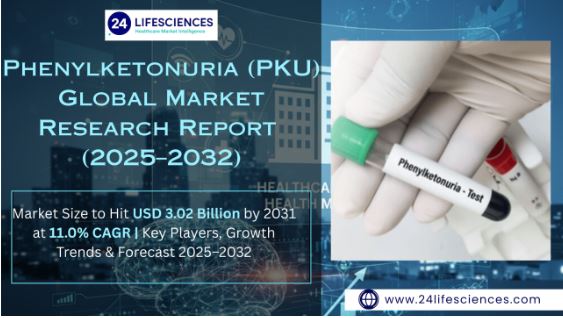
Phenylketonuria (PKU) market, valued at USD 1,477 million in 2024, is projected to grow to USD 1,640 million in 2025 and further expand to USD 3,024 million by 2031, registering a robust CAGR of 11.0% during the forecast period. This significant growth reflects rising awareness of metabolic disorders, advancements in nutritional and pharmacological therapies, and increasing global adoption of newborn screening programs.
PKU, a rare inherited metabolic disorder, remains a critical focus within precision nutrition, metabolic therapy innovation, and pediatric care. With evolving treatment approaches such as enzyme substitution, medical nutrition, gene-targeted therapies, and personalized diet management, the market is undergoing transformative expansion across both developed and emerging economies.
Access a Complimentary Sample Report https://www.24lifesciences.com/download-sample/6724/phenylketonuria-pku-market
Market Highlights: Segmentation Analysis
By Type
- Medications
- Supplements
- Others
Medication-based therapies are gaining traction due to the development of enzyme substitutes and potential gene-modulating pathways. Meanwhile, supplements and metabolic formulae remain essential for long-term dietary management.
By Application
- Household
- Hospital
The household segment represents a rapidly growing application category, supported by increasing availability of medical nutrition products and telehealth-enabled dietary monitoring.
By End User
- Pediatric Patients
- Adult Patients
- Pregnant Women
Pediatric patients remain the core demographic, driven by stringent early screening requirements and lifelong therapeutic needs. However, the adult patient segment is expanding as diagnosis rates improve globally.
By Distribution Channel
- Hospital Pharmacies
- Retail Pharmacies
- Online Pharmacies
Hospital pharmacies continue to dominate due to their role in specialized metabolic care, while online pharmacies show accelerating adoption with the rise of digital health and direct-to-home delivery models.
By Treatment Approach
- Dietary Management
- Pharmacological Therapy
- Combination Therapy
Dietary management remains fundamental, but pharmacological therapy is witnessing rapid advancements through enzyme-based treatments. Combination therapy is emerging as a preferred approach for long-term metabolic stability.
Access the Full Report Here https://www.24lifesciences.com/phenylketonuria-pku-market-6724
Emerging Trends Shaping the Healthcare Market
The PKU market is evolving alongside cutting-edge innovations in healthcare. Artificial intelligence, digital health platforms, and precision nutrition analytics are reshaping how metabolic disorders are monitored and managed. AI-enabled diet tracking, advanced metabolic monitoring devices, and personalized nutritional algorithms are helping improve patient adherence and outcomes. These technologies are expected to significantly strengthen PKU treatment efficiency and market expansion through 2032.
Regional Analysis: Global Market Outlook
North America
North America leads the PKU market, driven by strong diagnostic infrastructure, advanced metabolic clinics, and early adoption of innovative therapies. High awareness among pediatricians, genetic counselors, and specialized nutritionists contributes to sustained growth.
Europe
Europe holds a substantial market share backed by universal newborn screening protocols and well-established reimbursement ecosystems. Countries such as Germany, the UK, and the Netherlands continue to lead in R&D investment and clinical innovation.
Asia-Pacific
APAC is emerging as the fastest-growing region due to rising healthcare expenditure, increasing PKU diagnosis rates, and expanded access to medical nutrition products. Growing awareness in India, China, and Southeast Asia is expected to elevate regional market penetration.
Latin America & Middle East
These regions exhibit increasing adoption of PKU therapies driven by gradual improvements in screening systems, growth in pediatric healthcare, and increasing availability of imported metabolic formulas.
Key Players & Competitive Landscape
Major companies operating in the global Phenylketonuria (PKU) market include:
- BioMarin Pharmaceutical Inc.
- Mead Johnson Nutrition (Reckitt Benckiser)
- Abbott Laboratories
- Dr. Schär AG
- Nutricia (Danone S.A.)
- Vitaflo International Ltd. (Nestlé Health Science)
- Cambrooke Therapeutics, Inc.
- PKU Perspectives
- Applied Nutrition Corporation
- Solace Nutrition
- MetaX
- PAM enzyme developers (various biotech firms)
Access the Full Report Here https://www.24lifesciences.com/phenylketonuria-pku-market-6724
Growth Prospects
The Phenylketonuria (PKU) market is expected to exhibit strong growth through 2032, driven by sustained innovations in metabolic therapy, wider adoption of newborn screening programs, and rising demand for specialty nutrition solutions. With advancements in gene-based approaches and enzyme-targeting therapeutics, the market is poised for a significant shift toward more effective, patient-centric treatment paradigms. As stakeholders continue to focus on R&D and global access, the PKU market is set to achieve new milestones in both clinical outcomes and commercial expansion.
Explore our related reports
About 24lifesciences
Founded in 2017, 24LifeScience has emerged as a trusted research and analytics partner for organizations operating within the global life sciences and chemical industries. Our core mission is to provide intelligent, future-ready insights that help clients stay ahead in an increasingly complex and innovation-driven market
International: +1(332) 2424 294 | Asia: +91 9425150513 (Asia)
Website: www.24lifesciences.com
Follow us on LinkedIn: www.linkedin.com/company/lifesciences24