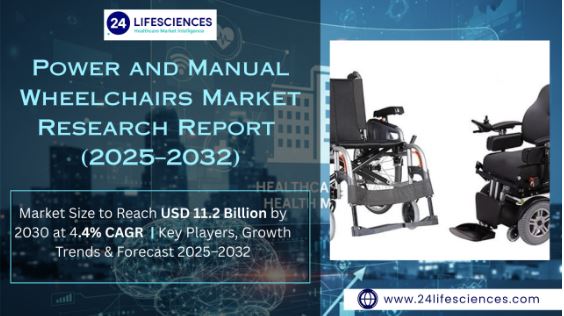
Power and Manual Wheelchairs Market, valued at USD 8.6 billion in 2023, is projected to reach USD 11.2 billion by 2030, growing at a steady 4.4% CAGR during the forecast period. As the aging population accelerates and disability prevalence rises worldwide, the market for mobility-assistive devices continues to expand, playing a critical role in healthcare, rehabilitation, and personal independence.
Wheelchairs—both manual and powered—have become essential components of modern care infrastructures. Their increasing adoption across hospitals, rehabilitation centers, and homecare environments underscores their significance in the broader healthcare and life sciences ecosystem.
Get Your Free Report Sample Now https://www.24lifesciences.com/download-sample/5612/power-and-manual-wheelchairs-market
Market Highlights
Segmentation by Type
The market is divided into Power Wheelchairs and Manual Wheelchairs.
Power Wheelchairs lead the premium segment, offering enhanced mobility autonomy for individuals with limited upper body strength or long-term mobility impairment. Their advanced joystick controls, customizable seating, battery-powered operation, and terrain capabilities make them a preferred long-term solution despite higher upfront costs.
Manual Wheelchairs remain widely used due to affordability, lightweight designs, and widespread application in medical facilities. They continue to serve as essential mobility aids in hospitals, clinics, temporary rehabilitation, and emergency care.
Segmentation by Application
Applications include:
- Hospitals and Clinics
- Homecare Settings
- Rehabilitation Centers
- Others
Hospitals and Clinics dominate the market, supported by consistent patient flow and the immediate need for mobility equipment in diagnostic, inpatient, and post-operative settings. Rapid patient turnover in medical facilities supports large-scale adoption of manual wheelchairs.
Rehabilitation Centers are emerging as high-growth application environments due to increasing demand for long-term mobility therapy, post-trauma rehabilitation, and chronic disease management.
Homecare Settings also exhibit rising demand as more patients shift toward in-home care solutions to support recovery, elderly living assistance, and chronic condition management.
Segmentation by End User
End users include:
- Individuals with Disabilities
- Healthcare Institutions
- Homecare Providers
Individuals with Disabilities represent the largest end-user group, forming the core demand base for personal mobility enhancements. Their purchasing patterns—significantly influenced by insurance coverage, government reimbursement programs, and supportive healthcare policies—drive innovation and accessibility advancements in wheelchair design.
Healthcare Institutions, including hospitals and rehabilitation centers, are major institutional buyers of manual wheelchairs, while Homecare Providers increasingly rely on lightweight, portable, and ergonomic models.
Get the Complete Report Now https://www.24lifesciences.com/power-and-manual-wheelchairs-market-5612
Emerging Trends Shaping the Healthcare Market
Digital transformation and technological innovation are reshaping the mobility solutions ecosystem. The integration of artificial intelligence, remote patient monitoring, IoT-enabled wheelchair diagnostics, and smart mobility devices is transforming how patients and caregivers manage mobility assistance.
AI-powered wheelchairs with adaptive navigation, collision avoidance, and personalized seating adjustments are emerging as next-generation solutions. Sustainability trends—from recycled frame materials to energy-efficient power systems—are further influencing product innovation and procurement decisions.
These advancements, combined with precision healthcare and rising adoption of home-based digital health platforms, are expected to accelerate market expansion through 2032.
Regional Analysis
North America
North America remains one of the largest and most technologically advanced markets. The U.S. market benefits from strong reimbursement structures, high healthcare spending, supportive disability rights legislation, and the presence of leading wheelchair manufacturers. Increased demand for homecare mobility equipment also boosts market growth.
Europe
Europe exhibits strong adoption rates, driven by aging populations in Germany, Italy, France, and the U.K. Well-developed healthcare systems and government-backed mobility support programs contribute to sustained market demand. The push for inclusive mobility infrastructure further drives innovation and accessibility.
Asia-Pacific
Asia-Pacific is a high-growth region, driven by rapidly aging populations in China, Japan, and South Korea, rising chronic disease incidence, and improving healthcare infrastructure. Economic development and growing awareness of mobility rights boost the adoption of both manual and power wheelchairs. Local manufacturers and government initiatives also play a major role in expanding product availability.
Rest of the World
Latin America, the Middle East, and Africa show steady growth supported by expanding hospital networks, improving rehabilitation services, and greater investment in healthcare infrastructure. Affordability and access remain key priorities in these regions.
Key Players & Competitive Landscape
The global power and manual wheelchairs market is moderately consolidated, with leading manufacturers shaping product innovation, distribution networks, and competitive pricing strategies.
Key companies profiled include:
- Invacare Corporation (United States)
- Sunrise Medical (United States)
- Permobil AB (Sweden)
These companies maintain their competitive edge through:
- Comprehensive product portfolios covering both manual and power mobility solutions
- Investment in advanced control systems, ergonomic designs, and customizable features
- Strategic mergers and collaborations with healthcare institutions
- Expansion of global distribution channels and after-sales service networks
Collectively, these manufacturers influence global accessibility standards and drive adoption of next-generation mobility technologies.
Get the Complete Report Now https://www.24lifesciences.com/power-and-manual-wheelchairs-market-5612
Future Outlook
With a projected 4.4% CAGR through 2030, the power and manual wheelchairs market is positioned for stable long-term growth. Key drivers include rising disability prevalence, global population aging, increased homecare adoption, and ongoing innovation in power-mobility systems. As healthcare systems strengthen their focus on patient mobility, independence, and rehabilitation outcomes, demand for both manual and power wheelchairs is expected to continue increasing through 2032.
Explore our related reports
About 24lifesciences
Founded in 2017, 24LifeScience has emerged as a trusted research and analytics partner for organizations operating within the global life sciences and chemical industries. Our core mission is to provide intelligent, future-ready insights that help clients stay ahead in an increasingly complex and innovation-driven market
International: +1(332) 2424 294 | Asia: +91 9425150513 (Asia)
Website: www.24lifesciences.com
Follow us on LinkedIn: www.linkedin.com/company/lifesciences24