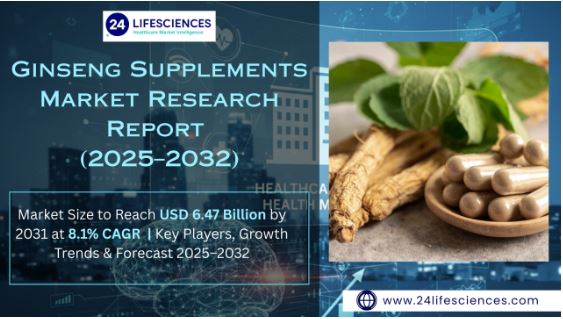
Ginseng Supplements Market, valued at USD 3.79 billion in 2024, is projected to reach USD 6.47 billion by 2031, expanding at a robust 8.1% CAGR during the forecast period. As the global population increasingly seeks natural, plant-based solutions for wellness, energy, immune support, and stress management, ginseng supplements have emerged as a cornerstone of the botanical health products industry. Their deep integration into traditional medicine systems and growing scientific validation underscore their expanding relevance within the healthcare and life sciences sectors.
This strong growth trajectory reflects rising consumer interest in adaptogens, preventative health strategies, and holistic wellness—positioning the ginseng supplements market for sustained expansion through 2032.
Receive a Free Preview of This Report https://www.24lifesciences.com/download-sample/6609/ginseng-supplements-market
Market Highlights
Segmentation by Type
The market is segmented into Capsules, Tablets, and Liquid formulations. Capsules account for the leading share, driven by consumer demand for convenience, accurate dosage, and ease of storage. Their neutral taste and portability make them a top choice for daily wellness routines. Tablets remain a widely used format, offering similar benefits at typically lower price points. Liquid formulations are gaining traction due to faster absorption and customized dosing, particularly appealing to seniors or individuals with difficulty swallowing solid supplements.
Segmentation by Application
Applications span Energy & Vitality, Immune Support, Cognitive Health, Stress Relief, and Others. Energy & Vitality is the dominant application, supported by ginseng’s long-standing reputation as an adaptogen that combats fatigue and enhances endurance. The immune support segment is expanding rapidly following heightened global health awareness post-pandemic. Cognitive health—enhancing focus, memory, and mental clarity—is another high-growth segment, with rising adoption among professionals, students, and aging populations.
Segmentation by End User
End users include Adults (Middle-aged & Senior), Teenagers, and Children. Adults form the largest consumer base, motivated by proactive wellness management, energy maintenance, and healthy aging. Teenagers represent a growing segment for cognitive support supplements, especially during academic pressure cycles. Use among children remains niche and requires parental oversight, with demand driven by specialized formulations.
Segmentation by Distribution Channel
Channels include Retail Pharmacies & Drugstores, Online Retail, Health Food Stores, and Supermarkets/Hypermarkets. Retail pharmacies & drugstores lead the market, offering trusted access to expert advice and secure product sourcing. Online retail is the fastest-growing channel, fueled by digital shopping convenience, broad assortment availability, better pricing, and growing acceptance of online wellness purchases.
Segmentation by Ingredient Source
Ginseng supplements are categorized into Panax Ginseng (Asian/Korean), American Ginseng, and Siberian Ginseng (Eleuthero). Panax Ginseng (Asian/Korean) dominates, driven by centuries of traditional use, extensive research, and strong cultural acceptance—particularly in Asia-Pacific markets. American Ginseng continues to gain traction for its milder, cooling properties. Siberian Ginseng appeals to cost-conscious consumers seeking broader adaptogenic benefits.
View the Complete Report Details https://www.24lifesciences.com/ginseng-supplements-market-6609
Emerging Trends Shaping the Healthcare Market
The global healthcare and nutraceutical landscape is undergoing rapid transformation with the integration of AI-driven healthcare insights, precision nutrition, digital wellness platforms, and sustainability-focused herbal sourcing. Consumers are increasingly seeking personalized supplement solutions based on biomarker testing and digital health recommendations.
AI-powered health apps are enabling tailored ginseng dosage suggestions, while advanced supply-chain technologies promote transparency—from ginseng cultivation to extraction. Additionally, sustainability trends are pushing manufacturers toward eco-friendly farming, ethical wild harvesting, and clean-label formulations. These shifts are expected to further strengthen market adoption from 2025 to 2032.
Regional Analysis
North America
North America represents a significant market for ginseng supplements, supported by widespread adoption of herbal products, strong presence of specialty supplement brands, and expanding digital retail. The U.S. leads consumption, driven by consumer interest in cognitive performance, energy enhancement, and stress management.
Europe
Europe maintains steady demand, especially in Germany, the U.K., and Scandinavian countries where herbal supplements are popular. Stringent quality regulations, a preference for natural wellness, and strong pharmacy-led distribution networks support regional growth.
Asia-Pacific
Asia-Pacific is the largest and most influential region, accounting for nearly 70% of global ginseng supplement consumption, largely due to cultural familiarity and long-standing integration of ginseng in Traditional Chinese Medicine and Korean herbal traditions. South Korea, China, and Japan remain key markets, reinforced by strong domestic manufacturing capabilities.
Rest of the World
Latin America, the Middle East, and Africa present growing opportunities as awareness of herbal supplements rises and online retail channels expand. Price-sensitive consumers in these regions often prefer Siberian Ginseng or American Ginseng formulations.
Key Players & Competitive Landscape
The competitive landscape is highly concentrated, with the top four companies controlling more than 50% of the global market. Korea Ginseng Corporation (KGC) stands as the global leader, supported by its deep heritage, integrated supply chain, and strong brand recognition across Asia-Pacific.
Other major players include:
- Pharmaton (Boehringer Ingelheim)
- Boots (Walgreens Boots Alliance)
- Jilin Zixin Pharmaceutical Industrial
- Allcura Naturheilmittel GmbH
- Orkla Health
- NOW Foods
- Nature’s Way
- Buddha’s Herbs
- Ginsana (Bristol-Myers Squibb)
- Swanson Health Products
- Puritan’s Pride
- Solaray (Nestlé Health Science)
- Gaia Herbs
- Nature’s Bounty
These companies compete on formulation innovation, organic sourcing, brand strength, e-commerce expansion, and scientific validation. Many invest significantly in marketing and R&D to differentiate their offerings in a crowded supplement landscape.
View the Complete Report Details https://www.24lifesciences.com/ginseng-supplements-market-6609
Market Projection
With an expected 8.1% CAGR through 2031, the ginseng supplements market is set for substantial expansion. Rising global emphasis on natural wellness, ongoing scientific research on adaptogens, and rapid growth in online supplement sales will continue fueling demand. As consumers prioritize immunity, cognitive performance, energy, and stress management, ginseng supplements are well-positioned to remain a core product in the nutraceutical and herbal wellness sector through 2032.
Explore our related reports
About 24lifesciences
Founded in 2017, 24LifeScience has emerged as a trusted research and analytics partner for organizations operating within the global life sciences and chemical industries. Our core mission is to provide intelligent, future-ready insights that help clients stay ahead in an increasingly complex and innovation-driven market
International: +1(332) 2424 294 | Asia: +91 9425150513 (Asia)
Website: www.24lifesciences.com
Follow us on LinkedIn: www.linkedin.com/company/lifesciences24