Introduction
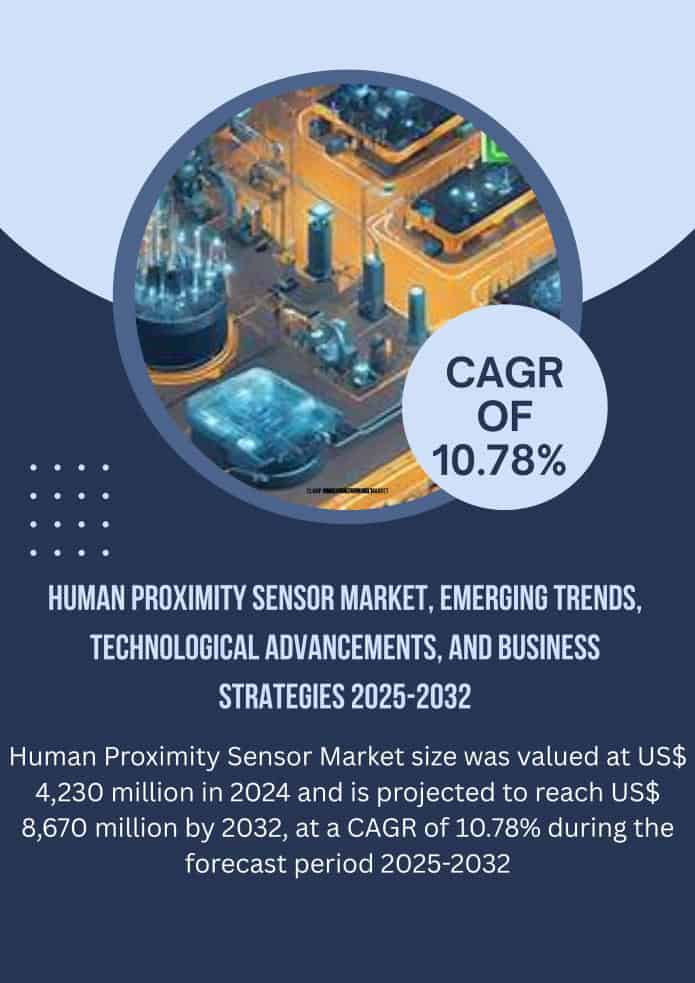
According to semiconductorinsight, the Human Proximity Sensor Market is entering a decisive growth phase, expanding from US$ 4,230 million in 2024 to an expected US$ 8,670 million by 2032, registering a strong CAGR of 10.78%. As intelligent sensing becomes a baseline requirement across consumer electronics, industrial automation, and smart infrastructure, this segment is rapidly evolving. The semiconductor industry continues to redefine global innovation, with this market showing robust expansion and technological disruption.
Download Sample Report PDF https://semiconductorinsight.com/download-sample-report/?product_id=97790
Emerging Trends Shaping the Market
AI-Enhanced Sensing for Consumer and Industrial Devices
Artificial intelligence is increasingly being embedded into proximity sensing modules to enhance accuracy, context awareness, and power efficiency. In human-interaction environments—such as smartphones, smart home devices, and collaborative robots—AI-optimized proximity sensors enable faster decision-making and safety-driven automation.
Miniaturized Sensor Architectures for Compact Electronics
As device OEMs push toward slimmer form factors, proximity sensors must deliver higher precision at substantially smaller footprints. This trend is fueling demand for compact, surface-mount proximity sensors optimized for low latency and low power consumption—especially in wearables and next-generation IoT devices.
Touchless Technology Adoption in Smart Infrastructure
Post-pandemic automation and the rise of contactless interfaces continue to expand the role of human proximity sensors. Smart buildings, automated access systems, and digital kiosks increasingly rely on high-accuracy proximity sensing to ensure seamless user experiences.
Integration with 3D Sensing and Gesture-Recognition Systems
Advanced sensor fusion—combining proximity detection with gesture recognition and 3D sensing—is gaining traction. These innovations are transforming user interfaces in automotive cabins, medical devices, and AR/VR systems.
Sustainability and Low-Power Chip Design
Energy-efficient semiconductor technology is becoming a key design parameter. Manufacturers are focusing on reducing energy consumption per interaction, supporting global sustainability roadmaps while extending battery life in portable devices.
Key Market Drivers and Growth Factors
- Expanding deployment in consumer electronics, especially smartphones, wearables, and intelligent home systems
- Rising demand for touchless user interfaces across healthcare, retail, and corporate spaces
- Growth of industrial robotics requiring human-safe sensing modules
- Increasing adoption of IoT-enabled infrastructure and smart environments
- Proliferation of automotive in-cabin sensing for safety and user experience
- OEM demand for ultra-low-power, compact, and fast-response semiconductor devices
Strategic Developments by Key Players
Leading companies are intensifying their focus on R&D, module efficiency, and integration flexibility.
- TDK Corporation is investing in next-generation miniaturized sensor technologies designed for tight-space consumer and automotive applications.
- ams AG continues to strengthen its position in optical and proximity sensor innovation with enhanced detection accuracy.
- SOUTHWEST MICROWAVE is advancing high-precision sensing solutions tailored for industrial and security applications.
- Seeed Studio Electronics supports the maker and IoT ecosystem with scalable sensing modules that accelerate prototyping and deployment.
Collectively, these players are prioritizing product upgrades, ecosystem collaborations, and expansion into emerging application domains.
Our comprehensive report is ready with the latest trends, growth opportunities, and strategic analysis https://semiconductorinsight.com/report/human-proximity-sensor-market/
Segment Analysis: Who Leads the Market?
The market is structured across sensor type, application area, and regional adoption.
- Capacitive and optical proximity sensors continue to dominate due to broad usage in consumer electronics and automation systems.
- Automotive and industrial automation remain among the fastest-growing applications as sensing precision and safety compliance become critical.
- Asia-Pacific leads the global landscape, driven by strong semiconductor ecosystems in China, Japan, Taiwan, and South Korea. Robust manufacturing capacity and high-volume consumer device production reinforce the region’s dominance.
Technological Advancements Impacting Growth
Breakthroughs in chip architecture, material science, and manufacturing are reshaping the market’s trajectory.
Can AI-Driven Lithography Redefine Semiconductor Yield Rates?
Evolving lithography techniques, including AI-enabled process optimization, are helping manufacturers achieve tighter geometry control and improved yields—an advantage for miniaturized proximity sensors.
The market also benefits from:
- Nanofabrication techniques enabling micro-scale sensor modules
- Automated cleanroom processes accelerating time-to-market
- Sensor-fusion ICs combining proximity, ambient light, and motion sensing
- Enhanced packaging methods targeting thermal stability and reduced power loss
Why This Report Matters
The Human Proximity Sensor Market assessment provides industry leaders with reliable data covering market estimations from 2024 to 2032, competitive strategies, technology roadmaps, and emerging opportunities. It supports decision-makers in evaluating expansion strategies, aligning R&D priorities, and identifying high-growth application areas backed by long-term demand.
For a deeper understanding of semiconductor innovation trends, readers can also explore our insights library at Semiconductor Insights (internal link) and consult reference materials from IEEE for technical standards and research developments (external link).
Download Sample Report PDF https://semiconductorinsight.com/download-sample-report/?product_id=97790
Forward-Looking Insight
As proximity sensing becomes integral to next-generation electronics, the market is positioned for sustained momentum. Stakeholders who align innovation with manufacturing resilience, sustainability, and evolving human-machine interface demands will remain at the forefront of this rapidly advancing semiconductor segment.
Explore Related Outgoing Coverage in semicoductorinsight Domain
https://semiconductorinsight.com/report/global-flat-panel-display-sputtering-targets-market/
https://semiconductorinsight.com/report/global-graphite-thermal-pads-market/
https://semiconductorinsight.com/report/hvdc-circuit-breaker-market/
https://semiconductorinsight.com/report/global-advanced-lead-acid-batteries-market/
https://semiconductorinsight.com/report/global-advanced-lead-acid-batteries-market/
https://semiconductorinsight.com/report/electron-beam-wafer-defect-inspection-system-market/
https://semiconductorinsight.com/report/multi-phase-controller-for-ai-server-market/
https://semiconductorinsight.com/report/thermal-switches-market/
https://semiconductorinsight.com/report/semiconductor-lasers-for-optical-communications-market/
Call-to-Action
Explore the full analysis, forecasts, and strategic opportunities at Semiconductor Insights