Introduction
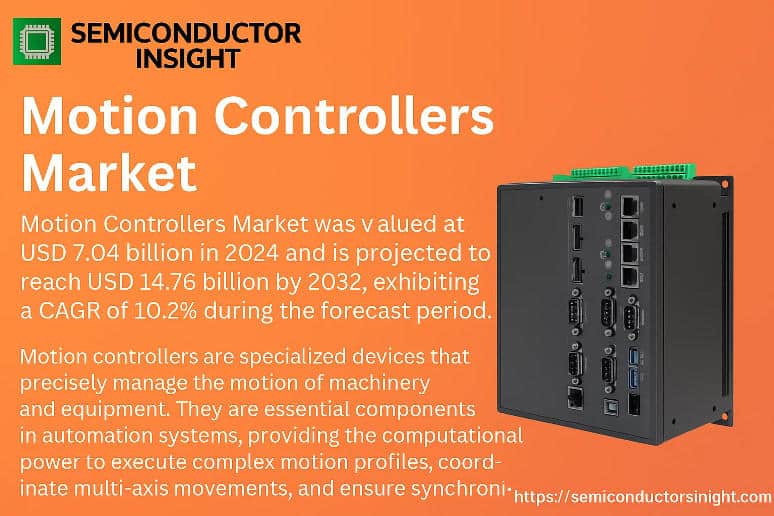
According to semiconductorinsight, the global Motion Controllers Market, valued at USD 7.04 billion in 2024, is set to more than double to USD 14.76 billion by 2032, powered by rapid automation and smarter manufacturing ecosystems. With industries accelerating toward high-precision robotics, intelligent motion architectures, and connected production lines, this segment is becoming a strategic pillar of next-generation semiconductor-driven automation. The semiconductor industry continues to redefine global innovation, with this market showing robust expansion and technological disruption.
Download Sample Report PDF https://semiconductorinsight.com/download-sample-report/?product_id=122632
Emerging Trends Shaping the Market
AI-Enhanced Robotic Motion
Artificial intelligence is shifting motion controllers from fixed-function units to predictive, self-optimizing systems. AI-driven interpolation, error correction, and trajectory control are enhancing performance in industrial robots, directly raising demand for advanced controllers across assembly, packaging, and automated inspection equipment.
EtherCAT and High-Speed Industrial Connectivity
Ultra-fast communication standards such as EtherCAT and Time-Sensitive Networking (TSN) are becoming the backbone of modern factories. Motion controllers increasingly integrate these protocols to synchronize axes, reduce latency, and improve precision—critical for semiconductor tools, CNC machines, and high-accuracy manufacturing.
Miniaturized Multi-Axis Controllers for Compact Automation
As equipment footprints shrink, manufacturers are adopting compact, multi-axis controllers that deliver powerful motion sequencing in minimal space. This trend is reshaping motion control solutions for medical devices, smart warehouses, and semiconductor backend equipment.
Rise of Collaborative Robotics (Cobots)
The global shift toward human-machine collaboration is accelerating demand for motion controllers engineered for safe torque control, real-time monitoring, and adaptive speed modulation—features essential to cobot stability and human-safe automation.
Sustainable and Energy-Optimized Motion Systems
With factories under pressure to reduce energy consumption, motion controllers equipped with regenerative braking, energy monitoring, and dynamic power optimization are becoming mainstream, influencing equipment design across major industries.
Key Market Drivers and Growth Factors
- Expanding adoption of advanced robotics in manufacturing and logistics
- Rising deployment of factory automation for precision machining and semiconductor tools
- Surge in EV production, requiring high-accuracy motion in battery assembly and testing
- Increased demand for cleanroom-grade automation in electronics and medical industries
- Acceleration of Industry 4.0 and digital twin ecosystems, boosting high-performance motion systems
Strategic Developments by Key Players
Leading companies are consolidating their technological footprint through R&D, product innovation, and strategic manufacturing expansions:
- Siemens AG continues enhancing integrated motion platforms with advanced digitalization for smart factories.
- Yaskawa Electric Corporation is strengthening its servo and multi-axis controller portfolio to support next-level robotics and EV manufacturing.
- Mitsubishi Electric Corporation is expanding industrial automation lines with precision motion modules tailored for high-speed pick-and-place and semiconductor equipment.
- Omron Corporation is integrating AI-driven motion technology into its automation suite to improve machine responsiveness and predictive performance.
- ABB Ltd. is advancing its motion control capabilities with smarter drives, servo technologies, and integrated robotics architectures.
- Shenzhen Inovance Technology Co., Ltd. is scaling its presence in multi-axis servo controllers and cost-efficient automation solutions across APAC’s fast-growing industrial markets.
Our comprehensive report is ready with the latest trends, growth opportunities, and strategic analysis https://semiconductorinsight.com/report/motion-controllers-market/
Segment Analysis: Who Leads the Market?
Motion controllers serve diverse applications, and several segments are emerging as market leaders:
By Type
Multi-axis controllers dominate due to their extensive use in robotics, semiconductor tools, and CNC machining, while single-axis controllers retain relevance in simpler industrial processes.
By Application
Robotics is the fastest-growing segment, driven by EV factories, electronics assembly, and warehouse automation. Semiconductor manufacturing tools also represent a high-value niche due to cleanroom precision requirements.
By Region
Asia-Pacific leads the global market, supported by dense manufacturing ecosystems in China, Japan, South Korea, and Taiwan. Europe maintains strong demand in automotive and industrial machinery, while North America grows steadily through robotics and warehouse automation investments.
Technological Advancements Impacting Growth
Modern factories are adopting advanced motion strategies powered by semiconductor innovations:
Can AI-Driven Algorithms Redefine Motion Accuracy?
AI-integrated controllers can now predict errors, adjust motor torque in real time, and optimize paths for faster cycle times—all without operator intervention.
Nanometer-Level Positioning
Improved semiconductor components are enabling ultra-fine resolution encoders and high-bandwidth servo control loops, unlocking new levels of precision for wafer handling and metrology tools.
Cleanroom-Ready Automation
Low-vibration, low-particle controllers are gaining traction in semiconductor fabs, where even minor disturbances can affect yield rates.
Digital Twins for Motion Simulation
Manufacturers are increasingly simulating motion performance before deployment, reducing commissioning time and improving reliability in high-value automation lines.
For deeper context on emerging semiconductor automation standards, readers may explore resources at SEMI.org.
Why This Report Matters
Stakeholders navigating the Motion Controllers Market from 2024 to 2032 benefit from a clear understanding of:
- Granular market forecasts and revenue projections
- Competitive intelligence across leading global players
- Technology roadmaps shaping factory automation
- Application-level opportunities across robotics, semiconductor tools, and precision equipment
With industries transitioning to hyper-automated ecosystems, this report equips decision-makers with actionable insights to align capital investments, technology planning, and product strategy.
Download Sample Report PDF https://semiconductorinsight.com/download-sample-report/?product_id=122632
Forward Outlook
As global manufacturing shifts toward high-precision, software-defined automation, motion controllers will remain foundational to next-generation robotics and intelligent machines. The companies that prioritize innovation, sustainability, and seamless digital integration will lead the market’s next era of growth and competitiveness.
Explore Related Outgoing Coverage in semicoductorinsight Domain
https://semiconductorinsight.com/report/alcohol-sensor-module-market/
https://semiconductorinsight.com/report/blocking-relays-market/
https://semiconductorinsight.com/report/far-infraredfir-laser-market/
https://semiconductorinsight.com/report/band-pass-electronic-filters-market/
https://semiconductorinsight.com/report/fixed-attenuator-pads-market/
https://semiconductorinsight.com/report/semiconductor-biochip-market/
Call-to-Action
Explore the full Motion Controllers Market report, technology insights, and competitive profiles at Semiconductor Insights.