Introduction
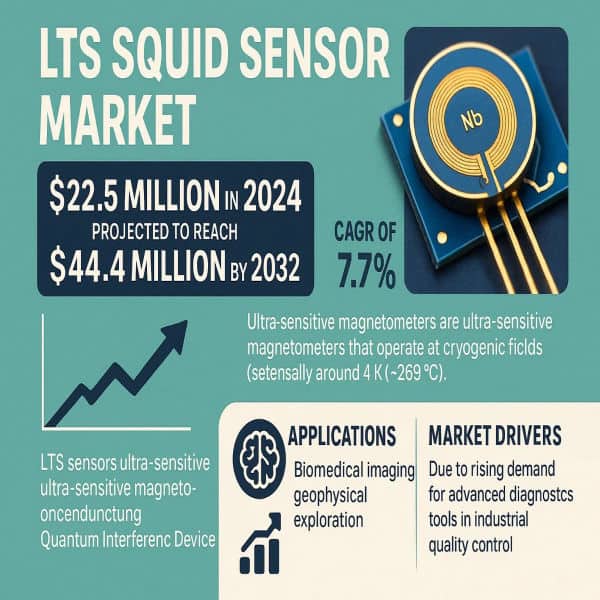
The LTS SQUID Sensor Market was valued at USD 22.5 million in 2024 and is projected to reach USD 44.4 million by 2032, expanding at a CAGR of 7.7% through the forecast period. Demand is being pulled by clinical imaging, geophysical exploration and national quantum programs that require ultra-sensitive magnetic detection.
𝐃𝐨𝐰𝐧𝐥𝐨𝐚𝐝 𝐅𝐑𝐄𝐄 𝐒𝐚𝐦𝐩𝐥𝐞 𝐑𝐞𝐩𝐨𝐫𝐭: https://semiconductorinsight.com/download-sample-report/?product_id=117786
Emerging Trends Shaping the Market
- Cryogen-free and closed-cycle refrigeration
Closed-cycle systems and helium-conservation designs are lowering operational costs and complexity for LTS SQUID installations, making clinical and field deployments more practical and widening adoption beyond specialist labs. - Clinical MEG miniaturization and portability
Advances in sensor packaging and cryostat design are enabling smaller, more patient-friendly MEG systems. Portable or sit-stand MEG units could expand diagnostics access to more hospitals and diagnostic centers. - Integration with advanced signal processing and AI
AI-enabled denoising and source-localization enhance the clinical utility of SQUID arrays, improving diagnostic yield for epilepsy and neurodegenerative disorders and strengthening the case for new MEG purchases. - Quantum research and superconducting electronics demand
National quantum initiatives funnel funding into superconducting sensors, positioning LTS SQUIDs as essential tools for both applied quantum device testing and fundamental physics experiments. - Industry crossover — mining and rare-earth exploration
Field-grade SQUID arrays with ruggedized cryogenics are demonstrating superior sensitivity for deep-target mineral exploration, especially for rare earths — a strategic input for electronics and green technologies.
Key Market Drivers and Growth Factors
- Rising demand for precision neurological imaging — MEG adoption grows as clinicians seek non-invasive tools for epilepsy mapping and early neurodegenerative diagnosis.
- Government and institutional quantum investments — dedicated funding increases procurement for superconducting instrumentation.
- Geophysical exploration needs — superior magnetic sensitivity helps locate deep, low-contrast mineral deposits, reducing drilling risk.
- Technological cost reductions — improvements in cryocoolers and sensor manufacturing lower total cost of ownership.
- Niche, high-value applications — unlike mass electronics, SQUIDs command premium pricing where performance is mission-critical.
𝐃𝐨𝐰𝐧𝐥𝐨𝐚𝐝 𝐅𝐑𝐄𝐄 𝐒𝐚𝐦𝐩𝐥𝐞 𝐑𝐞𝐩𝐨𝐫𝐭: https://semiconductorinsight.com/download-sample-report/?product_id=117786
Strategic Developments by Key Players
Major suppliers are pursuing vertical integration, partnerships and platform diversification to capture specialized demand:
- STAR Cryoelectronics — expanded European footprint via a 2023 acquisition of a German cryogenics firm, strengthening system delivery.
- Tristan Technologies — focuses on turnkey MEG and full-system integration for clinical customers.
- Quantum Design — leveraging distributor partnerships to accelerate penetration in Asia.
- Supracon and Magnicon GmbH — compete on ultra-high sensitivity and bespoke MEG components.
- SUSTEC, ez SQUID, MagQu, Physike Technology — target cost-sensitive industrial, compact and geophysical segments with tailored product lines.
Across the board, firms are investing in helium conservation, closed-cycle cooling and system software to reduce operating costs and broaden addressable markets.
Segment Analysis: Who Leads the Market?
- By Type: DC SQUID leads on account of superior sensitivity in low-field applications; RF SQUID occupies niche roles where simplicity outweighs peak sensitivity.
- By Application: Healthcare (MEG) dominates near-term revenues, followed by geological survey and industrial NDT.
- By End User: Research institutions remain the largest buyers due to continuous quantum and physics research; diagnostic centers are the fastest growing clinical adopters.
- By Region: While North America and Europe host many technology leaders and clinical early adopters, Asia-Pacific is becoming increasingly important thanks to investment in quantum programs and a growing base of clinical facilities.
𝐃𝐨𝐰𝐧𝐥𝐨𝐚𝐝 𝐅𝐑𝐄𝐄 𝐒𝐚𝐦𝐩𝐥𝐞 𝐑𝐞𝐩𝐨𝐫𝐭: https://semiconductorinsight.com/download-sample-report/?product_id=117786
Technological Advancements Impacting Growth Can cryogen-free systems broaden clinical adoption?
Advances in Josephson junction fabrication, improved noise suppression, AI-driven signal processing, and robust closed-cycle cryocoolers collectively reduce lifecycle costs and ease integration into hospitals and field rigs. Questioning whether cryogen-free designs can unlock mass clinical adoption is central — early evidence suggests substantial uptake where operational simplicity and maintenance budgets are critical.
Why This Report Matters
This analysis offers stakeholders:
- Clear market estimations for 2024–2032 and segment forecasts.
- Competitive intelligence on player strategies and M&A moves.
- Opportunity mapping across clinical, industrial and geophysical use cases.
- Technology impact assessments to guide procurement and R&D priorities.
𝐆𝐞𝐭 𝐅𝐮𝐥𝐥 𝐑𝐞𝐩𝐨𝐫𝐭 𝐇𝐞𝐫𝐞: https://semiconductorinsight.com/report/lts-squid-sensor-market/
Conclusion
As LTS SQUID sensors migrate from specialist labs into clinical and industrial workflows, suppliers that pair high sensitivity with lower operational costs will set the market standard. Stakeholders that align manufacturing, cryogenics innovation and software will best harness growth as demand for precise magnetic sensing converges with quantum and healthcare imperatives.
Contact Us:
🌐 Website: https://semiconductorinsight.com/
📞 International: +91 8087 99 2013
🔗 LinkedIn: Follow Us