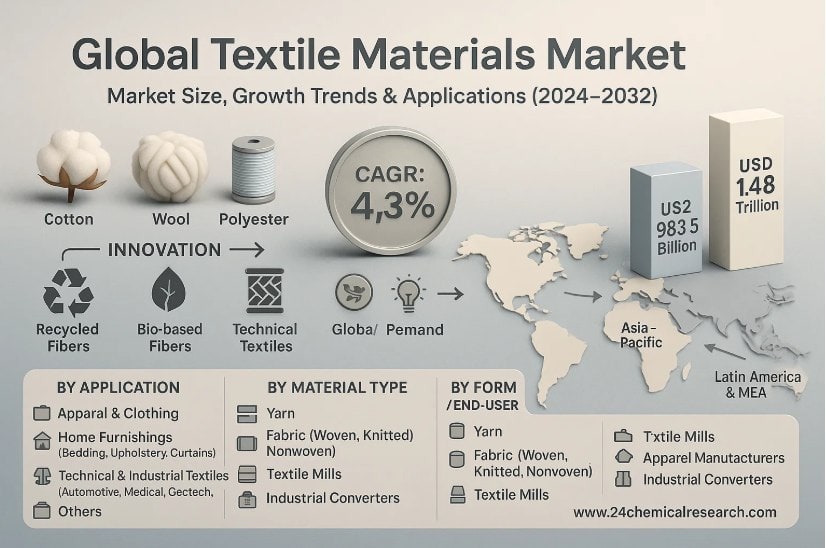
Global Textile Materials market is exhibiting consistent expansion, with its valuation reaching USD 983.5 billion in 2024. Industry analysis projects the market will grow from USD 1.05 trillion in 2025 to USD 1.48 trillion by 2032, exhibiting a CAGR of 4.3% during the forecast period. This vast market encompasses the entire spectrum of fibers, yarns, and fabrics—from natural staples like cotton and wool to synthetic polymers like polyester and nylon, as well as advanced technical textiles—that form the foundational input for the global apparel, home furnishing, and industrial sectors.
The Textile Materials market is undergoing a significant transformation driven by sustainability imperatives, digitalization, and evolving end-use demands. While traditional apparel and home textiles remain the volume-driven core, the fastest growth is emanating from technical textiles used in automotive, healthcare, construction, and personal protection. Innovations in bio-based and recycled fibers, smart fabrics with embedded electronics, and advanced manufacturing techniques are reshaping material capabilities and supply chain dynamics.
Download FREE Sample Report (2025-2032 Forecasts Included):
https://www.24chemicalresearch.com/download-sample/245412/textile-materials-market
Textile Materials Market Overview & Regional Analysis
Asia-Pacific dominates the global landscape, commanding an overwhelming share of both production and consumption, accounting for over 60% of the global market in 2024. This leadership is anchored by the complete textile manufacturing ecosystem in China, India, Bangladesh, and Vietnam, which serves as the workshop for global apparel and home textile production, supported by massive domestic markets.
North America and Europe are mature markets characterized by high-value consumption, strong brands, and a focus on innovation, sustainability, and technical textiles. These regions are leaders in R&D and the adoption of advanced materials. Regions such as the Middle East & Africa and Latin America contribute through raw material production (e.g., cotton) and growing domestic manufacturing, though they remain influenced by global trade policies and economic conditions.
Key Textile Materials Market Drivers and Opportunities
The steadily growing global population and rising disposable incomes, particularly in emerging economies, drive continuous baseline demand for apparel and home furnishings, ensuring stable volume growth for core textile materials.
The powerful sustainability megatrend presents a dual vector: it drives demand for recycled polyester (rPET), organic cotton, and other eco-fibers, while simultaneously pushing innovation in closed-loop production and biodegradability, creating new material categories and premium segments. Rapid expansion of technical and industrial textile applications is a major growth engine. This includes nonwoven fabrics for hygiene and medical use, composites for automotive and wind energy, protective fabrics for workwear, and geotextiles for infrastructure. Digitalization and supply chain transparency through blockchain and IoT are creating opportunities for traceable, on-demand, and customized production, allowing for premiumization and efficiency gains.
Challenges & Restraints in Textile Materials Market
Extreme volatility in raw material prices (cotton, crude oil derivatives for synthetics) and fluctuating energy costs create significant margin pressure and planning uncertainty for producers across the value chain, from fiber to fabric.
Intense global competition and overcapacity in conventional textile production, particularly in Asia, lead to persistent price pressure, thin margins, and trade tensions, challenging the profitability of undifferentiated producers. Stringent environmental regulations and shifting consumer expectations regarding chemical use (e.g., PFAS, dyes), water consumption, and carbon footprint necessitate continuous, capital-intensive investment in cleaner production technologies, disproportionately affecting smaller players. Complex and fragmented global supply chains are vulnerable to disruptions (as seen during the pandemic), trade policy shifts, and logistical bottlenecks, impacting lead times and reliability.
Textile Materials Market Segmentation by Application
Textile Materials market is segmented by application. Apparel & Clothing is the dominant and primary consumption sector. Home Furnishings (Bedding, Upholstery, Curtains), Technical & Industrial Textiles (Automotive, Medical, Geotech, Protective), and Others (Footwear, Luggage) are also significant application areas.
Textile Materials Market Segmentation by Type
Market is segmented by type. By Material Type: Natural Fibers (Cotton, Wool, Silk), Synthetic Fibers (Polyester, Nylon, Acrylic), Regenerated Fibers (Viscose, Lyocell), Specialty & Technical Fibers. By Form: Yarn, Fabric (Woven, Knitted, Nonwoven). By End-User: Textile Mills, Apparel Manufacturers, Industrial Converters.
Competitive Landscape of Textile Materials Market
Competitive landscape of Textile Materials market is highly fragmented, featuring global conglomerates, specialized fiber giants, and countless regional fabric producers.
Key Market Players:
- Sinopec (China) – Major synthetic fiber feedstock producer.
- Reliance Industries Ltd. (India) – Largest producer of polyester fiber.
- Toray Industries, Inc. (Japan) – Leader in advanced fibers & technical textiles.
- Indorama Ventures (Thailand) – Global leader in PET and fibers.
- Weiqiao Textile Company Ltd. (China) – Major cotton yarn and fabric producer.
- Hyosung TNC (South Korea) – Leading spandex and specialty yarn producer.
- Lenzing AG (Austria) – Global leader in botanic fibers (Lyocell, Modal).
- Milliken & Company (U.S.) – Diversified specialty textiles.
- Freudenberg Group (Germany) – Global leader in nonwovens.
- Shandong Ruyi Technology Group (China) – Major textile and apparel manufacturer.
Competition is based on production scale and cost leadership in commodity fibers, technological leadership in high-performance and sustainable fibers, vertical integration and supply chain control, agility in responding to fast fashion and custom demands, and strength in technical textile applications and certifications.
Get Full Market Intelligence Report (Detailed Forecast Analysis):
https://www.24chemicalresearch.com/reports/245412/global-textile-materials-forecast-market-2023-2032-240
Importance of Textile Materials Market
Importance of Textile Materials market lies in its fundamental role as one of the world’s largest and most essential manufacturing sectors, providing the basic materials for clothing, shelter, and an increasingly wide array of industrial products. It is a critical economic engine for numerous developing nations and a major global employer. The market’s evolution towards sustainability and high-tech applications is central to solving global challenges related to resource consumption, waste, and the development of next-generation products for healthcare, transportation, and environmental protection.
Contact Us:
International: +1(332) 2424 294 | Asia: +91 9169162030
Website: https://www.24chemicalresearch.com/
LinkedIn: https://www.linkedin.com/company/24chemicalresearch
SEE RELATED REPORTS :