Introduction
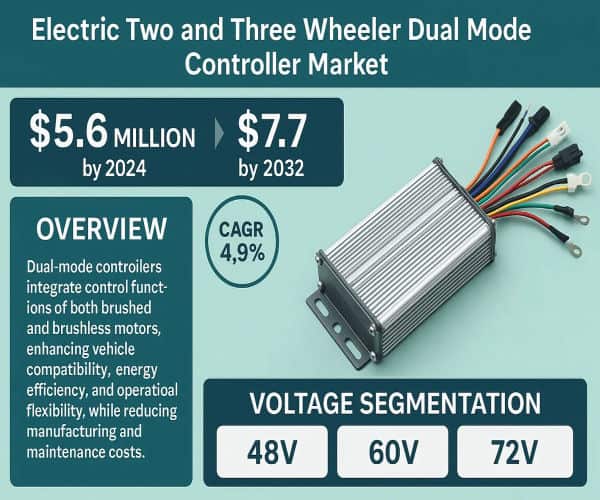
The Electric Two and Three Wheeler Dual Mode Controller market was valued at US$5.6 million in 2024 and is projected to reach US$ 7.7 million by 2032 at a 4.9% CAGR, driven by electrification, cost consolidation, and rising demand for multi-functional vehicles. The semiconductor industry continues to redefine global innovation, with this market showing robust expansion and technological disruption. Dual-mode controllers are rapidly becoming a strategic component for scalable, efficient e-mobility.
𝐃𝐨𝐰𝐧𝐥𝐨𝐚𝐝 𝐅𝐑𝐄𝐄 𝐒𝐚𝐦𝐩𝐥𝐞 𝐑𝐞𝐩𝐨𝐫𝐭: https://semiconductorinsight.com/download-sample-report/?product_id=117620
Emerging Trends Shaping the Market
- Rise of compound semiconductors (SiC, GaN)
Wide-bandgap devices enable higher switching frequencies and thermal resilience in power stages. For dual-mode controllers, SiC and GaN adoption reduces power losses and shrinks thermal management needs, directly improving system efficiency and enabling compact designs for 48V–72V platforms. - 3D packaging and miniaturization
Advanced packaging and chip-scale modules let manufacturers combine motor control, protection, and power management in tighter footprints. This trend reduces BOM complexity and supports the industry’s move toward modular controllers that serve both brushed and brushless motor variants. - AI-enabled power management
Edge intelligence and adaptive algorithms optimize energy distribution in real time—improving range, smoothing torque transitions, and enabling smarter regenerative braking. Such capabilities make dual-mode controllers more attractive to OEMs focused on user experience and operational efficiency. - Sustainability and circular design
Lifecycle considerations—repairability, recyclable materials, and energy-efficient operation—are increasingly influencing procurement. Controllers that lower total cost of ownership through higher durability and easier servicing gain an edge in regulated and subsidy-driven markets. - Interoperability and standardization
Growing demand for multi-compatibility across motor types and voltages is driving standard interfaces and firmware-configurable platforms, simplifying integration for global OEMs and aftermarket suppliers.
Key Market Drivers and Growth Factors
- Global push to sustainable mobility: Emission regulations and phase-out timelines for ICE vehicles have spurred investment in electrified two- and three-wheelers, creating steady component demand.
- Multi-function vehicle preference: Consumers and fleet operators favor versatile vehicles, amplifying the appeal of controllers that switch seamlessly between motor technologies.
- Cost and manufacturing efficiencies: Consolidating controller functions reduces SKUs, lowers production and inventory costs, and shortens assembly time—benefits that are crucial for price-sensitive segments.
- Policy support and subsidies: Incentives in Asia-Pacific, parts of Europe, and targeted schemes such as India’s FAME program accelerate adoption and local sourcing.
- Advances in battery and regenerative systems: Compatibility with 48V and 72V architectures and regenerative braking expands the functional value of dual-mode designs.
𝐆𝐞𝐭 𝐅𝐮𝐥𝐥 𝐑𝐞𝐩𝐨𝐫𝐭 𝐇𝐞𝐫𝐞: https://semiconductorinsight.com/report/electric-two-and-three-wheeler-dual-mode-controller-market/
Strategic Developments by Key Players
GOBAO, Wuxi Jinghui Electronics, Jiangsu Xiechang Electronic Technology, Ananda Drive Techniques, Taicheung, Wuxi Lingbo Electronic Technology, and sine-power are notable participants. Across the board these companies are investing in R&D for modular controllers, pursuing closer OEM partnerships, tailoring firmware for regional vehicle types, and optimizing production lines to lower unit costs. Several players are also focusing on certification and qualification for commercial fleets and last-mile logistics partners to secure large-volume contracts.
Segment Analysis: Who Leads the Market?
- By Type: The 48V segment dominates due to its balance of cost, safety, and performance for entry- to mid-range EVs.
- By Application: Electric two-wheelers lead adoption because of strong urban demand and extensive use cases; electric three-wheelers follow, especially for cargo and shared-transport roles in emerging markets.
- By Motor Type: Brushless DC motor systems hold significant share owing to superior efficiency and lower maintenance. Dual-mode controllers that support both brushed and BLDC motors capture broader OEM interest.
- By Sales Channel: OEM integrations account for the majority of revenue as manufacturers standardize controllers across models.
- By Region: Asia-Pacific dominates—driven by China and India’s manufacturing scale, expansive EV deployment, and dense supply ecosystems—while Southeast Asia and Latin America show rapid uptake for multi-use three-wheelers.
𝐃𝐨𝐰𝐧𝐥𝐨𝐚𝐝 𝐅𝐑𝐄𝐄 𝐒𝐚𝐦𝐩𝐥𝐞 𝐑𝐞𝐩𝐨𝐫𝐭: https://semiconductorinsight.com/download-sample-report/?product_id=117620
Technological Advancements Impacting Growth
Nanofabrication, better power MOSFETs, and automated calibration are improving controller density and reliability. Firmware-level diagnostics and OTA update capability are turning controllers into serviceable system components.
Can AI-Enabled Power Management Extend Real-World Range? Early implementations of adaptive torque mapping and context-aware regenerative strategies show measurable range improvements—making intelligent controllers a differentiator for OEMs and fleet operators.
Why This Report Matters
This analysis delivers practical insight for product planners, investors, and procurement teams by offering:
- Market estimations and revenue forecasts for 2024–2032.
- Competitive intelligence on manufacturing leaders and regional specialists.
- Technology roadmaps linking power management, motor compatibility, and modular design.
- Opportunity mapping for OEM partnerships, aftermarket channels, and regional go-to-market strategies.
𝐆𝐞𝐭 𝐅𝐮𝐥𝐥 𝐑𝐞𝐩𝐨𝐫𝐭 𝐇𝐞𝐫𝐞: https://semiconductorinsight.com/report/electric-two-and-three-wheeler-dual-mode-controller-market/
𝐂𝐨𝐧𝐜𝐥𝐮𝐬𝐢𝐨𝐧
As electrified two- and three-wheeler markets mature, dual-mode controllers will shift from optional upgrades to core architecture choices that determine vehicle versatility and lifecycle costs. Stakeholders that combine technological differentiation with cost discipline and regulatory alignment will capture the fastest growth.
Contact Us:
🌐 Website: https://semiconductorinsight.com/
📞 International: +91 8087 99 2013
🔗 LinkedIn: Follow Us
