The India Pre-Engineered Buildings (PEB) market has emerged as one of the fastest-growing segments within the construction and infrastructure sectors. Pre-engineered buildings are factory-fabricated steel structures designed and manufactured off-site, then assembled on location. These structures are known for their speed of construction, design flexibility, cost efficiency, and long-term durability, making them widely adopted across industrial, commercial, and infrastructure projects.
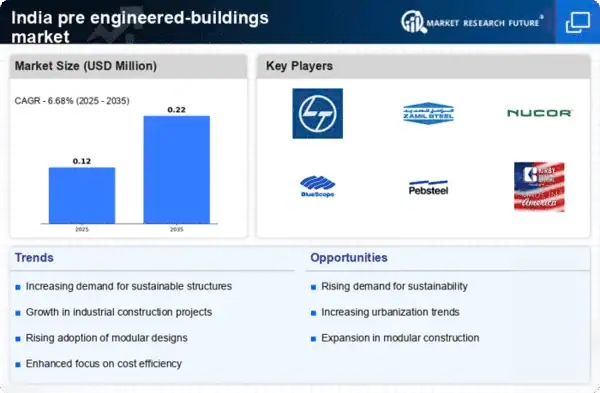
According to Market Research Future Analysis, The India Pre Engineered Buildings Market Size was estimated at 0.108 USD Million in 2024. The pre engineered-buildings market is projected to grow from 0.115 USD Million in 2025 to 0.22 USD Million by 2035, exhibiting a compound annual growth rate (CAGR) of 6.68% during the forecast period 2025 – 2035.
In India, rising investments in logistics, manufacturing, warehousing, transportation, and real estate have significantly contributed to the growth of the PEB market. Government initiatives promoting industrialization, urbanization, and infrastructure expansion further support the adoption of PEB systems. With increasing demand for sustainable, efficient, and scalable construction solutions, pre-engineered buildings are positioned for strong growth across the country.
Market Dynamics
1. Drivers
a. Rapid Industrialization and Infrastructure Growth
India’s industrial sector is expanding at a rapid pace due to increased investments in manufacturing, automotive, fast-moving consumer goods, and heavy industries. Pre-engineered buildings are widely used for factories, industrial sheds, assembly plants, and processing units. Their quick construction timelines and high structural efficiency make them ideal for large-scale industrial applications.
b. Growth of Warehousing and Logistics
The boom in e-commerce, retail expansion, and supply chain modernization has driven demand for warehousing and logistics spaces. PEB systems offer long clear spans, high load-bearing capacity, and flexibility for future expansion, making them suitable for warehouses, cold storage units, logistics hubs, and distribution centers.
c. Cost and Time Efficiency
Compared to conventional construction, PEB structures can reduce construction time by up to 50% and overall project costs by a significant margin. Pre-fabrication ensures consistent quality, minimal on-site labor, and predictable timelines—major factors driving adoption in time-sensitive and large-scale projects.
d. Government Initiatives and Policy Support
Programs such as Make in India, Smart Cities Mission, Bharatmala, PM Gati Shakti, and Industrial Corridor Development have accelerated construction activities nationwide. These initiatives encourage the use of modern, efficient construction technologies such as PEBs to meet large-scale infrastructure needs.
e. Rising Demand for Sustainable Construction
PEB systems use recyclable steel, generate minimal construction waste, and support green building standards. Growing awareness of sustainability and energy efficiency has further driven the shift toward pre-engineered building solutions.
2. Restraints
a. High Initial Investment in Fabrication and Machinery
PEB manufacturing requires advanced machinery, skilled labor, and precision engineering, which entails high upfront investment. Smaller contractors may find it challenging to adopt PEB systems due to cost barriers.
b. Limited Awareness in Rural and Small-Scale Projects
While major cities and industrial hubs have widely accepted PEB systems, adoption is slower in smaller towns and rural regions. Limited awareness and preference for conventional construction methods hinder market expansion in these areas.
c. Skilled Workforce Requirement
Designing, fabricating, and assembling pre-engineered buildings requires specialized skills. The shortage of trained engineers, detailers, and erection teams can impact project execution quality and timelines.
Get Free Sample Copy of Report @ https://www.marketresearchfuture.com/sample_request/2565
3. Opportunities
a. Expansion of E-Commerce and Cold Chain Infrastructure
India’s e-commerce sector continues to witness exponential growth, leading to increasing demand for large warehouses, distribution centers, and cold chain facilities. PEB systems are well suited to meet these needs due to their scalability and structural efficiency.
b. Growth of Data Centers and Smart Infrastructure
As digitalization accelerates, India is seeing rising investments in data centers. Pre-engineered structures are increasingly being used for these technologically advanced facilities, offering speed, precision, and modern architectural capabilities.
c. Demand for Affordable Housing and Public Infrastructure
PEB systems can support mass housing, community shelters, schools, transit hubs, and healthcare facilities. Faster construction timelines make them ideal for large government-backed housing and infrastructure development projects.
d. Customizable Design and Modern Aesthetics
Modern architectural demands require flexible designs and sleek aesthetics. PEB technology offers curved roofs, mezzanine systems, multi-story structures, and advanced cladding options—supporting innovative applications in commercial buildings, showrooms, and institutional facilities.
Emerging Trends
1. Multi-Story PEB Structures
Advancements in engineering are enabling multi-story PEB solutions, expanding their use into office buildings, commercial complexes, and institutional projects.
2. Integration of Smart Building Technologies
Internet of Things (IoT), building automation, and energy-efficient systems are increasingly being incorporated into PEB structures to improve operational performance.
3. Advanced Insulated Panel Solutions
Use of insulated roof and wall panels is growing due to improved thermal efficiency, contributing to energy savings in warehouses, cold storage units, and industrial buildings.
4. Increasing Adoption of Hybrid PEB Systems
Combining PEB with traditional RCC construction provides enhanced architectural flexibility, expanding the application of PEBs in commercial and residential sectors.
5. Digitalization and BIM Integration
Building Information Modeling (BIM) is widely being used to optimize design, reduce errors, and streamline the fabrication and erection process.
Buy Now @ https://www.marketresearchfuture.com/checkout?currency=one_user-USD&report_id=2565
Future Outlook
The India Pre-Engineered Buildings market is expected to witness strong growth over the next decade as the country accelerates industrialization, infrastructure expansion, and urban development. Demand will be driven by warehousing, logistics, manufacturing, and commercial infrastructure.
The growth of digital infrastructure, expansion of industrial corridors, and increasing investments in transportation networks will fuel PEB adoption. Technological advancements in design automation, high-strength steel fabrication, and hybrid construction techniques will further enhance performance and efficiency.
In emerging sectors such as renewable energy, aerospace, and data centers, PEBs offer flexibility and rapid deployment capabilities. With urbanization and sustainability becoming national priorities, PEB systems are poised to play a central role in shaping India’s modern construction landscape.
The India Pre-Engineered Buildings market is evolving into a critical component of the country’s construction ecosystem. Offering speed, efficiency, cost savings, and sustainability, PEB systems are being widely adopted across industrial, commercial, and institutional applications. Government infrastructure initiatives, increased manufacturing activity, and rapid growth in warehousing and logistics will continue to propel demand.
While challenges such as limited awareness, high initial investment, and skilled labor shortages persist, the overall outlook remains strongly positive. Technological advances, digital integration, and sustainable construction practices will support long-term market expansion.
Browse Related Reports:
Pre-Engineered Buildings Market
India Wood Based Panels Market
India Vertical Garden Construction Market
India Lightweight Precast Wall Panel Market
India Ready Mix Concrete Market
India Energy Efficient Building Market
India Construction Scaffolding Rental Market
