Introduction
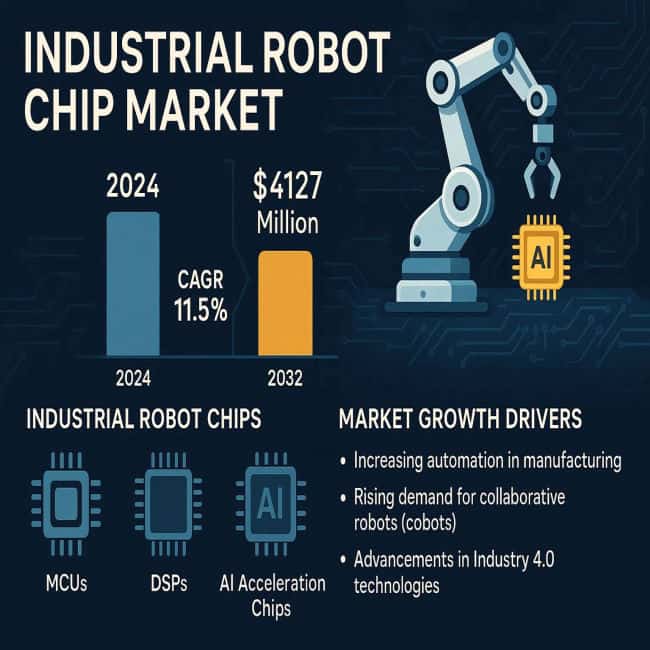
Industrial robot chips from MCUs to AI accelerators are powering the next wave of factory automation, collaborative robotics and autonomous material handling. With a projected CAGR of 11.5% through 2032 and rising adoption in automotive, electronics and logistics, this market is shifting from niche control electronics to high-performance, AI-enabled edge compute. The result: smarter, safer and more autonomous production lines that cut costs and accelerate reshoring efforts.
𝐃𝐨𝐰𝐧𝐥𝐨𝐚𝐝 𝐅𝐑𝐄𝐄 𝐒𝐚𝐦𝐩𝐥𝐞 𝐑𝐞𝐩𝐨𝐫𝐭: https://semiconductorinsight.com/download-sample-report/?product_id=117763
Emerging Trends Shaping the Market
AI-driven chip design. Neural Processing Units (NPUs) and AI accelerators are being integrated into robot SOCs to enable real-time perception and decision-making at the edge. This trend reduces latency and dependence on cloud connectivity, unlocking new use cases in dynamic manufacturing environments.
Advanced lithography and 3D packaging. Shrinking node sizes and 3D packaging increase compute density while improving thermal performance—critical for compact cobots and mobile robots where space and power are constrained.
Rise of compound semiconductors and energy efficiency. Wider adoption of SiC and GaN in power management ICs improves efficiency for high-torque actuators and long-running autonomous systems, extending operational lifetimes and reducing energy costs on the factory floor.
Edge computing and 5G connectivity. Low-latency 5G and on-device edge compute are enabling distributed robotic fleets (AGVs, AMRs) to coordinate in real time, increasing throughput in logistics hubs and reducing downtime.
Sustainability and circular design. Growing OEM focus on repairability and chip recyclability is prompting suppliers to design for longevity and reuse, aligning robotics procurement with corporate ESG goals.
Key Market Drivers and Growth Factors
- Rising industrial automation: Broad adoption across automotive, electronics and logistics is the single largest driver, with multi-axis robots and AGVs demanding more capable chips.
- AI and edge compute integration: Devices like Nvidia’s Jetson-class modules (noted for high TOPS performance) are enabling vision and autonomy that were previously cloud-dependent.
- Government incentives for smart manufacturing: Fiscal stimulus and industrial policy—subsidies, tax incentives and regional fab investments—are accelerating modernization and local sourcing of semiconductors.
- Cobots and SME uptake: Compact, safe collaborative robots expand the addressable market into small and medium enterprises, increasing demand for energy-efficient MCUs and safety ICs.
- Supply-chain regionalization: CHIPS-era incentives and multi-sourcing strategies are reshaping supplier strategies and investment flows, improving resilience but adding short-term cost pressure.
𝐆𝐞𝐭 𝐅𝐮𝐥𝐥 𝐑𝐞𝐩𝐨𝐫𝐭 𝐇𝐞𝐫𝐞: https://semiconductorinsight.com/report/industrial-robot-chip-market/
Strategic Developments by Key Players
Major semiconductor and systems firms are sharpening their robotics playbooks:
- STMicroelectronics — deepening MCU and power-IC portfolios tailored to cobots and motor control.
- Nvidia — expanding edge AI modules for high-performance vision and autonomy.
- Intel — investing in heterogeneous compute stacks for industrial-grade inference.
- Qualcomm — pivoting mobile SoC know-how to 5G-enabled mobile robots and AMRs.
- AMD, NXP, Rockchip, HiSilicon, Amicro Semiconductor — pursuing niche high-reliability and real-time processing solutions.
These players are advancing through targeted R&D, strategic alliances with automation OEMs, and selective fab and packaging investments to meet the unique reliability and lifecycle demands of industrial deployments.
Segment Analysis: Who Leads the Market?
- By Type: MCUs remain dominant for real-time control; AI accelerators and MPUs are growing fastest as vision and autonomy requirements increase.
- By Application: Multi-axis robots (6–7 axis) lead in value due to complexity; cobots are fastest-growing by volume thanks to SME adoption.
- By End-User: Automotive represents the largest vertical, followed by electronics and logistics.
- By Region: Asia-Pacific dominates owing to mature fabrication ecosystems and concentrated robotics adoption in Taiwan, South Korea, Japan and China.
𝐃𝐨𝐰𝐧𝐥𝐨𝐚𝐝 𝐅𝐑𝐄𝐄 𝐒𝐚𝐦𝐩𝐥𝐞 𝐑𝐞𝐩𝐨𝐫𝐭: https://semiconductorinsight.com/download-sample-report/?product_id=117763
Technological Advancements Impacting Growth
Can AI-driven lithography and heterogeneous integration redefine yield and performance? Innovations such as nanofabrication, co-packaged power modules, and on-chip safety fabrics are materially improving reliability, thermal efficiency and deterministic latency—key metrics for industrial deployments where uptime and safety are non-negotiable.
Why This Report Matters
This market brief delivers actionable intelligence for procurement leaders, chip designers and policy makers by providing:
- Market estimations and forecast windows (2024–2032)
- Competitive intelligence on strategic moves and innovation pathways
- Opportunity mapping across segments, geographies and application classes
- Practical insights for supply-chain and R&D prioritization
𝐆𝐞𝐭 𝐅𝐮𝐥𝐥 𝐑𝐞𝐩𝐨𝐫𝐭 𝐇𝐞𝐫𝐞: https://semiconductorinsight.com/report/industrial-robot-chip-market/
𝐂𝐨𝐧𝐜𝐥𝐮𝐬𝐢𝐨𝐧
As robotics proliferate across manufacturing and logistics, chips will shift from commoditized controllers to strategic, differentiated assets that embed AI, safety and connectivity. Stakeholders who align semiconductor innovation with operational sustainability and resilient sourcing will gain a decisive advantage.
Contact Us:
🌐 Website: https://semiconductorinsight.com/
📞 International: +91 8087 99 2013
🔗 LinkedIn: Follow Us

- Single-Domain Heavy Chain Antibody Market - 2026-01-23
- Qianlie Antong Capsules Market - 2026-01-23
- Veterinary Amitraz Solution Market - 2026-01-23