Introduction
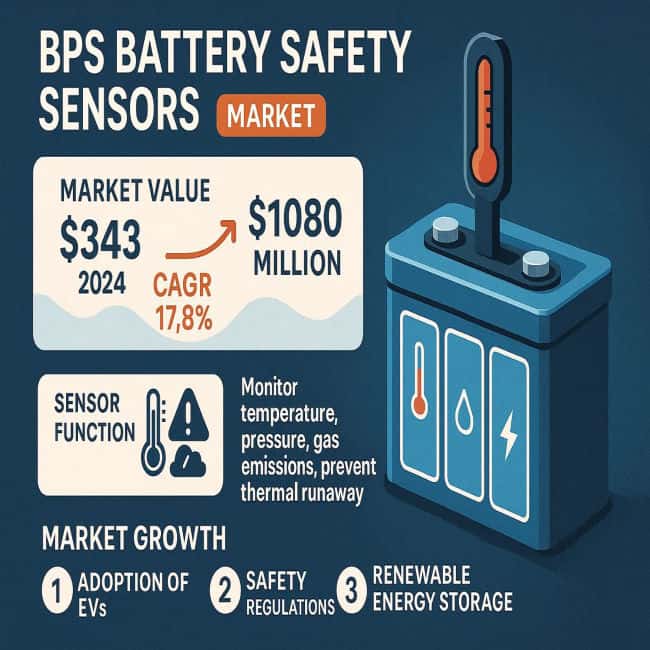
The BPS Battery Safety Sensors market, valued at US$ 343 million in 2024 and projected to reach US$1,080 million by 2032 at a 17.8% CAGR, sits at the crossroads of accelerating electrification and grid-scale energy expansion. The semiconductor industry continues to redefine global innovation, with this market showing robust expansion and technological disruption. Battery safety sensors — monitoring temperature, voltage, pressure and gas emissions are rapidly becoming mandatory components for safe EV and ESS deployments.
𝐃𝐨𝐰𝐧𝐥𝐨𝐚𝐝 𝐅𝐑𝐄𝐄 𝐒𝐚𝐦𝐩𝐥𝐞 𝐑𝐞𝐩𝐨𝐫𝐭: https://semiconductorinsight.com/download-sample-report/?product_id=117989
Emerging Trends Shaping the Market
- Multi-parameter integrated sensing: Compact modules that combine temperature, pressure and gas detection are reducing pack complexity and improving early-fault identification, speeding OEM adoption.
• IoT connectivity and predictive analytics: Cloud-linked sensor networks feeding AI-based models enable predictive maintenance and extend battery life, turning safety data into operational value.
• Wireless and modular BPS architectures: Wireless sensor solutions simplify wiring for large battery packs and enable modular, scalable battery systems for second-life and distributed storage use cases.
• Sustainability and recyclability in sensor design: Low-power operation and recyclable materials are increasingly demanded by OEMs and ESS integrators focused on circular-economy goals.
Each of these trends ties directly back to increased sensor penetration — both for regulatory compliance and for lifecycle cost reduction.
Key Market Drivers and Growth Factors
- Rapid EV adoption: Growing EV production and rising fleet electrification create a large and expanding addressable market.
• Tighter safety regulations: Mandates for real-time thermal monitoring in installations above 5 kWh and multi-point sensing for packs above 20 kWh accelerate retrofits and new integrations.
• Expansion of energy storage systems (ESS): Utility-scale and commercial ESS deployments, driven by renewables and backup-power needs, widen sensor use beyond automotive applications.
• High cost of battery failures: Recall events and expensive pack replacements make investment in advanced detection technologies financially prudent for manufacturers and operators.
These factors convert safety sensors from optional extras into procurement priorities and competitive differentiators.
𝐆𝐞𝐭 𝐅𝐮𝐥𝐥 𝐑𝐞𝐩𝐨𝐫𝐭 𝐇𝐞𝐫𝐞: https://semiconductorinsight.com/report/bps-battery-safety-sensors-market/
Strategic Developments by Key Players
Valeo — strengthening multi-sensor module offerings for EV platforms.
Honeywell International Inc. — adapting industrial sensing capabilities to meet ESS certification demands.
Metis Engineering Ltd. — commercializing advanced thermal-runaway detection for professional installations.
Cubic Sensor and Instrument Co., Ltd. — scaling integrated gas-detection modules tailored to automotive needs.
Volt Electronics — launched wireless BPS sensors to reduce wiring complexity and enable modular pack designs.
Dong Guan Churod Electronics — secured significant ESS contracts in Europe, expanding serviceable markets.
Zhengzhou Weisheng Electronic Technology Co. & Yangzhou Ruikong — leveraging local manufacturing to compete on price in Asia-Pacific.
These moves — from product launches to contract wins — underline a market shifting toward connected, certified, and differentiated safety solutions.
Segment Analysis: Who Leads the Market?
- By Type: Integrated sensors lead, favored for compactness and energy efficiency in modern packs.
• By Application: Electric vehicles represent the largest near-term demand; energy storage systems offer parallel, high-growth opportunities.
• By End User: Automotive OEMs hold the greatest share, driven by mandatory safety integration and OEM-driven system design.
Regional outlook: Asia-Pacific dominates due to dense EV supply chains and local manufacturing capacity, while North America and Europe emphasize regulatory compliance and third-party validation.
𝐃𝐨𝐰𝐧𝐥𝐨𝐚𝐝 𝐅𝐑𝐄𝐄 𝐒𝐚𝐦𝐩𝐥𝐞 𝐑𝐞𝐩𝐨𝐫𝐭: https://semiconductorinsight.com/download-sample-report/?product_id=117989
Technological Advancements Impacting Growth
Can AI-driven analytics reduce false alarms and speed detection? Yes — machine-learning models trained on multi-parameter sensor streams materially improve anomaly detection and help prioritize interventions. Advances in MEMS temperature sensors, gas-sensing chemistries, low-power wireless telemetry, and edge analytics are lowering both adoption barriers and total cost of ownership.
Why This Report Matters
This analysis provides decision-makers with actionable intelligence: precise market estimates for 2024–2032, regulatory inflection points, competitive positioning of leading and regional players, and technology roadmaps. Procurement teams, R&D leaders, and investors will find targeted opportunity mapping that highlights where certification readiness, integration capability, and manufacturing scale will determine market winners.
𝐆𝐞𝐭 𝐅𝐮𝐥𝐥 𝐑𝐞𝐩𝐨𝐫𝐭 𝐇𝐞𝐫𝐞: https://semiconductorinsight.com/report/bps-battery-safety-sensors-market/
𝐂𝐨𝐧𝐜𝐥𝐮𝐬𝐢𝐨𝐧
As EV production rises and grid-scale energy storage proliferates, BPS battery safety sensors will evolve from supplemental safety equipment to indispensable system components. Firms that combine multi-parameter sensing, analytics, certification readiness, and scalable manufacturing will gain disproportionate market share and long-term contracts.
Contact Us:
🌐 Website: https://semiconductorinsight.com/
📞 International: +91 8087 99 2013
🔗 LinkedIn: Follow Us

- Single-Domain Heavy Chain Antibody Market - 2026-01-23
- Qianlie Antong Capsules Market - 2026-01-23
- Veterinary Amitraz Solution Market - 2026-01-23