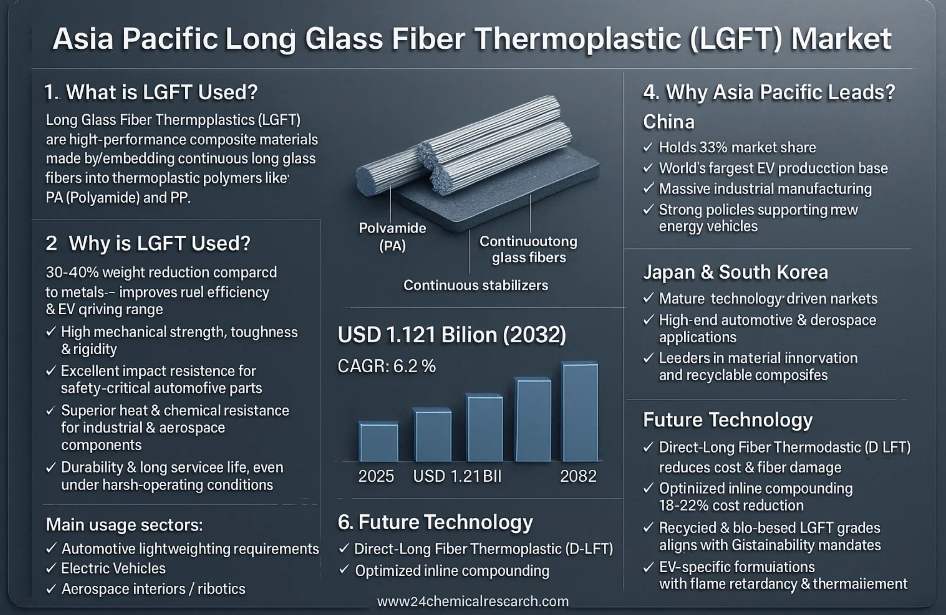
Asia Pacific Long Glass Fiber Thermoplastic (LGFT) market is projected to grow from USD 769.3 million in 2025 to USD 1.21 billion by 2032, achieving a compound annual growth rate (CAGR) of 6.2%. This robust expansion is fundamentally driven by the region’s leadership in automotive manufacturing and the global electric vehicle (EV) revolution, where LGFT’s exceptional strength-to-weight ratio is critical for lightweighting. The market’s trajectory is further supported by substantial investments in aerospace, industrial machinery, and continuous advancements in material science, positioning LGFT as a key enabler of next-generation manufacturing across the Asia Pacific.
Download FREE Sample Report: https://www.24chemicalresearch.com/download-sample/280032/asia-pacific-long-glass-fiber-thermoplastic-market
Market Definition and Strategic Importance
Long Glass Fiber Thermoplastics are high-performance composite materials engineered by embedding continuous glass fibers into a thermoplastic polymer matrix, such as polyamide (PA) or polypropylene (PP). This structure provides superior mechanical properties—including high strength, stiffness, and impact resistance—compared to short-fiber composites. Their strategic importance lies in replacing traditional metals and other materials to achieve significant weight reduction, which is a non-negotiable requirement for improving fuel efficiency in conventional vehicles and extending the range of electric vehicles, while also meeting the demanding performance needs of aerospace and industrial applications.
Market Drivers and Key Advantages
- Automotive Lightweighting Imperative: The paramount driver is the automotive industry’s urgent need for lightweight materials. LGFT components offer 30-40% weight reduction versus metals, directly contributing to improved fuel economy and reduced emissions for internal combustion engines and critically extending the driving range of electric vehicles. The Chinese EV market, accounting for over 60% of global production, is a primary consumption hub.
- Expansion in High-Value Industrial Sectors: Significant growth is fueled by investments in aerospace, defense, and industrial automation. LGFTs are increasingly adopted for aircraft interiors, robotic arms, and pump housings due to their excellent durability, chemical resistance, and dimensional stability, which enhance product lifespan and performance in demanding environments.
- Technological and Manufacturing Advancements: Innovations in processing technologies, particularly in-line compounding, present a major opportunity. This method can reduce part costs by 18-22% by improving production cycle times and better preserving fiber length and integrity, thereby enhancing the material’s performance-to-cost ratio and competitiveness.
Primary Market Challenges and Restraints
- High Production and Processing Costs: The total cost of manufacturing with LGFT remains a significant barrier. Specialized injection molding equipment and processes can add 25-30% to production costs compared to short-fiber composites. Furthermore, technical challenges like fiber attrition during processing can lead to 15-20% material loss, impacting overall economics.
- Intense Competition from Alternative Materials: LGFT faces strong competition from other advanced lightweight solutions, including carbon fiber composites and aluminum hybrids. In applications where ultimate performance or minimal weight is paramount, these alternatives can justify their higher cost, pressuring LGFT’s market position in premium segments.
- Raw Material Volatility and Supply Chain Pressures: Manufacturing costs are sensitive to fluctuations in the prices of key inputs, namely fiberglass and polymer resins such as polyamide. This volatility creates margin pressure for compounders and complicates long-term budgeting and pricing strategies for original equipment manufacturers (OEMs).
- Technical Certification and Skills Gap: The lengthy (18-24 months) and costly certification processes required for new materials in automotive and aerospace applications slow time-to-market. Concurrently, a regional shortage of skilled technicians for specialized LGFT processing—estimated at 15,000 qualified professionals—creates operational bottlenecks and delays in capacity expansion.
Competitive Landscape and Key Players
The market is semi-consolidated, featuring a mix of global chemical conglomerates and specialized material science firms with strong technological portfolios.
- Global Material Science Leaders:
- SABIC (Saudi Arabia)
- BASF SE (Germany)
- Lanxess AG (Germany)
- Solvay (Belgium)
- Specialized and Regional Powerhouses:
- Toray Industries, Inc. (Japan)
- Celanese Corporation (U.S.)
- Sumitomo Chemical (Japan)
- DSM (Netherlands)
Market Segmentation and Regional Dynamics
Segmentation by Resin, Application, and Process:
The market is segmented by resin type, application, and manufacturing process. By resin, Polyamide (PA) is the leading segment due to its high-performance characteristics, while Polypropylene (PP) is significant for cost-sensitive applications. Injection Molding remains the dominant manufacturing process. In terms of applications, the Automotive sector is the largest consumer, with structural components and battery enclosures for EVs being critical growth areas.
Regional Analysis highlights distinct leadership and growth patterns:
- China: The undisputed market engine, commanding over 38% of the regional share. Its dominance is anchored by the world’s largest automotive and EV production base, massive industrial manufacturing, and strong governmental support for advanced materials and new energy vehicles.
- Japan and South Korea: These are mature, technology-driven markets focused on high-value applications in automotive, aerospace, and electronics. They lead in material innovation, including the development of bio-based resins and advanced recycling technologies for composites.
- Southeast Asia and India: Represent high-growth emerging markets fueled by increasing foreign direct investment in manufacturing, growing domestic automotive production, and rising industrialization, which drive demand for durable, high-performance materials.
Technological Pathways and Future Projections
Market progression toward its 2032 valuation is tightly linked to cost reduction, performance enhancement, and sustainability.
- Advancements in Processing and Compounding: The future will see increased adoption of Direct-Long Fiber Thermoplastic (D-LFT) and optimized in-line compounding processes. These technologies are key to reducing cycle times, minimizing fiber damage, and ultimately lowering the total system cost, making LGFT more competitive against metals.
- Development of Sustainable Material Solutions: Aligning with regional environmental goals, significant R&D is focused on creating LGFT grades with recycled content and bio-based polymer matrices. This evolution supports the circular economy and meets the growing demand for sustainable material options in automotive and consumer goods.
- Innovation for Next-Generation Mobility: As EV architectures evolve, material requirements will become more specific. Future growth relies on developing LGFT formulations with enhanced flame retardancy for battery systems, improved thermal management properties, and tailored solutions for structural vehicle components in next-generation vehicle platforms.
Summary of Strategic Insights
The Asia Pacific LGFT market is on a strong growth trajectory, powered by the region’s manufacturing dominance and the structural shift toward vehicle electrification and industrial advancement. While challenges related to cost, competition, and technical expertise persist, the fundamental drivers of lightweighting and performance are compelling and sustained.
Future market leadership will be determined by a company’s ability to innovate in cost-effective manufacturing processes, develop sustainable material solutions that meet regional regulatory trends, and forge deep collaborative partnerships with automotive and industrial OEMs. Players that can successfully integrate advanced material science with application-specific engineering support will be best positioned to capitalize on the expansive opportunities across this dynamic region.
Get Full Report Here: https://www.24chemicalresearch.com/reports/280032/asia-pacific-long-glass-fiber-thermoplastic-market-2024-2030-257
Contact Information:
International: +1(332) 2424 294
Asia: +91 9169162030
Website: https://www.24chemicalresearch.com/
Follow us on LinkedIn: https://www.linkedin.com/company/24chemicalresearch
➤ See Related Report :
Global China Ceramic Magnets Market Report 2025-2032
Global 3D Graphene Foam Market Report 2025-2032
Global 4 Formylpyridine Market Report 2025-2032
