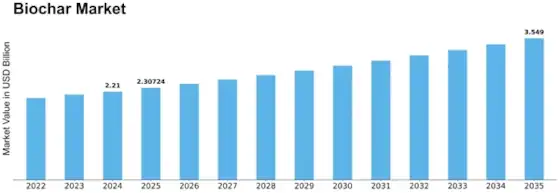
The global biochar market is witnessing remarkable growth as industries and governments increasingly adopt carbon-negative technologies to address climate change, soil degradation, and agricultural productivity challenges. Biochar, a stable, carbon-rich material produced by the pyrolysis of organic biomass, plays a crucial role in long-term carbon sequestration and soil enhancement. Its ability to store carbon for hundreds to thousands of years makes it an essential component of global climate action strategies. At the same time, its soil-enriching properties have made it invaluable for farmers seeking higher crop yields, improved soil structure, and enhanced water retention.
As sustainability and regenerative agriculture gain momentum globally, the demand for biochar continues to rise across both developed and developing economies. Government policies, incentives for carbon sequestration, and increased awareness of soil health are fueling rapid market expansion. This growth is further supported by research advancements, innovations in pyrolysis technologies, and the growing need for organic waste management solutions.
Market Drivers and Growth Factors
One of the primary forces driving the biochar market is the global urgency to reduce carbon emissions. Biochar production effectively locks carbon away, preventing its release into the atmosphere and helping countries progress toward net-zero targets. As nations implement carbon credit programs, forests, farmlands, and industries are increasingly integrating biochar into soil and environmental management systems.
Another major driver is agricultural demand. Soil degradation, nutrient deficiencies, and declining crop yields continue to challenge the global food system. Biochar helps rejuvenate soil by improving aeration, increasing nutrient retention, and enhancing microbial activity. These benefits translate into higher agricultural productivity, particularly in regions where soil health has deteriorated due to overuse, chemical runoff, or climate impacts.
Waste management challenges also contribute to the expansion of the biochar market. Converting agricultural waste, forestry residues, and organic by-products into biochar offers a sustainable alternative to burning or landfilling. This not only reduces pollution but also creates valuable soil-enhancing products. Industries such as forestry, agriculture, and municipal waste management are adopting biochar production technologies as part of circular economy initiatives.
Download Report Sample Copy with TOC: https://www.marketresearchfuture.com/sample_request/10808
Market Segmentation
The global biochar market can be segmented based on technology, application, and feedstock.
By Technology
Pyrolysis
Gasification
Slow Pyrolysis
Fast Pyrolysis
Hydrothermal Carbonization
Pyrolysis remains the dominant technology due to its ability to yield high-quality biochar and its operational efficiency. Slow pyrolysis, which produces a higher char yield, is especially favored for agricultural applications. Gasification is also gaining traction as industries look for scalable and energy-efficient biomass conversion technologies.
By Application
Agriculture
Livestock Farming
Metal Recovery
Water Treatment
Construction Materials
Energy Generation
Agriculture accounts for the largest share of the market, with biochar widely used in soil conditioning, composting, and organic farming. In livestock farming, biochar enhances animal feed efficiency and reduces methane emissions. Its porous structure makes it suitable for water filtration, while its thermal stability supports applications in energy and industrial processes.
By Feedstock
Agricultural Waste
Forestry Waste
Animal Manure
Municipal Waste
Others
Agricultural waste is the primary feedstock used globally due to its abundance and low cost.
Regional Insights
The global biochar market shows strong regional variation driven by environmental policies, agricultural needs, and technological advancements.
North America leads the market, supported by advanced farming systems, carbon credit initiatives, and large-scale adoption of sustainable agricultural practices. The United States has emerged as a major producer and consumer of biochar, with universities and research institutions driving technological innovation.
Europe is another significant market, propelled by strict environmental regulations, climate action policies, and strong commitments to carbon sequestration. European countries are promoting biochar through soil management programs and renewable energy strategies. Germany, the UK, and the Nordic region are notable contributors.
Asia Pacific represents the fastest-growing market, driven by agricultural demand, rapidly increasing population, and extensive need for soil enhancement. Countries such as China, India, Indonesia, and Japan are scaling up biochar usage to improve soil fertility and manage large volumes of agricultural residue.
Latin America and Africa also show strong potential due to their expanding agricultural sectors and increasing awareness of soil health and regenerative farming.
Opportunities and Challenges
The biochar market is poised for significant opportunities across agriculture, carbon sequestration, and waste management. The growing acceptance of carbon credits is expected to unlock billions of dollars in value for farmers and industries deploying biochar on a large scale. Similarly, innovations in pyrolysis technologies are reducing production costs and enhancing product consistency.
However, the industry faces challenges. The high initial investment in production systems, lack of standardized product quality, and limited awareness among rural farmers hinder adoption. Supply chain fragmentation and regulatory variations across regions also slow down market development. Despite these barriers, increasing global attention to sustainability ensures strong long-term market prospects.
Related Report
