Introduction
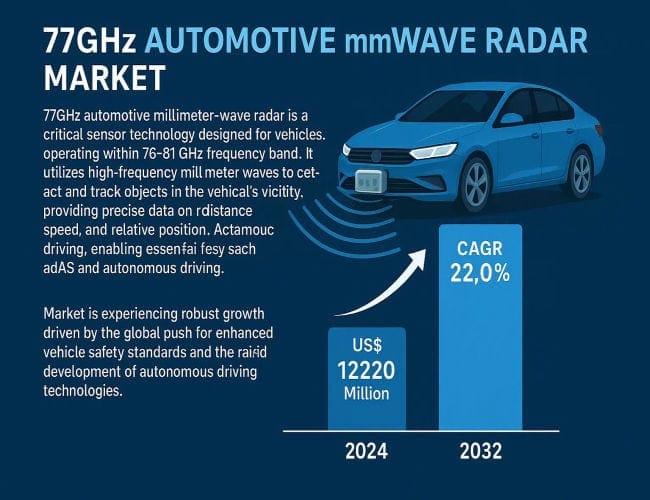
The Global 77GHz Automotive mmWave Radar Market, valued at USD 12,220 million in 2024, is set for remarkable growth, projected to reach USD 49,150 million by 2032 at a CAGR of 22.0%. As vehicles evolve toward higher levels of automation, 77GHz radar systems emerge as foundational components of safety, perception, and driving intelligence. The semiconductor industry continues to redefine global innovation, with this market showing robust expansion and technological disruption across every tier of automotive engineering.
𝐃𝐨𝐰𝐧𝐥𝐨𝐚𝐝 𝐅𝐑𝐄𝐄 𝐒𝐚𝐦𝐩𝐥𝐞 𝐑𝐞𝐩𝐨𝐫𝐭: https://semiconductorinsight.com/download-sample-report/?product_id=117498
Emerging Trends Shaping the Market
Rise of AI-Enhanced Radar Signal Processing
Artificial intelligence is transforming radar capabilities by enabling faster and more accurate object classification. These AI-driven algorithms help 77GHz radar systems distinguish between pedestrians, roadside objects, and moving vehicles with greater reliability, improving the performance of ADAS and automated driving functions.
Shift Toward Multi-Radar Architectures in Level 3+ Vehicles
Advanced autonomy demands more diverse perception inputs. The industry is transitioning to multi-radar configurations—combining long-, medium-, and short-range systems—to enhance 360-degree situational awareness. This trend directly reinforces the adoption of 77GHz radars, which serve as the central perception layer for vehicle decision-making.
Integration of Radar in 3D Sensor Fusion Platforms
Automakers are increasingly pairing radar with LiDAR, cameras, and ultrasonic sensors to build high-resolution sensor fusion systems. 77GHz radar adds reliability in rain, fog, and low-light conditions, strengthening fused perception stacks for next-generation automated vehicles.
Advancements in Compact mmWave Radar Packaging
Innovations in semiconductor packaging, including 3D stacking and system-on-chip (SoC) radars, are reducing module size while enhancing performance. These highly integrated designs allow OEMs to place radars in tight vehicle corners without compromising range or accuracy.
Sustainability-Driven Redesign of Automotive Electronics
Automakers are pursuing energy-efficient radar systems with optimized power consumption and recyclable components. As sustainability becomes a global priority, greener electronic architectures are influencing the design philosophy of mmWave radar modules.
Key Market Drivers and Growth Factors
- Rapid progression toward Level 2+, Level 3, and Level 4 autonomy is sharply increasing radar unit installations per vehicle.
• Rising regulatory mandates for AEB, FCW, and BSD systems accelerate the adoption of 77GHz radars.
• Superior range, resolution, and interference tolerance over 24GHz systems make 77GHz technology the preferred choice for future vehicles.
• Expansion of automotive manufacturing in Asia-Pacific boosts high-volume radar deployments.
• Growing demand for intelligent safety systems in both passenger and commercial vehicles fuels market momentum.
𝐃𝐨𝐰𝐧𝐥𝐨𝐚𝐝 𝐅𝐑𝐄𝐄 𝐒𝐚𝐦𝐩𝐥𝐞 𝐑𝐞𝐩𝐨𝐫𝐭: https://semiconductorinsight.com/download-sample-report/?product_id=117498
Strategic Developments by Key Players
Leading companies are expanding manufacturing capacity, investing in R&D, and forming alliances to deliver more intelligent radar systems:
- Robert Bosch GmbH is advancing radar platforms optimized for automated lane-keeping and predictive safety analytics.
• Continental AG continues to invest in high-integration radar chipsets supporting multi-sensor fusion.
• Denso Corporation is enhancing long-range radar modules for smoother high-speed automation.
• Aptiv PLC is focusing on scalable radar architectures for software-defined vehicles.
• ZF Friedrichshafen AG is accelerating radar-centric ADAS solutions tailored to Level 3 autonomy.
• Valeo SA is developing next-generation imaging radars to improve object separation and perception depth.
• HELLA GmbH & Co. KGaA is expanding global production to meet rising OEM demand in Asia and Europe.
These companies are also collaborating with semiconductor suppliers to develop cost-optimized chipsets, enabling mass adoption across vehicle categories.
Segment Analysis: Who Leads the Market?
Long-range radar systems account for the largest market share, driven by their role in adaptive cruise control and highway autopilot functions. Passenger vehicles dominate overall adoption due to growing integration of safety features across mid- and high-end models. From a regional perspective, Asia-Pacific leads the market, supported by strong automotive manufacturing ecosystems in China, Japan, and South Korea. North America follows, driven by rapid development in autonomous driving technologies.
Technological Advancements Impacting Growth
Can AI-Driven Radar Processing Redefine Autonomous Vehicle Accuracy?
Machine learning and neural-network processing embedded within radar chipsets are enabling more precise detection of small and fast-moving objects. In parallel, new CMOS-based mmWave platforms offer enhanced integration and lower power consumption. Advances in nanofabrication and automated testing are reducing unit costs, improving reliability, and increasing performance consistency. Cleanroom robotics and semiconductor-grade precision manufacturing further elevate the quality of radar modules entering the market.
Why This Report Matters
This market analysis provides:
• Detailed market estimations from 2024–2032
• Competitive intelligence across global and regional players
• Technology roadmaps shaping next-generation radar development
• Opportunity mapping for OEMs, Tier-1 suppliers, and semiconductor companies
• Strategic insights into segment performance and future demand patterns
The report serves as a comprehensive resource for decision-makers navigating the rapidly evolving automotive perception ecosystem.
𝐆𝐞𝐭 𝐅𝐮𝐥𝐥 𝐑𝐞𝐩𝐨𝐫𝐭 𝐇𝐞𝐫𝐞: https://semiconductorinsight.com/report/77ghz-automotive-mmwave-radar-market/
Conclusion
As the race toward autonomous mobility accelerates, 77GHz automotive radar stands at the center of the transformation. Stakeholders must align innovation with cost efficiency, software intelligence, and safety standards to maintain competitiveness in an increasingly sensor-driven automotive future.
Contact Us:
🌐 Website: https://semiconductorinsight.com/
📞 International: +91 8087 99 2013
🔗 LinkedIn: Follow Us
