Market Overview
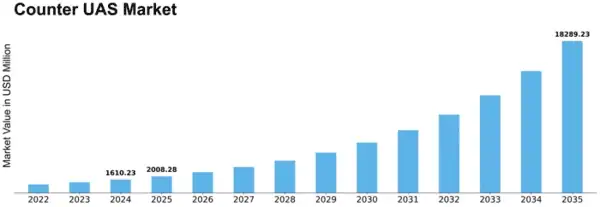
The Counter UAS Market, which was valued at USD 1.61 billion in 2024, is expected to expand significantly and reach USD 18.29 billion by 2035. This increase is indicative of a strong compound annual growth rate (CAGR) of 24.7% from 2025 to 2034.
The counter-unmanned aerial systems (C-UAS) market is witnessing unprecedented growth, propelled by escalating security concerns and technological advancements. As drones become more accessible and their applications diversify, the need for effective countermeasures has never been more critical. This article explores the dynamics of the C-UAS market, highlighting its growth trajectory, influencing factors, emerging trends, and future outlook.
Growth Drivers
Several factors are fueling the rapid growth of the C-UAS market. The proliferation of drones in both military and civilian applications has heightened concerns over unauthorized surveillance, potential attacks, and breaches of sensitive areas. Governments and defense organizations are investing heavily in countermeasures to mitigate these threats. Technological advancements in radar, radio frequency (RF) jamming, and directed energy weapons have enhanced the effectiveness of C-UAS systems, making them more attractive to end-users. Additionally, the increasing frequency of drone-related incidents at critical infrastructure sites and public events has further propelled the demand for robust counter-UAS solutions.
Free Sample Copy – Access a complimentary copy of our report to explore its content and insights.
Key Companies: Northrop Grumman, Boeing, Lockheed Martin, BAE Systems, Raytheon, Airbus, Thales Group, Israel Aerospace Industries, Elbit Systems, General Atomics.
Emerging Trends
The C-UAS market is witnessing several emerging trends that are shaping its future. Integration of artificial intelligence (AI) and machine learning (ML) into C-UAS systems is enabling real-time threat assessment and automated responses, enhancing operational efficiency. The development of multi-layered defense strategies, combining detection, identification, and neutralization capabilities, is becoming standard practice. Moreover, the miniaturization of counter-UAS technologies is facilitating their deployment in diverse environments, from military bases to urban settings. The rise of commercial drone usage has also led to increased collaboration between public and private sectors to develop comprehensive countermeasures.
Opportunities
The expanding C-UAS market presents numerous opportunities for stakeholders across the value chain. Defense contractors and technology providers can capitalize on the growing demand for advanced counter-UAS systems by investing in research and development to create innovative solutions. Governments and law enforcement agencies are potential end-users, seeking to bolster national security and public safety. Furthermore, the integration of C-UAS systems into smart city infrastructures offers new avenues for growth, as urban areas aim to protect against drone-related threats. The commercial sector, including airports, stadiums, and critical infrastructure facilities, represents a burgeoning market for counter-UAS solutions.
Future Outlook
Looking ahead, the C-UAS market is poised for continued growth and innovation. Advancements in technology, coupled with the increasing need for aerial security, will drive the development of more sophisticated and cost-effective countermeasures. Collaboration between governments, defense organizations, and private enterprises will be crucial in addressing the evolving challenges posed by drone threats. As regulatory frameworks evolve to accommodate the growing presence of drones, the C-UAS market will play a pivotal role in ensuring the safety and security of airspace worldwide.
In conclusion, the counter-UAS market is at the forefront of addressing the challenges posed by the proliferation of unmanned aerial systems. With sustained investment in technology and strategic collaboration across sectors, the industry is well-positioned to safeguard the skies against emerging threats, ensuring a secure and resilient future.
Table of Contents
SECTION I: EXECUTIVE SUMMARY AND KEY HIGHLIGHTS
SECTION II: SCOPING, METHODOLOGY AND MARKET STRUCTURE
SECTION III: QUALITATIVE ANALYSIS
SECTION IV: QUANTITATIVE ANALYSIS
SECTION V: COMPETITIVE ANALYSIS ……..
Discover more research Reports on Aerospace & Defense by Market Research Future:
Inflight Shopping Market Research Overview
Drone Analytics Market Research Overview
eVTOL Aircraft Market Research Overview
Maritime VSAT Market Research Overview
Satellite Market Research Overview
Air Traffic Control (ATC) Simulation & Training Market Research Overview
Autonomous Ships Market Research Overview
About Market Research Future:
At Market Research Future (MRFR), we enable our customers to unravel the complexity of various industries through our Cooked Research Report (CRR), Half-Cooked Research Reports (HCRR), Raw Research Reports (3R), Continuous-Feed Research (CFR), and Market Research & Consulting Services.
MRFR team have supreme objective to provide the optimum quality market research and intelligence services to our clients. Our market research studies by products, services, technologies, applications, end users, and market players for global, regional, and country level market segments, enable our clients to see more, know more, and do more, which help to answer all their most important questions.
Contact Us:
Market Research Future (part of Wantstats Research and Media Private Limited),
99 Hudson Street,5Th Floor, New York, New York 10013, United States of America
𝐂𝐨𝐧𝐭𝐚𝐜𝐭 𝐍𝐮𝐦𝐛𝐞𝐫:
+1 (855) 661-4441 (US)
+44 1720 412 167 (UK)
+91 2269738890 (APAC)
𝐄𝐦𝐚𝐢𝐥: info@marketresearchfuture.com
