Market Overview
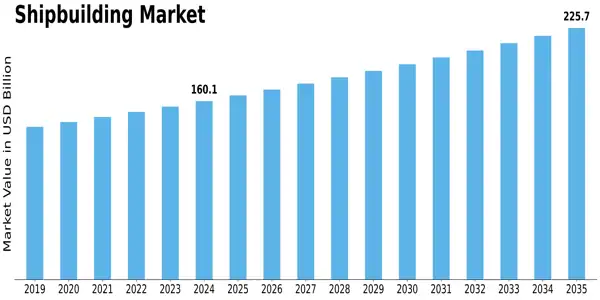
The global Shipbuilding Market industry is navigating a course toward steady growth, with the market valued at USD 155.91 billion in 2023. Projections indicate an increase to USD 197.94 billion by 2030, reflecting a compound annual growth rate (CAGR) of 2.67%. This growth trajectory underscores the sector’s resilience and adaptability in the face of evolving global trade dynamics and technological advancements.
Key Growth Drivers
Several factors are propelling the shipbuilding market forward:
- Rising Seaborne Trade: The expansion of global trade has led to increased demand for various types of vessels, including bulk carriers, tankers, and container ships, to facilitate the transportation of goods across international waters.
- Technological Advancements: Innovations in ship design, automation, and materials are enhancing vessel efficiency, safety, and environmental performance, making modern ships more attractive to operators.
- Environmental Regulations: Stricter international maritime regulations are prompting shipbuilders to develop eco-friendly vessels that comply with emission standards, driving demand for green technologies.
- Fleet Modernization: Aging fleets are being replaced with newer, more efficient ships, contributing to the demand for new builds and retrofitting services.
Free Sample Copy- Access a complimentary copy of our report to explore its content and insights.
Major Players: Raytheon Technologies Corporation (US), Huntington Ingalls Industries, Inc. (US), General Dynamics Corporation (US), Damen Shipyards Group (Netherlands), BAE Systems (UK), STX Offshore & Shipbuilding Co., Ltd. (South Korea), Sumitomo Heavy Industries, Ltd. (Japan), FINCANTIERI S.p.A. (Italy), China State Shipbuilding Corporation Limited (China), DSME Co., Ltd. (South Korea), China Shipbuilding Industry Corporation (China), United Shipbuilding Corporation (Russia), LARSEN & TOUBRO LIMITED (India), Northstar Shipbuilding Pvt. Ltd. (India), TSUNEISHI SHIPBUILDING Co., Ltd. (Japan).
Emerging Trends
The shipbuilding industry is witnessing several emerging trends that are shaping its future:
- Digitalization: The integration of digital technologies, including Internet of Things (IoT) sensors and data analytics, is improving operational efficiency and predictive maintenance capabilities.
- Sustainability Initiatives: Shipbuilders are increasingly focusing on sustainable practices, such as using alternative fuels and designing energy-efficient vessels, to meet environmental standards and reduce operational costs.
- Modular Construction: The adoption of modular construction techniques allows for more flexible and cost-effective shipbuilding processes, enabling quicker delivery times and customization.
- Automation and Robotics: The implementation of automation and robotics in shipyards is enhancing precision, reducing labor costs, and improving safety standards.
Regional Insights
- Asia-Pacific Dominance: The Asia-Pacific region continues to lead the global shipbuilding market, with countries like China, South Korea, and Japan being major contributors to production and exports.
- North America and Europe: While these regions have a smaller share in global production, they are focusing on specialized vessels and advanced technologies, catering to niche markets and high-value segments.
Opportunities for Stakeholders
The evolving shipbuilding landscape presents numerous opportunities for industry stakeholders:
- Investment in Research and Development: Companies investing in R&D can capitalize on the development of innovative ship designs and technologies, gaining a competitive edge in the market.
- Strategic Partnerships: Collaborations between shipbuilders, technology providers, and regulatory bodies can facilitate the development of vessels that meet emerging environmental and safety standards.
- Expansion into Emerging Markets: Exploring opportunities in emerging economies with growing trade activities can open new avenues for shipbuilding projects and services.
Challenges to Address
Despite the positive growth outlook, the shipbuilding industry faces several challenges:
- Supply Chain Disruptions: Global supply chain issues can impact the timely delivery of materials and components, affecting production schedules and costs.
- Skilled Labor Shortage: The industry faces a shortage of skilled workers, necessitating investment in training and development programs to ensure a competent workforce.
- Economic Fluctuations: Economic downturns can lead to reduced demand for new vessels, affecting order volumes and profitability.
Future Outlook
Looking ahead, the global shipbuilding market is expected to continue its growth trajectory, driven by ongoing advancements in technology, sustainability efforts, and the increasing demand for efficient maritime transportation solutions. Stakeholders who adapt to these trends and address the associated challenges will be well-positioned to capitalize on the opportunities within the evolving shipbuilding landscape.
Table of Contents
SECTION I: EXECUTIVE SUMMARY AND KEY HIGHLIGHTS
SECTION II: SCOPING, METHODOLOGY AND MARKET STRUCTURE
SECTION III: QUALITATIVE ANALYSIS
SECTION IV: QUANTITATIVE ANALYSIS
SECTION V: COMPETITIVE ANALYSIS ……..
Discover more research Reports on Aerospace & Defense by Market Research Future:
Air Traffic Control (ATC) Simulation & Training Market
Space Debris Monitoring and Removal Market
Contact Us:
Market Research Future (part of Wantstats Research and Media Private Limited),
99 Hudson Street,5Th Floor, New York, New York 10013, United States of America
𝐂𝐨𝐧𝐭𝐚𝐜𝐭 𝐍𝐮𝐦𝐛𝐞𝐫:
+1 (855) 661-4441 (US)
+44 1720 412 167 (UK)
+91 2269738890 (APAC)
𝐄𝐦𝐚𝐢𝐥: info@marketresearchfuture.com
