The global construction and infrastructure industry is witnessing continuous transformation, with safety, aesthetics, and durability becoming central design considerations. One critical architectural element that combines all three aspects is the balustrade. Balustrades are protective barriers installed along staircases, balconies, terraces, bridges, and walkways to prevent falls while enhancing visual appeal.
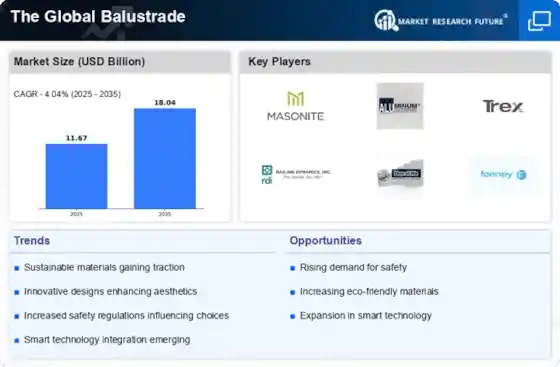
According to MRFR analysis, the Global Balustrade Market Size was estimated at USD 11.67 Billion in 2024. The industry is projected to grow from USD 12.14 Billion in 2025 to USD 18.04 Billion by 2035, registering a CAGR of 4.04% during the forecast period (2025–2035).
Market Drivers
Several factors are driving the growth of the global balustrade market:
- Rapid Urbanization and Infrastructure Development
Urban expansion, smart city initiatives, and large-scale infrastructure projects such as airports, metro stations, and commercial complexes are increasing the demand for durable balustrade systems. - Rising Safety Awareness
Stringent building safety standards across residential and commercial buildings are compelling developers to install compliant balustrade systems. - Architectural Aesthetics and Customization
Modern architectural trends favor sleek glass, stainless steel, and aluminum balustrades, boosting adoption in luxury housing and commercial spaces. - Growth in Renovation Activities
Renovation and remodeling projects in developed economies are replacing traditional wooden systems with modern balustrade solutions.
Get a Sample PDF Brochure of the Report https://www.marketresearchfuture.com/sample_request/27091
Regulation (Religion / Regulatory Environment)
Government regulations and building codes play a crucial role in shaping the balustrade market. Authorities across regions enforce strict height, load-bearing, and material safety standards to reduce accident risks. Compliance with international and regional construction standards such as ISO certifications and local building safety codes ensures product quality and reliability. These regulatory frameworks not only ensure public safety but also encourage innovation in material usage and installation techniques.
Market Objectives
The primary objectives of the balustrade market include:
- Enhancing public and residential safety
- Supporting sustainable and recyclable construction materials
- Improving architectural aesthetics
- Offering cost-effective and long-lasting solutions
- Expanding adoption across industrial, commercial, and residential applications
Manufacturers are increasingly focusing on lightweight, corrosion-resistant, and low-maintenance balustrade systems to meet evolving customer expectations.
Key Players
The global balustrade market is moderately competitive, with both global and regional players focusing on product innovation and geographic expansion. Key players typically invest in advanced materials, modular designs, and strategic partnerships with construction firms. Leading companies emphasize aluminum, glass, stainless steel, and composite balustrades to cater to diverse architectural requirements.
Challenges
Despite steady growth, the market faces several challenges:
- High Installation Costs: Premium materials such as glass and stainless steel increase overall project costs.
- Maintenance Concerns: Glass balustrades require regular cleaning and care.
- Raw Material Price Volatility: Fluctuations in metal prices can impact profit margins.
- Skilled Labor Requirement: Proper installation demands trained professionals, which can be limited in emerging markets.
Buy Now https://www.marketresearchfuture.com/checkout?currency=one_user-USD&report_id=27091
Market Segmentation
The global balustrade market is segmented based on material, application, and end-user:
- By Material: Glass, metal, wood, stone, composite
- By Application: Staircases, balconies, terraces, bridges, walkways
- By End-User: Residential, commercial, industrial
Among these, glass and metal balustrades dominate due to their modern appearance, durability, and compliance with safety norms.
Future Outlook
The future of the balustrade market looks promising, supported by continuous growth in construction activities and evolving architectural preferences. Technological advancements such as smart glass, modular systems, and eco-friendly materials are expected to reshape the industry. Emerging economies in Asia-Pacific and the Middle East are likely to offer lucrative growth opportunities due to rapid urbanization and infrastructure investments.
With increasing emphasis on safety, sustainability, and design innovation, the global balustrade market is poised for consistent expansion through 2035, reinforcing its importance within the broader construction and architectural industry.
Browse More Reports:
