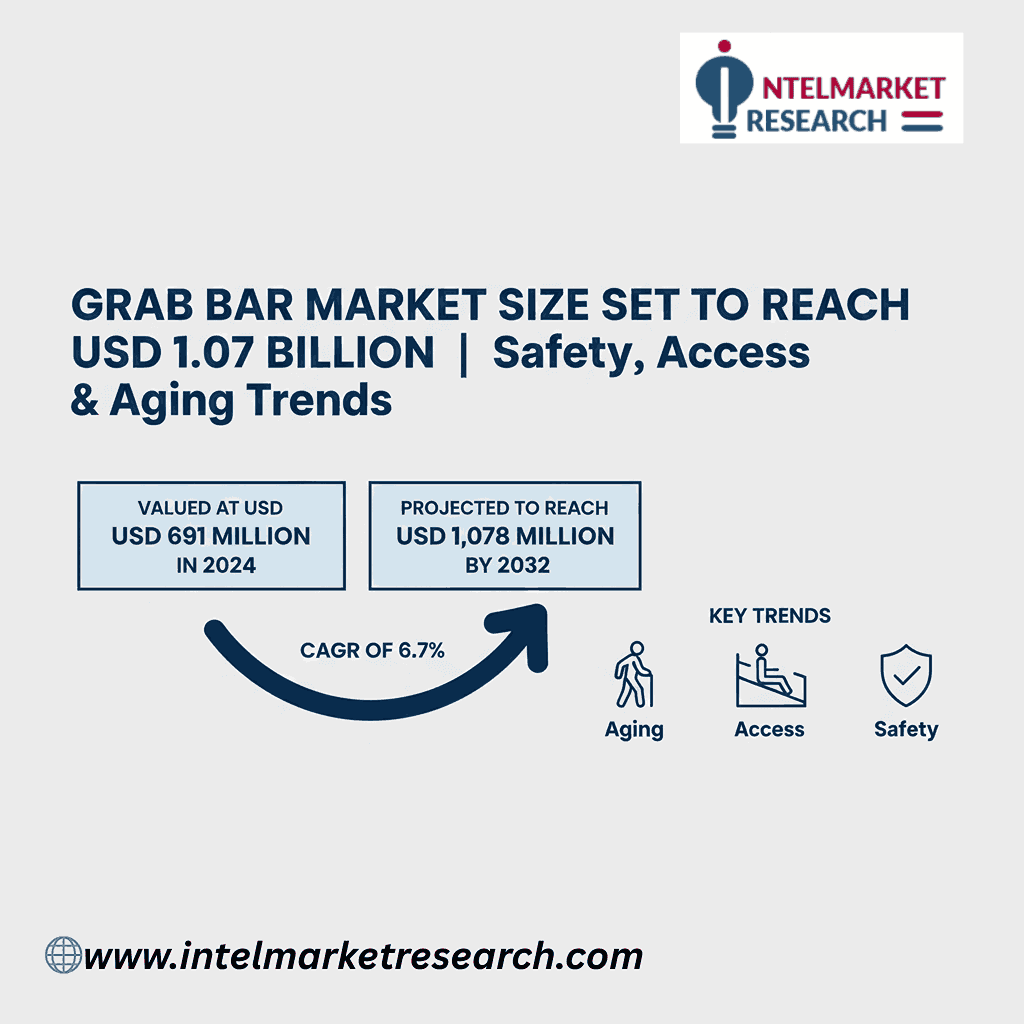
The global grab bar market is entering a decisive growth phase as safety, accessibility, and inclusive design move from optional features to essential infrastructure. Valued at USD 691 million in 2024, the market is projected to reach USD 1,078 million by 2032, expanding at a CAGR of 6.7% during the 2025–2032 period. Driven by demographic shifts, stricter building regulations, and rising awareness of fall prevention, grab bars are increasingly embedded across residential, healthcare, and commercial environments worldwide.
At the center of this expansion is a simple but critical need: reducing injury risk while improving mobility and independence. From private homes to hospitals, hotels, and public facilities, grab bars are becoming a standard requirement rather than a retrofit solution, reflecting a broader shift toward safer and more inclusive spaces.
Get FREE Sample Report:www.intelmarketresearch.com/download-free-sample/10833/grab-bar-2025-2032-217
Emerging Market Trends
One of the most visible trends reshaping the grab bar market is the integration of safety design into modern architecture. Builders and interior designers are increasingly specifying grab bars during the planning phase, particularly in multi-family housing and senior living projects, rather than treating them as aftermarket additions.
Material innovation is also gaining momentum. Manufacturers are moving beyond basic stainless steel toward corrosion-resistant alloys, antimicrobial coatings, and aesthetically refined finishes that blend with contemporary interiors. This evolution is helping overcome long-standing consumer resistance tied to the “clinical” appearance of safety fixtures.
Another notable trend is the rise of universal design principles. Grab bars are no longer limited to elderly care settings; they are being adopted in homes for families with children, hospitality spaces, and workplaces seeking to reduce liability and improve user comfort. This broader appeal is expanding the addressable market across income groups and regions.
Get the Complete Report & TOC:www.intelmarketresearch.com/consumer-goods-and-services/10833/grab-bar-2025-2032-217
Key Market Drivers
Population aging remains the most powerful growth driver. As life expectancy increases across Europe, North America, and parts of Asia, the demand for in-home safety solutions that support independent living is accelerating. Grab bars are among the most cost-effective interventions to prevent falls, which remain a leading cause of injury-related hospitalization globally.
Regulatory pressure is another catalyst. Building codes and accessibility standards in many countries now mandate the installation of grab bars in public buildings, healthcare facilities, and certain residential projects. Compliance with these standards is creating steady baseline demand, particularly in developed markets.
Rising healthcare costs are also influencing adoption. Preventive safety installations are increasingly viewed as a way to reduce long-term medical expenses associated with fall-related injuries, encouraging adoption by insurers, care providers, and facility managers.
Get the Complete Report & TOC:www.intelmarketresearch.com/consumer-goods-and-services/10833/grab-bar-2025-2032-217
Competitive Landscape: Leading Players
The global grab bar market remains fragmented, with the top ten companies accounting for roughly 11% of total market share. This competitive structure encourages continuous product differentiation and regional expansion.
Key players such as TOTO, MOEN, Kohler, LIXIL Group, and Pressalit Care are focusing on design-led innovation, combining safety performance with premium aesthetics. Companies including Invacare, Handicare, Drive DeVilbiss, and Etac continue to strengthen their presence in medical and assisted-living segments through product reliability and clinical partnerships. Asian manufacturers such as KAWAJUN, YJL, and Liansheng are expanding exports, supported by cost efficiency and growing domestic demand.
Segment Analysis & Regional Outlook
Wall-mounted grab bars represent the dominant product segment, favored for their ease of installation and versatility across residential and commercial settings. Floor-mounted designs, while a smaller segment, are gaining traction in healthcare facilities where enhanced load-bearing capacity is required.
By application, household use accounts for a growing share of demand as aging-in-place becomes a preferred lifestyle choice. Commercial installations, including hospitals, hotels, and public infrastructure, continue to provide stable, regulation-driven growth.
Regionally, Europe leads the global market with approximately 33% share, supported by stringent accessibility regulations and an aging population. North America follows with around 29%, driven by strong building standards and high awareness of fall prevention. Asia-Pacific is emerging as the fastest-growing region, fueled by urbanization, expanding middle-class populations, and rising investment in healthcare infrastructure.
Technological Advancements & Strategic Insights
Manufacturers are increasingly leveraging data-driven design and ergonomic research to improve grip comfort, load tolerance, and long-term durability. Smart manufacturing techniques are also helping reduce costs while maintaining compliance with international safety standards.
Can Design-Led Safety Redefine Market Value?
As grab bars evolve from purely functional devices into design-conscious fixtures, their perceived value is changing. Products that seamlessly integrate into modern interiors are expanding adoption beyond traditional healthcare contexts, suggesting that future growth will be shaped as much by design strategy as by regulation.
Key Benefits of the Report
The report provides a detailed view of market dynamics and future potential, including revenue and volume forecasts through 2032, competitive benchmarking, segment-level insights by type and application, and regional performance analysis across major economies. These insights support informed decision-making for manufacturers, distributors, investors, and planners navigating a rapidly evolving safety landscape.
Forward View
As societies adapt to aging populations and higher expectations for safety and accessibility, the grab bar market is positioned for sustained, resilient growth. Innovation in materials, design, and compliance will continue to shape competitive advantage, while emerging markets are expected to play a larger role in global demand. In the years ahead, grab bars will increasingly be viewed not as assistive add-ons, but as integral components of thoughtful, inclusive design.
Get the Complete Report & TOC:www.intelmarketresearch.com/consumer-goods-and-services/10833/grab-bar-2025-2032-217
Call to Action
Explore deeper market insights, segment data, and long-term forecasts by accessing the full grab bar market analysis available on the Intel Market Research website. For broader context on global accessibility and safety trends, readers can also refer to related coverage from Bloomberg and Statista.
About Intel Market Research
Intel Market Research is a leading provider of strategic intelligence, offering actionable insights in biotechnology, pharmaceuticals, and healthcare infrastructure. Our research capabilities include:
- Real-time competitive benchmarking
- Global clinical trial pipeline monitoring
- Country-specific regulatory and pricing analysis
- Over 500+ healthcare reports annually
Trusted by Fortune 500 companies, our insights empower decision-makers to drive innovation with confidence.
🌐 Website: https://www.intelmarketresearch.com
📞 International: +1 (332) 2424 294
📞 Asia-Pacific: +91 9169164321
🔗 LinkedIn: Follow Us