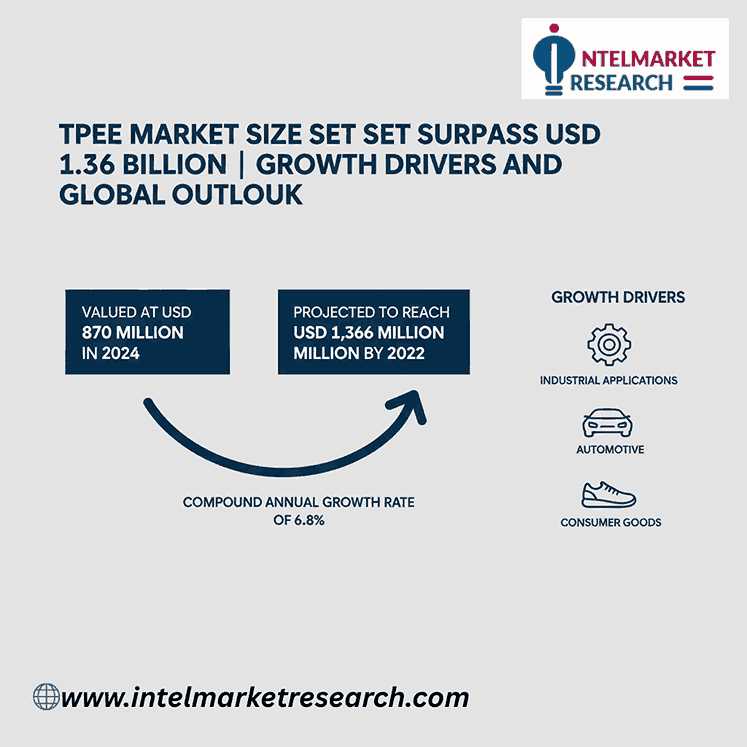
The global TPEE (Thermoplastic Ester Elastomer) market is entering a decisive growth phase as industries seek materials that balance flexibility, durability, and processing efficiency. Valued at USD 870 million in 2024, the market is projected to reach USD 1,366 million by 2032, expanding at a compound annual growth rate of 6.8% during the forecast period. Driven by rapid innovation in automotive engineering, electronics manufacturing, and industrial design, TPEE is increasingly positioned as a strategic material for next-generation applications where performance and longevity are critical.
Get FREE Sample Report:www.intelmarketresearch.com/download-free-sample/11284/tpee-2025-2032-596
Emerging Market Trends Shaping TPEE Demand
One of the most notable trends influencing the TPEE market is the shift toward lightweight and high-performance materials in automotive manufacturing. As vehicle platforms evolve, especially with the rise of electric vehicles, manufacturers are prioritizing elastomers that can withstand higher thermal loads while contributing to overall weight reduction. TPEE’s balance of rubber-like elasticity and engineering plastic strength makes it well suited for seals, connectors, and under-the-hood components.
Sustainability is also reshaping material selection across industries. TPEE benefits from recyclability and energy-efficient processing, aligning with broader ESG goals adopted by manufacturers. This has led to increased adoption in consumer and industrial products where environmental considerations are becoming part of procurement decisions.
In electronics and electrical infrastructure, demand is being supported by the expansion of wire and cable insulation, connectors, and flexible components. TPEE’s resistance to chemicals, abrasion, and repeated mechanical stress makes it an attractive alternative to traditional elastomers in high-cycle applications.
Another emerging trend is formulation innovation. Advances in polymer chemistry are enabling customized TPEE grades with enhanced temperature resistance, flexibility, and processing characteristics, opening doors to newer applications such as wearable devices and specialized industrial components.
Get the Complete Report & TOC:www.intelmarketresearch.com/materials-and-chemicals/11284/tpee-2025-2032-596
Key Market Drivers
The automotive sector remains the primary growth engine for the global TPEE market. Increasing production volumes, combined with regulatory pressure to improve fuel efficiency and reduce emissions, are accelerating the use of advanced elastomers. Electric vehicles further amplify this demand, as components require materials capable of handling vibration, heat, and long service life.
Industrial automation and machinery upgrades are also contributing to steady consumption. TPEE is increasingly used in industrial products that require durability under continuous motion and exposure to harsh operating environments. At the same time, expanding electronics manufacturing across Asia is driving consistent demand for high-quality elastomeric materials.
Competitive Landscape: Leading Players
The TPEE market is moderately consolidated, with leading global manufacturers accounting for more than half of total production. Companies such as DuPont, Celanese, DSM, Taiwan Changchun, and Toyobo play a central role in shaping product standards and innovation pathways. Other notable participants include SK Chemicals, LG Chem, SABIC, Mitsubishi Chemical, RadiciGroup, and Eastman. These players are strengthening their positions through capacity optimization, targeted R&D investments, and regional expansion strategies aimed at high-growth markets in Asia and Europe.
Get the Complete Report & TOC:www.intelmarketresearch.com/materials-and-chemicals/11284/tpee-2025-2032-596
Segment Analysis and Regional Outlook
By type, injection molding grade TPEE dominates the market, accounting for more than 50% of total demand. Its versatility and processing efficiency make it the preferred choice for complex automotive and industrial components. Extrusion and blow molding grades follow, supported by applications in tubing, profiles, and flexible structures.
From an application perspective, automotive industrial uses represent the largest share, followed by industrial products and consumer goods. This hierarchy reflects the material’s growing importance in performance-critical environments.
Regionally, Europe stands as the single largest market with around a 30% share, supported by advanced automotive manufacturing and strong regulatory standards. China and North America together account for over 40% of global demand, with Asia-Pacific emerging as the fastest-growing region due to rapid industrialization, expanding electronics production, and increasing vehicle output in countries such as China, South Korea, and India.
Technological Advancements and Strategic Insights
Innovation in processing techniques is enhancing the cost-efficiency and performance consistency of TPEE materials. Manufacturers are focusing on improving crystallization control and segment distribution to deliver tailored properties for specific end uses.
Can advanced material design redefine elastomer performance standards? As industries demand higher efficiency and longer product lifecycles, strategic investment in polymer science is becoming a differentiator, positioning TPEE as a long-term solution rather than a niche alternative.
Key Benefits of the Report
The study provides detailed market size forecasts from 2024 to 2032, offering clarity on revenue and volume trends across regions. It delivers segment-level insights by type and application, along with competitive benchmarking of leading manufacturers. Readers gain a structured view of regional opportunities, industry risks, and strategic growth areas supported by both quantitative data and qualitative analysis.
Forward-Looking Perspective
As global manufacturing ecosystems adapt to sustainability goals, electrification, and advanced engineering requirements, the TPEE market is set to evolve steadily. Its ability to bridge the gap between traditional rubber and rigid plastics places it at the center of material innovation strategies. The coming years are likely to redefine how industries leverage high-performance elastomers to achieve efficiency, resilience, and long-term value.
Gain access to deeper data tables, regional breakdowns, and strategic insights by exploring the complete analysis available at Intel Market Research, with additional context on global materials trends also reflected in broader industry coverage such as Bloomberg’s materials and manufacturing insights.
Get the Complete Report & TOC:www.intelmarketresearch.com/materials-and-chemicals/11284/tpee-2025-2032-596
About Intel Market Research
Intel Market Research is a leading provider of strategic intelligence, offering actionable insights in biotechnology, pharmaceuticals, and healthcare infrastructure. Our research capabilities include:
- Real-time competitive benchmarking
- Global clinical trial pipeline monitoring
- Country-specific regulatory and pricing analysis
- Over 500+ healthcare reports annually
Trusted by Fortune 500 companies, our insights empower decision-makers to drive innovation with confidence.
🌐 Website: https://www.intelmarketresearch.com
📞 International: +1 (332) 2424 294
📞 Asia-Pacific: +91 9169164321
🔗 LinkedIn: Follow Us