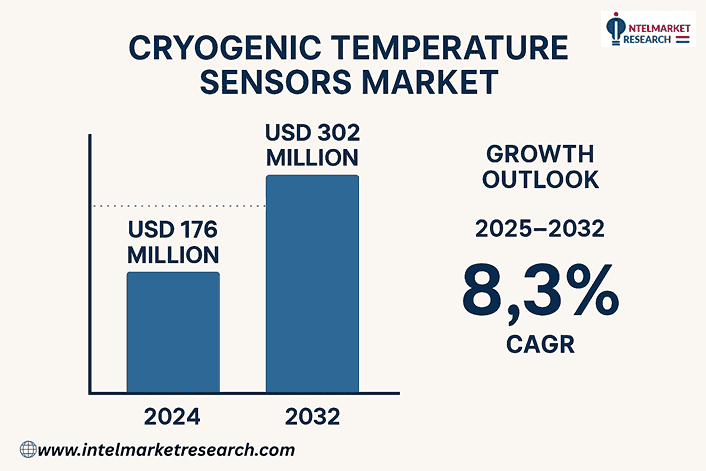
Driven by rapid advances in low-temperature engineering and the expanding use of cryogenic systems across aerospace, healthcare, and industrial energy, the global Cryogenic Temperature Sensors market is entering a decisive growth phase. The market was valued at USD 176 million in 2024 and is expected to reach USD 302 million by 2032, growing at a steady CAGR of 8.3% during the 2025–2032 period. This trajectory reflects not only rising demand for precise thermal measurement at extreme temperatures but also broader shifts in how industries manage safety, efficiency, and performance in ultra-cold environments.
Cryogenic temperature sensors are designed to operate reliably at temperatures typically below –150°C, where conventional sensors fail. They play a central role in monitoring liquid nitrogen, liquid hydrogen, and liquid helium systems used in space exploration, industrial gas processing, medical imaging, and scientific research. As these applications scale globally, the requirement for accuracy, stability, and long-term reliability is pushing sensor technologies into sharper focus.
Get FREE Sample Report:www.intelmarketresearch.com/download-free-sample/11133/cryogenic-temperature-sensors-2025-2032-918
Emerging Market Trends
One of the most influential trends shaping the cryogenic temperature sensors market is the growing integration of advanced materials and miniaturized designs. Manufacturers are increasingly focusing on compact sensors that deliver high accuracy while fitting into space-constrained systems such as satellite payloads and medical imaging equipment. This trend supports broader system optimization and reduces overall operational risk.
Another notable shift is the gradual move toward smarter, connected cryogenic monitoring systems. While cryogenic environments remain technically challenging, sensors are increasingly being paired with digital monitoring platforms that allow remote diagnostics, predictive maintenance, and real-time performance analysis. This mirrors wider industrial digitalization trends already visible in energy and manufacturing sectors.
Sustainability-driven innovation is also influencing sensor development. As LNG and hydrogen infrastructure expands globally, operators are under pressure to minimize losses and improve safety. Accurate cryogenic temperature measurement reduces boil-off losses and improves system efficiency, aligning with broader environmental and cost-efficiency goals seen across global energy markets.
Finally, demand from research-intensive fields such as quantum computing and particle physics is quietly reshaping the market. These applications require extreme precision and stability at near-absolute-zero temperatures, creating demand for high-value, application-specific cryogenic sensors rather than standardized components.
Get the Complete Report & TOC:www.intelmarketresearch.com/semiconductor-and-electronics/11133/cryogenic-temperature-sensors-2025-2032-918
Key Market Drivers
Aerospace and space exploration remain among the strongest demand drivers. Cryogenic sensors are essential in rocket propulsion systems, satellite thermal management, and space science instruments. With global launch activity increasing and private-sector participation expanding, reliable cryogenic monitoring has become a non-negotiable requirement for mission safety and success.
Industrial gas and energy applications form another major pillar of growth. Liquefied natural gas facilities, hydrogen production plants, and industrial gas storage terminals rely on precise temperature monitoring to maintain safety and operational integrity. The global transition toward cleaner energy sources continues to accelerate investments in LNG and hydrogen infrastructure, directly supporting long-term demand for cryogenic temperature sensors.
Healthcare and scientific research add further momentum. Magnetic resonance imaging systems depend on cryogenic cooling for superconducting magnets, while biobanking, cryopreservation, and advanced life sciences research require tightly controlled low-temperature environments. Increased healthcare spending and research funding across developed and emerging economies are reinforcing sensor adoption in these areas.
Competitive Landscape: Leading Players
The cryogenic temperature sensors market features a mix of multinational electronics companies and highly specialized sensor manufacturers. Competition is moderately concentrated, with the top three players accounting for roughly 38% of global revenue. Companies such as ABB, Emerson, Omron, Omega Engineering, and Amphenol Corporation continue to strengthen their positions through product innovation, portfolio expansion, and targeted regional growth.
Specialist players including Lake Shore Cryotronics, Scientific Instruments, and Minco focus on high-precision and research-oriented applications, where performance requirements are more demanding and margins tend to be higher. Across the board, competitive strategies increasingly emphasize accuracy improvements, durability in extreme environments, and compatibility with modern monitoring systems.
Get the Complete Report & TOC:www.intelmarketresearch.com/semiconductor-and-electronics/11133/cryogenic-temperature-sensors-2025-2032-918
Segment Analysis and Regional Outlook
By type, resistance temperature detectors and NTC thermistors account for a significant share of current demand due to their accuracy and reliability at low temperatures. Semiconductor-based sensors and thermocouples continue to find niche applications where fast response times or broader temperature ranges are required.
From an application perspective, industrial and aerospace uses dominate global consumption, while research and healthcare applications represent fast-growing segments driven by technological advancement and expanding infrastructure.
Regionally, North America leads the global market with approximately 34% share, supported by a strong aerospace ecosystem, advanced research facilities, and early adoption of emerging technologies such as quantum computing. Europe follows closely, with sustained demand from industrial gas operations and large-scale scientific research initiatives. Asia-Pacific is the fastest-growing region, propelled by LNG infrastructure expansion, rising healthcare investment, and ambitious space programs in China, India, Japan, and South Korea. The Middle East and Africa are emerging as important growth markets, particularly in energy-exporting economies investing heavily in cryogenic storage and transport systems.
Technological Advancements and Strategic Insights
Innovation remains central to market evolution. Advances in sensor calibration techniques, material science, and packaging are enabling improved stability and reduced measurement drift at extreme temperatures. Manufacturers are also aligning product development with end-user requirements through collaborative engineering and application-specific customization.
Can data-driven monitoring reshape how cryogenic systems are managed? While full automation in ultra-cold environments remains complex, incremental improvements in sensor intelligence are already helping operators detect anomalies earlier and optimize maintenance schedules, reducing downtime and operational risk.
Key Benefits of the Report
The report provides detailed global and regional market forecasts from 2025 to 2032, along with in-depth analysis by type, application, and region. It offers competitive benchmarking, strategic insights, and a clear view of emerging opportunities across energy, aerospace, healthcare, and research sectors. Readers gain access to structured data, market dynamics analysis, and scenario-based insights designed to support informed decision-making.
Industry Perspective
As industries push the boundaries of low-temperature technology, cryogenic temperature sensors are becoming foundational components rather than supporting accessories. From space missions to medical diagnostics and clean energy infrastructure, their role is expanding alongside technological ambition. The coming decade is expected to redefine how precision measurement supports innovation in some of the world’s most demanding environments.
For broader context on industrial sensor adoption trends, recent coverage from Bloomberg highlights how advanced sensing technologies are becoming critical enablers across energy and aerospace systems.
To explore detailed market data, segmentation analysis, and strategic insights, readers can access the complete Cryogenic Temperature Sensors market report on the Intel Market Research website.
Get the Complete Report & TOC:www.intelmarketresearch.com/semiconductor-and-electronics/11133/cryogenic-temperature-sensors-2025-2032-918
About Intel Market Research
Intel Market Research is a leading provider of strategic intelligence, offering actionable insights in biotechnology, pharmaceuticals, and healthcare infrastructure. Our research capabilities include:
- Real-time competitive benchmarking
- Global clinical trial pipeline monitoring
- Country-specific regulatory and pricing analysis
- Over 500+ healthcare reports annually
Trusted by Fortune 500 companies, our insights empower decision-makers to drive innovation with confidence.
🌐 Website: https://www.intelmarketresearch.com
📞 International: +1 (332) 2424 294
📞 Asia-Pacific: +91 9169164321
🔗 LinkedIn: Follow Us