Introduction
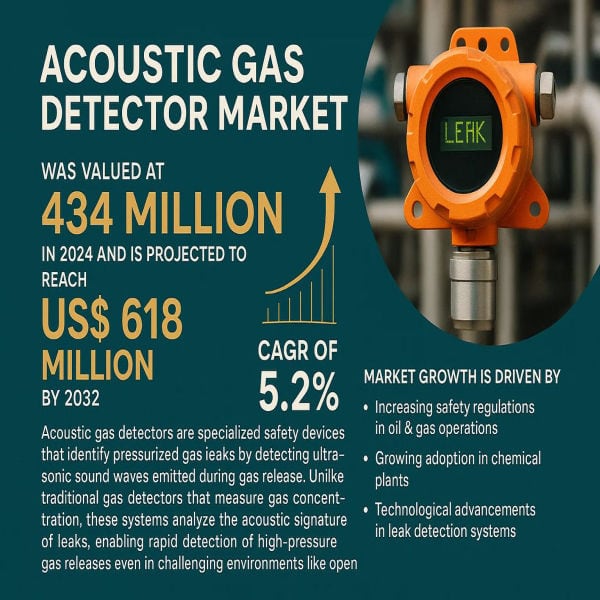
The global Acoustic Gas Detector Market, valued at USD 434 million in 2024, is forecast to reach USD 618 million by 2032 at a CAGR of 5.2%. This Semiconductor Insight report examines how ultrasonic and acoustic-emission technologies are becoming indispensable for early leak detection across oil & gas, chemical, and energy sectors. With tightening safety regulations and growing investments in industrial safety, acoustic detectors are central to modern risk-mitigation strategies.
𝐃𝐨𝐰𝐧𝐥𝐨𝐚𝐝 𝐅𝐑𝐄𝐄 𝐒𝐚𝐦𝐩𝐥𝐞 𝐑𝐞𝐩𝐨𝐫𝐭: https://semiconductorinsight.com/download-sample-report/?product_id=117862
Emerging Trends Shaping the Market
Stricter Safety & Environmental Regulations
Regulatory pressure and higher penalties for leaks are prompting widespread deployment of non-intrusive acoustic leak detection systems, particularly in oil & gas and chemical plants.
IoT Integration & Predictive Maintenance
Smart acoustic detectors with wireless connectivity and cloud analytics enable predictive maintenance, reduce false alarms, and improve asset uptime in industrial settings.
Hydrogen & Alternative Fuel Monitoring
Growth in LNG, hydrogen, and other alternative fuels has created demand for acoustic solutions capable of detecting a broader range of gas types under varied pressure conditions.
Portable Leak Inspection & Robotics-Assisted Surveys
Portable ultrasonic detectors and robot-mounted acoustic sensors accelerate field inspections in hazardous or hard-to-access areas, improving safety and reducing inspection times.
Hybrid Detection Systems
Combining acoustic detection with traditional concentration sensors and infrared imaging reduces missed detections and improves diagnostic accuracy.
Key Market Drivers and Growth Factors
- Regulatory compliance: Stringent global safety standards drive adoption, with oil & gas responsible for roughly 62% of applications.
- Non-intrusive early detection: Acoustic systems detect pressurized leaks at source earlier than concentration-based sensors.
- Industry 4.0 enablement: Connectivity and analytics lower false positives (manufacturer claims up to 40% reductions) and optimize maintenance workflows.
- Expansion of LNG, renewables, and hydrogen infrastructures: New installations require robust leak-detection strategies, broadening use-cases.
- Regional demand concentration: North America and the Middle East together consume about 68% of detectors, driven by extensive hydrocarbon infrastructure.
𝐆𝐞𝐭 𝐅𝐮𝐥𝐥 𝐑𝐞𝐩𝐨𝐫𝐭 𝐇𝐞𝐫𝐞: https://semiconductorinsight.com/report/acoustic-gas-detector-market/
Strategic Developments by Key Players
Emerson Electric Co. — Platform-level integrations and digital services for remote monitoring.
MSA Safety Incorporated — Expanded portable detector portfolios and field-service offerings.
AOIP — Focus on ultrasonic sensing specialization and customized monitoring solutions.
INFICON — Strengthening gas-detection capabilities with advanced sensor fusion and diagnostics.
Drägerwerk AG & Co. KGaA — Emphasis on ruggedized devices and global service networks.
Det-Tronics & Bacharach — Integration of acoustic detection into broader safety systems and SCADA connectivity.
Spectris plc & Beha-Amprobe — Diversified instrumentation portfolios and testing tools to support detection and calibration.
Companies are prioritizing IoT-enabled features, regional expansion, and partnerships with system integrators to capture growth in both established and emerging end-markets.
Segment Analysis: Who Leads the Market?
By Type — Fixed ultrasonic detectors dominate for continuous monitoring; portable detectors support maintenance checks and field surveys.
By Application — Oil & Gas (~62%) leads, followed by chemical, mining, and energy & power sectors.
By Technology — Ultrasonic detection and acoustic emission monitoring are core; hybrid systems gain traction for layered safety strategies.
By End-User — Industrial facilities and government infrastructure are primary buyers, with commercial buildings and research institutions adopting specialized solutions.
By Region — North America and the Middle East account for the largest shares due to dense hydrocarbon infrastructures; Asia-Pacific shows rising adoption amid expanding LNG and industrial investments.
𝐃𝐨𝐰𝐧𝐥𝐨𝐚𝐝 𝐅𝐑𝐄𝐄 𝐒𝐚𝐦𝐩𝐥𝐞 𝐑𝐞𝐩𝐨𝐫𝐭: https://semiconductorinsight.com/download-sample-report/?product_id=117862
Technological Advancements Impacting Growth
Advanced Signal Processing & AI
Machine-learning algorithms improve acoustic signature recognition, distinguishing real leaks from environmental noise and reducing false alarms.
Wireless Mesh Networks & Edge Analytics
Edge computing in detectors reduces data transmission needs and enables faster, localized decision-making during leak events.
Sensor Fusion
Combining acoustic inputs with infrared, electrochemical, and catalytic sensors creates robust multi-parameter detection systems with higher diagnostic confidence.
Robotics & UAV Integration
Drone and robotic platforms equipped with acoustic sensors expand inspection reach in hazardous or remote sites, enabling frequent, low-risk surveillance.
Why This Report Matters
This Semiconductor Insight study delivers practical insights for stakeholders, covering:
- Market sizing and forecasts (2024–2032)
- Competitive landscapes and strategic moves
- Technology trend evaluations and use-case mapping
- Regional demand analysis to guide market entry and investment choices
𝐆𝐞𝐭 𝐅𝐮𝐥𝐥 𝐑𝐞𝐩𝐨𝐫𝐭 𝐇𝐞𝐫𝐞: https://semiconductorinsight.com/report/acoustic-gas-detector-market/
Conclusion
As industries intensify safety investments and transition to alternative fuels, acoustic gas detectors will become integral to layered leak-detection architectures — combining early detection, smart analytics, and operational resilience.
Contact Us:
🌐 Website: https://semiconductorinsight.com/
📞 International: +91 8087 99 2013
🔗 LinkedIn: Follow Us