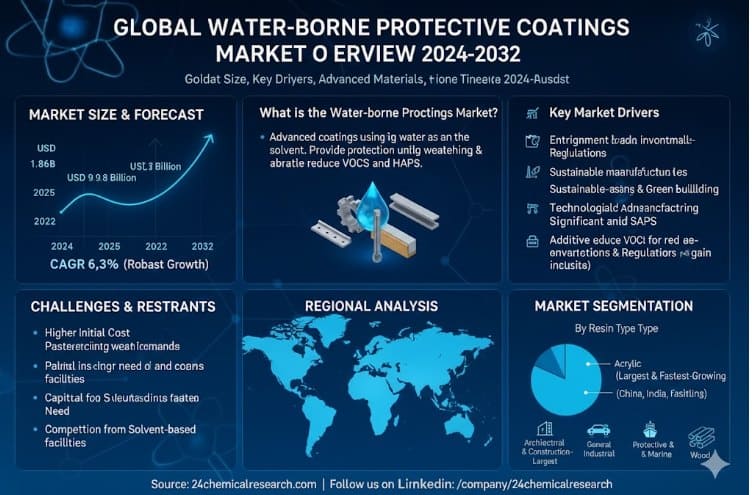
Global Water-borne Protective Coatings market size was valued at USD 9.8 billion in 2024. The market is projected to grow from USD 10.5 billion in 2025 to USD 16.2 billion by 2032, exhibiting a CAGR of 6.3% during the forecast period. Water-borne protective coatings are advanced coating systems that use water as the primary solvent or dispersing agent instead of traditional organic solvents. These coatings provide vital protection against corrosion, weathering, abrasion, and chemical attack for a wide range of substrates, including metals, concrete, and wood. They are engineered to deliver high-performance durability while significantly reducing emissions of volatile organic compounds (VOCs) and hazardous air pollutants (HAPs).
The market’s strong growth is primarily driven by increasingly stringent global environmental regulations that mandate lower VOC emissions in industrial and construction applications. Concurrently, a growing emphasis on sustainability across manufacturing sectors, the rise of green building certifications, and heightened focus on workplace safety are accelerating the shift from solvent-based to water-based protective solutions. Significant technological advancements in resin chemistry and formulation are overcoming historical performance limitations, enabling their use in more demanding and high-value applications.
Download FREE Sample Report: https://www.24chemicalresearch.com/download-sample/254977/global-waterborne-protective-coatings-forecast-market
Market Overview & Regional Analysis
Asia-Pacific is the largest and fastest-growing market, driven by rapid industrialization, massive infrastructure development, and booming manufacturing sectors in China, India, and Southeast Asia. The region benefits from supportive government policies and a growing focus on environmental compliance, which are accelerating the adoption of advanced protective coatings.
North America and Europe are mature and technologically advanced markets where growth is driven by the strictest VOC regulations globally (e.g., EPA Clean Air Act, EU directives). The presence of leading coating manufacturers and a strong emphasis on sustainable industrial practices in the automotive, aerospace, and construction sectors further supports demand.
Other regions, including Latin America and the Middle East & Africa, are emerging markets witnessing gradual growth, supported by investments in construction, oil & gas infrastructure, and the gradual implementation of stricter environmental standards.
Key Market Drivers and Opportunities
Stringent Environmental and Health Safety Regulations: The primary driver is the global enforcement of regulations limiting VOC and HAP emissions. Agencies like the U.S. EPA and the European Union have implemented strict standards, making water-borne coatings a compliant and often necessary choice for industrial and architectural applications.
Growth in Sustainable Manufacturing and Green Building: The global push for sustainability and the rise of green building certifications (e.g., LEED) are compelling industries to adopt low-VOC, eco-friendly materials. Water-borne coatings are a key component in achieving these sustainability goals across construction, automotive, and general manufacturing.
Technological Advancements in Coating Performance: Continuous innovation in resin technologies (e.g., water-based epoxies, polyurethanes, acrylics, and UV-curable hybrids) is closing the performance gap with solvent-based systems. New formulations offer improved corrosion resistance, chemical durability, faster curing, and application efficiency, unlocking opportunities in demanding sectors like marine, heavy industrial, and automotive OEM.
Expansion of Key End-Use Industries: Robust growth in global construction activity, automotive production (including electric vehicles), and infrastructure development directly fuels demand for high-performance protective coatings. The automotive industry, in particular, is a high-growth segment transitioning to water-borne systems for both manufacturing and refinishing.
Challenges & Restraints
Higher Initial Cost and Raw Material Prices: Water-borne coatings can be more expensive than traditional solvent-based alternatives due to the cost of advanced raw materials, specialized additives, and significant investments in R&D and formulation technology.
Performance Sensitivities and Application Complexity: The performance and curing of water-borne coatings are more sensitive to environmental conditions like humidity and temperature, requiring controlled application environments. They also often demand more precise surface preparation and skilled application techniques, which can be a barrier to adoption.
Need for Capital Investment and Process Adjustment: Transitioning from solvent-based to water-borne systems frequently requires manufacturers to invest in new application equipment (e.g., spray guns with corrosion-resistant components), modify drying/curing infrastructure (e.g., spray booths with humidity control), and retrain personnel, posing an upfront hurdle.
Competition from Established Solvent-based Technologies: In some heavy-duty or extreme-environment applications (e.g., certain marine, oil & gas), solvent-based coatings are still preferred for their perceived robustness and simpler application under variable conditions, presenting competitive resistance.
Market Segmentation by Resin Type
Acrylic (Largest segment, valued for excellent weather resistance, UV stability, and color retention)
Epoxy (High-growth segment for superior chemical resistance and adhesion)
Polyurethane (Fastest-growing segment, prized for high durability, flexibility, and abrasion resistance)
Alkyd
Polyester
Others (including PTFE, PVDF)
Market Segmentation by Application
Architectural & Construction (Largest application segment for buildings and infrastructure)
Automotive (Fastest-growing segment, including OEM and refinish)
General Industrial (Machinery, equipment)
Protective & Marine (Heavy-duty corrosion protection for structures, ships, offshore platforms)
Wood (Furniture, flooring)
Others (Packaging, coil coatings)
Market Segmentation by End-User Industry
Building & Construction (Dominant consumer)
Automotive & Transportation
Industrial Manufacturing
Marine
Oil & Gas
Others
Download FREE Sample Report: https://www.24chemicalresearch.com/download-sample/254977/global-waterborne-protective-coatings-forecast-market
Competitive Landscape
The market is highly competitive and features a mix of global chemical giants and specialty coating companies. Key players include:
- PPG Industries, Inc.
- The Sherwin-Williams Company
- AkzoNobel N.V.
- BASF SE
- Axalta Coating Systems
- RPM International Inc.
- Nippon Paint Holdings Co., Ltd.
- Asian Paints Limited
- Kansai Paint Co., Ltd.
- Jotun Group
Report Scope
This analysis provides comprehensive coverage of the Global Water-borne Protective Coatings Market from 2024 to 2032, including:
- Market size estimations and detailed 8-year forecasts.
- In-depth segmentation by resin type, application, end-user industry, and region.
- Analysis of key regulatory drivers, sustainability trends, and technological advancements.
- Evaluation of the competitive landscape, strategic developments, and supply chain dynamics.
- Assessment of market challenges, opportunities, and future growth potential.
Get Full Report Here: https://www.24chemicalresearch.com/reports/254977/global-waterborne-protective-coatings-forecast-market-2024-2030-313
CONTACT US :
International: +1(332) 2424 294 | Asia: +91 9169162030
Website: https://www.24chemicalresearch.com/
Follow us on LinkedIn: https://www.linkedin.com/company/24chemicalresearch
➤See Related Report :
Asia Pacific Long Glass Fiber Thermoplastic Market
Global Industrial Adhesive Market
𝐆𝐥𝐨𝐛𝐚𝐥 𝐍𝐮𝐜𝐥𝐞𝐚𝐫 𝐅𝐮𝐬𝐢𝐨𝐧 𝐚𝐧𝐝 𝐀𝐝𝐯𝐚𝐧𝐜𝐞𝐝 𝐌𝐚𝐭𝐞𝐫𝐢𝐚𝐥𝐬 𝐌𝐚𝐫𝐤𝐞𝐭